Shared Expense Tracker
Shared Expense Tracker That Shows Who Owes Whom
Shared expenses stop feeling simple as soon as they become ongoing. One person pays for groceries, someone else covers dinner, a subscription renews, a utility bill shows up, and now nobody is fully sure what the current balance is.
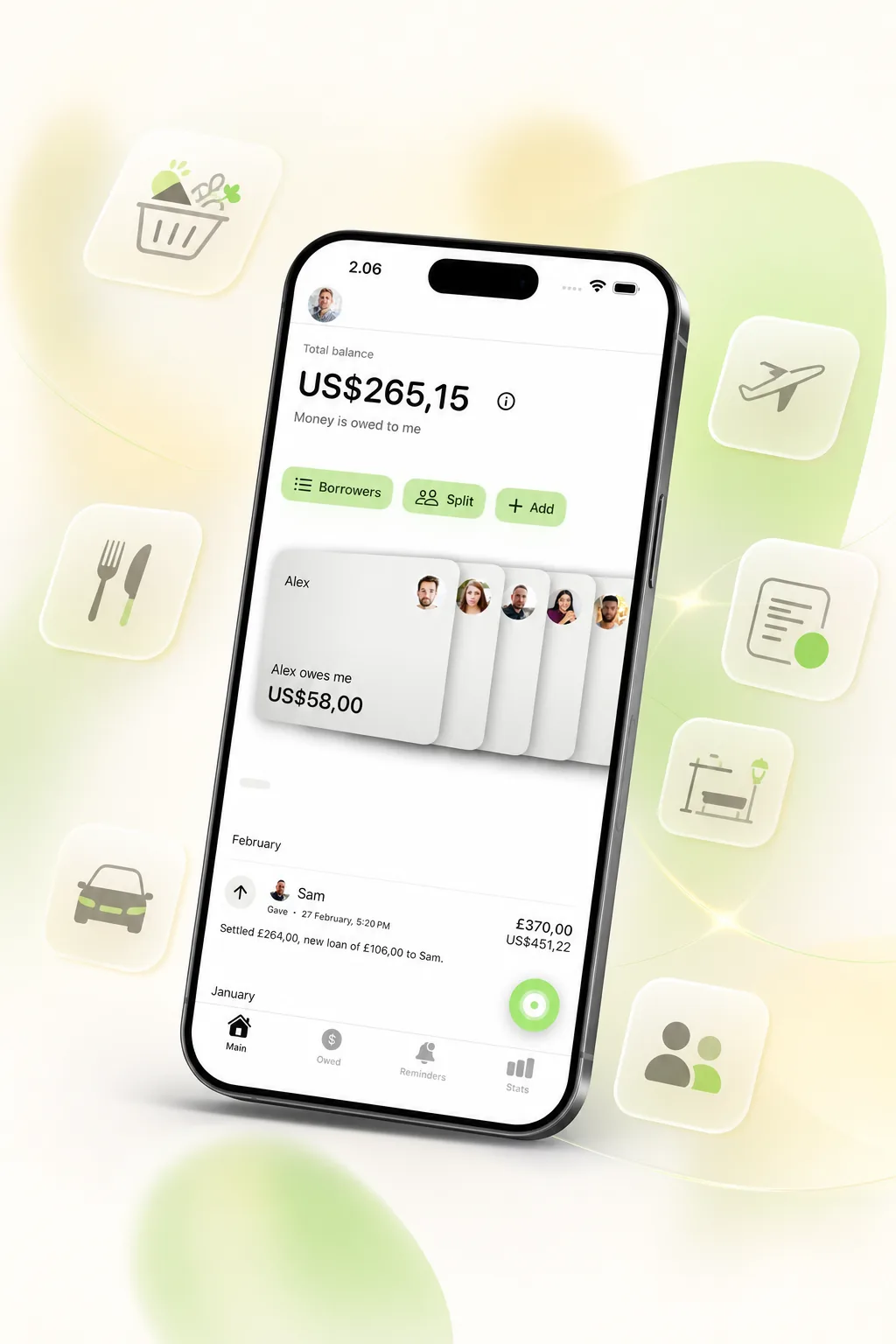
YouOweMe helps friends, couples, roommates, and families track shared expenses with a clear running balance, fair bill splitting, reminders, recurring entries, and repayment history that stays visible over time.
When shared expenses turn into silence or uncertainty, read when to ask for money back or send a repayment update.
Instead of constantly recalculating every purchase, you keep one shared picture of what happened and who owes whom now.
If you only need to divide one bill, start with the free Split Expense Calculator. If the situation is one monthly roommate settle-up, use the Roommate Bill Split Calculator. If you want to test the ongoing-balance idea before using the app, try the free Running Balance Calculator. It lets you add expenses and repayments over time and see the current balance between two people.
Works offline • No mandatory sign-up • Face ID / Touch ID lock
If you are looking for an app to track shared expenses
Some people search for a shared expense tracker. Others search for a shared expense app, an app to split bills, or an app to track who owes whom. The core job is the same: keep shared costs visible without redoing the math every time.
YouOweMe is built for ongoing shared balances, not just one-off split calculations. It works when expenses keep happening over time and the real need is a running balance, clear repayment history, recurring entries, and calmer follow-ups when needed.
For ongoing shared spending, the important part is not just splitting one bill — it is keeping a running balance between two people as new expenses and repayments happen.
If you are choosing between a collaborative group expense app and a running-balance app, read the Shared Expense App vs Running Balance App comparison. If the specific choice is Splitwise-style tracking vs You Owe Me, use the Splitwise alternative comparison.
If your main question is whether everyone needs to join the same app, read the guide to one-person shared-money tracking.
If the shared expenses are between two people who keep separate bank accounts and want unrelated personal spending outside the record, use the guide to tracking shared expenses without a joint account.
For a quick one-time split, the calculator can be enough. For repeated shared costs, recurring bills, partial repayments, and follow-ups, an ongoing shared expense tracker is usually easier to trust.
Keep the record yourself—or choose how to share it
Keep it private
Use this when only you need the working record and nothing needs to remain continuously visible.
Share an always-current Live Link
Use this when one person maintains the record and the other person needs a read-only browser view without installing the app.
See one-person sharingKeep it in sync
Use Balance Sync when exactly two You Owe Me users both want supported connected entries changed on either phone to stay aligned.
See Balance SyncWhen one shared cost needs payback tracking
Some shared costs are more than a quick split. If you paid for a group gift, tickets, dinner, deposit, booking, or shared purchase and people will repay at different times, the Group Payback Tracker gives that cost one place to live until everyone pays.
If a cancellation, refund, resale, replacement participant, or added charge changed the original cost, recalculate the agreement before tracking who has paid.
For a quick browser status check before you move into the app workflow, use the Group Payback Calculator.
- See who paid
- See who partially paid
- See who still owes
- Keep each person’s share connected to their own balance
For a step-by-step manual workflow and copyable reminder messages, read how to track who paid you back for a group expense.
Use Splitwise-style group apps when several people need to add their own expenses to the same group ledger. Use Group Paybacks when you paid first and want a clean payback record tied to per-person balances. Compare You Owe Me with Splitwise.
Who this is for
A shared expense tracker is most useful when money moves between the same people over time. That usually looks like one of these situations.
Friends and everyday shared spending
For regular back-and-forth costs like groceries, dinner, rides, tickets, and small purchases that add up faster than people expect.
Good fit for: casual shared spending, trips, frequent reimbursements, and uneven everyday costs.
Roommates
For shared rent extras, utilities, groceries, household items, and recurring home costs that should stay visible without constant settling up. For roommate-specific rules around rent, utilities, groceries, and household supplies, read how to split rent, utilities, and groceries with roommates. If you share ongoing costs with people you live with, see the dedicated roommate expense tracker. For the full household method, read the roommate-specific guide to tracking money between roommates.
Good fit for: rent-related costs, utility bills, household supplies, and recurring shared purchases.
Couples
For partners who want shared spending to stay clear without turning daily life into scorekeeping, silent resentment, or repeated money conversations.
If the relationship has ended and the job is a final everyday closeout rather than ongoing tracking, use the breakup settlement guide.
Good fit for: groceries, travel, subscriptions, uneven purchases, and periodic settle-ups.
Families
For reimbursements, subscriptions, household bills, and purchases handled on someone else’s behalf, especially when the balance stays ongoing. If the repeated shared costs are mainly parent bills, pharmacy purchases, subscriptions, sibling reimbursements, or purchases made for an elderly parent, use the Elderly Parent Expense Tracker. For broader family reimbursement records, use the Family Reimbursement Tracker Template or the Family Reimbursement Tracker solution.
If siblings have not yet agreed how parent expenses should be shared, choose the contribution method before recording expected reimbursements.
Good fit for: parents, adult children, shared bills, and recurring family-related charges.
If the situation is less about shared spending and more about one person temporarily covering rent, groceries, bills, or support for another person, see the Temporary Financial Support Tracker.
If the support is already happening and now needs to stop or taper, use the transition guide before deciding what balance, if any, remains open.
What usually breaks
Most shared expense tension is not really about arithmetic. It comes from unclear systems, delayed tracking, and the fatigue of settling every small thing in real time.
Constant micro-settling
You split every meal, every ride, and every small purchase, and daily life starts feeling more transactional than it needs to.
Memory replaces records
People remember differently, round numbers in their heads, and small purchases are usually the first things to disappear.
If two people already remember the expenses or repayments differently, rebuild the agreed history before opening or changing a running balance.
The spreadsheet goes stale
One person updates it, the other forgets, and opening a file on mobile feels heavier than the situation deserves.
Recurring costs fade into the background
Subscriptions, utilities, household costs, and repeating charges quietly distort the balance over time when nobody tracks them consistently.
Nobody wants to be the one who brings it up
When the system is unclear, even a simple follow-up starts to feel more awkward than it should.

Recurring bill example
When a shared bill renews before anyone talks about it
An automatic payment can go through normally and still leave the shared balance unclear. Here is what happens when a $60 internet bill is charged to Maya’s card each month and Maya and Noah have agreed to split it equally.
The bill renews
The $60 charge happens on Maya’s card, outside You Owe Me.
Noah’s share is recorded
The recurring schedule creates a real $30 entry for Noah’s agreed half, so the amount does not depend on either person remembering the renewal.
A partial repayment carries forward
Noah repays $20, leaving $10 open. When the next $30 share is added, the current balance shows that Noah owes Maya $40.
You Owe Me does not read the bank or card charge and does not move money. It schedules the agreed shared entry, records repayments, and keeps the amount still open visible. See how Recurring Entries work, or use the full guide to tracking shared expenses without a joint account.
Did the situation change after the original agreement?
Start with the focused guide when the amount, participants, relationship, or support arrangement changed after the first shared cost.
How YouOweMe keeps shared expenses clear
The goal is not to turn shared spending into accounting. The goal is to keep the balance and history clear with as little friction as possible.
Log shared expenses as they happen
Add groceries, subscriptions, bills, household purchases, travel costs, and one-off expenses without relying on memory later.
Keep one visible running balance
Instead of reconstructing the past every time, the current balance stays visible so you can see who owes whom right now. Relationship Timeline keeps the surrounding history clear too, including statements, follow-ups, repayment updates, and exports. For a larger shared cost or repayment plan that should not get mixed into everyday expenses, Loan Records can keep that specific balance separate while the full history stays clear.
Split bills fairly
Handle equal splits or custom splits while keeping balances consistent automatically.
Track partial repayments
When someone pays back part of the balance, the history stays clear instead of getting lost in chat messages or mental notes. If a shared expense was only partly repaid, use the partial repayment follow-up guide to ask about the rest clearly.
Repeat recurring costs
Recurring entries and reminders help with utilities, subscriptions, rent extras, and any shared cost that keeps coming back.
Make follow-ups calmer when needed
If shared spending turns into money owed, Money Conversations can help with clearer follow-up or repayment-update messages based on real numbers. For a one-time message, use the polite reminder guide, the Polite Payback Reminder Generator to create wording for the relationship and situation, or the Repayment Reminder Text Examples for ready-made scripts.
Optional two-person connection
Keep one balance updated in both apps
If both people use You Owe Me, Balance Sync can privately connect one running balance. Add or update an entry on either phone, and both apps stay aligned from each person’s perspective.
- Exactly two connected users
- Private, bidirectional updates
- Offline changes synchronize after reconnecting
- Explicit conflict handling
- Local names, images, reminders, recurrence rules, and attachments stay private
Balance Sync is not a group-expense workspace and does not currently synchronize Group Paybacks.
Explore Balance SyncWhat people actually track
A shared expense tracker matters most when the same relationship keeps generating small and medium-sized costs over time.
Everyday shared spending
- Meals
- Groceries
- Taxis
- Small purchases
Household and recurring costs
- Rent extras
- Utilities
- Subscriptions
- Internet
Trips and group plans
- Flights
- Hotels
- Tickets
- Shared activities
Repayments and balance clarity
- Partial repayments
- Who paid last
- Current balance
- Family purchases made on someone else’s behalf
If the shared costs are specifically roommate bills for one month, the Roommate Bill Split Calculator can help you split rent, utilities, groceries, supplies, repayments, and previous balances before deciding whether you need ongoing tracking.
Why it works better than spreadsheets
Spreadsheets can look organized, but ongoing shared expenses usually break them in real life. The better system is the one people actually keep using.
For a fuller breakdown of when a spreadsheet is enough and when an app is better, read the spreadsheet vs app comparison.
When the system is a spreadsheet
- Someone still has to remember to update it
- Small expenses are easy to skip
- Recurring costs still need manual handling
- Mobile use feels heavier than the situation deserves
- The current balance is only as trustworthy as the last update
When the system is built for shared expenses
- Expenses and repayments live in one running history
- The balance updates as soon as something is logged
- Split bills, recurring entries, and reminders are part of the flow
- It is easier to keep using in real daily life
- Clarity stays visible before tension builds

The better system is not the one with the most columns. It is the one people actually keep using.
What this looks like in real life
People already use YouOweMe for situations like these.
Couples balance groceries, flights, hotels, and larger costs.
Families track subscriptions, utilities, pharmacy purchases, and online purchases for elderly parents.
Roommates let household costs roll into a monthly balance.
Friends share meals, tickets, transport, and trip costs without recalculating.
Why people keep using it
The value of a shared expense tracker is not just whether it sounds organized. It is whether people keep using it once real life gets messy. These are the kinds of situations people already use YouOweMe for.
Recurring bills and family spending
“It has been incredibly helpful for managing money exchanged between me and my elderly parents... The recurring charge feature is especially useful for monthly bills.”
Everyday balances without awkward follow-ups
“I finally have an easy way to track money I’ve loaned or am owed... No more awkward ‘you still owe me’ talks.”
Multiple shared-money relationships
“It is invaluable at keeping me on track with purchases made on behalf of multiple family members... so easy to use and allows all of us to see where we are at any point in time.”
Short excerpts from reviews already featured on the site.
Frequently asked questions
What is a shared expense tracker?
A shared expense tracker records who paid, what it was for, any repayments, and the current running balance between people. The goal is clarity without constant manual recalculation.
Is YouOweMe good for roommates?
Yes. It works well for utilities, household items, groceries, rent-related extras, and recurring shared costs. If the shared costs are specifically roommate bills for one month, the Roommate Bill Split Calculator can help with rent, utilities, groceries, supplies, repayments, and previous balances before deciding whether you need ongoing tracking.
Is YouOweMe a shared expense app or just a split calculator?
It is a shared expense app for ongoing balances, not just a one-off split calculator. For a single bill, you can use the free Split Expense Calculator. You Owe Me works best when people keep sharing costs over time and need a running balance, repayment history, recurring entries, and clearer follow-ups.
Can couples use it without settling every transaction immediately?
Yes. Many couples prefer periodic reconciliation instead of constant micro-transfers. You can keep the balance visible and settle when it makes sense.
Can I track recurring bills and subscriptions?
Yes. Recurring entries and reminders are useful for utilities, streaming services, rent extras, and any repeating shared charge.
Is this better than a spreadsheet for ongoing shared expenses?
Usually, yes. Spreadsheets often become stale, feel heavy on mobile, and depend on manual upkeep. A lighter system is easier to keep consistent over time.
Can it help with awkward repayment follow-ups?
Yes. If shared spending turns into money owed, YouOweMe can help keep the amount clear and support calmer follow-up or repayment-update messages through Money Conversations.
Can You Owe Me track a group gift or shared booking I paid for?
Yes. Group Paybacks are designed for shared costs you paid for, such as group gifts, tickets, bookings, deposits, dinners, or small shared purchases. You can track who paid, who partially paid, and who still owes while each person's balance stays clear.
Does the other person need You Owe Me?
Not always. One person can keep the record and share an always-current Live Link when the other person only needs visibility. If both people want to add and update supported connected entries, Balance Sync connects exactly two You Owe Me users and requires both participants to sign in with Apple.
Can two people update the same shared-expense balance?
Yes, with Balance Sync. Supported connected entries can be added, edited, archived, or deleted from either phone. It is designed for one balance between exactly two users, not a multi-person group ledger.
Can the other person see changes without editing the balance?
Yes. Use Live Link when one person should maintain the record and the other person only needs an always-current, read-only browser view without installing the app.
Related solutions and guides
If your situation is more specific, these are the best next places to go.
Keep shared expenses clear before they turn into friction
If shared spending happens regularly in your life, you do not need a heavier system. You need a clearer one. YouOweMe helps you log expenses, keep a running balance, split bills fairly, track repayments, and reduce the uncertainty that makes shared money tiring.
Built for friends, couples, roommates, families, recurring costs, and everyday shared balances. Read You Owe Me reviews to see how people use it in real life.
Updated