App to Track Money Owed
Simple App to Track Who Owes You Money
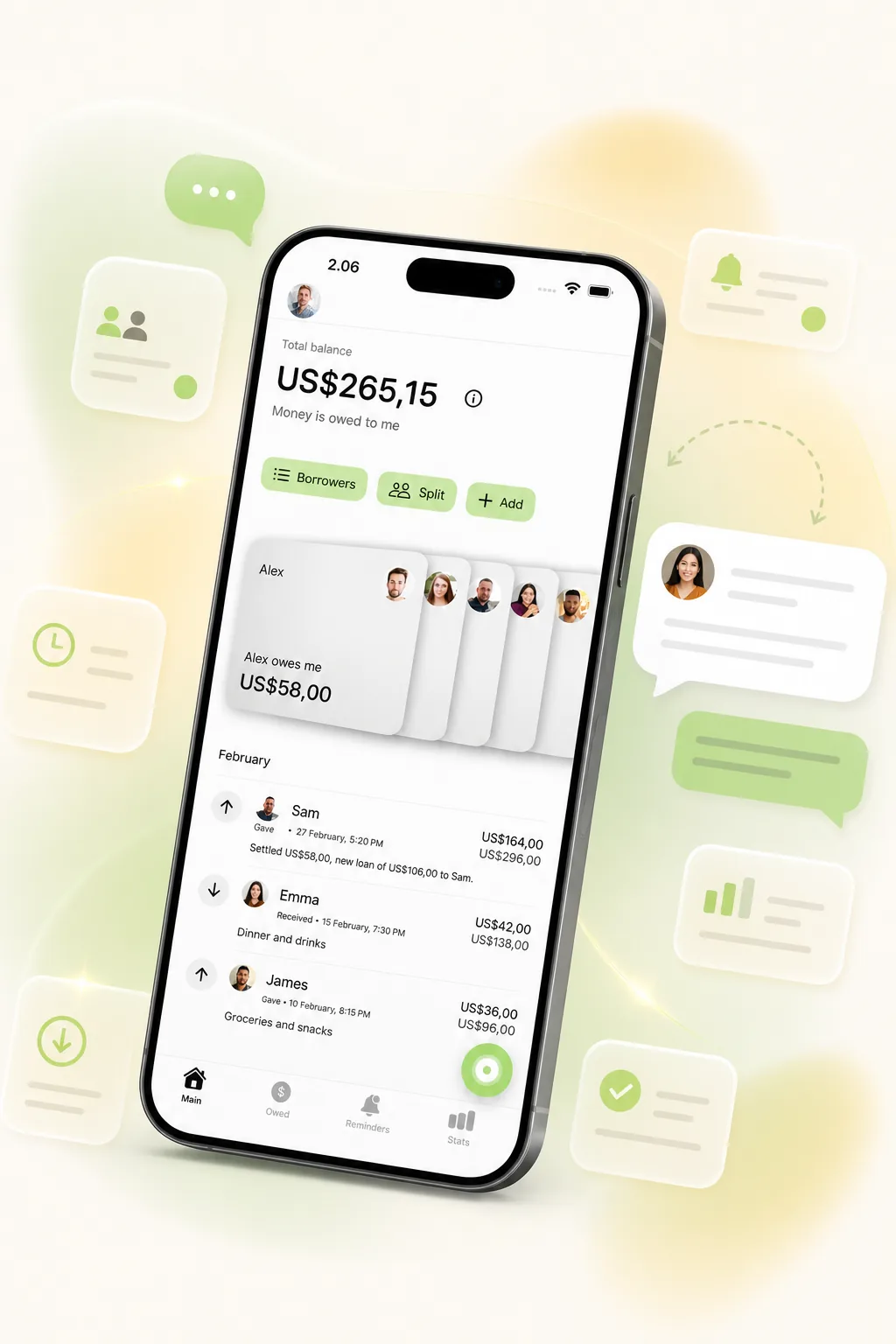
You Owe Me keeps IOUs and repayments in one place. Add a person and the amount owed, then record payments to see what’s left.
Keep track on your iPhone
Record repayments and see what each person still owes.
Scan with your iPhone camera to get You Owe Me.
Free download · In-app purchases available.
View app details on the App Store
Get started
Start with one real balance
- Add one personFor example, add Alex, who owes you money.
- Record the amountRecord the $120 Alex owes you and what it was for.
- Log a repaymentWhen Alex pays back $30, log the repayment. The app shows $90 still owed.
Share when you’re ready. A read-only Live Link opens in the other person’s browser without an app or account.
Face ID / Touch ID app lock
Since 2016 · Actively maintained.
You Owe Me is a private record and communication tool. It does not lend money, move money, collect debts, or replace accounting software.
Start with what you already have
Have a loan to bring with you?
Turn the notes, spreadsheet or photo for one personal loan into a record you can review. Keep its repayments and remaining balance together on iPhone.
Text · CSV · Excel (.xlsx) · Word (.docx) · Photo
One loan at a time. Review and correct the details before saving. Import does not keep a spreadsheet in sync.
How to keep track of money lent to friends
Record each IOU with your friend’s name, the date, the amount and what it was for. Add repayments as they arrive, keeping the original amount and payment history so you can see what remains. Keep larger loans in separate named Loan Records when needed.
You Owe Me is built for real-life back-and-forth balances, not only formal loans. It works when you need to track personal loan repayments between friends, partial paybacks, changing balances, family reimbursements, or money someone keeps meaning to return.
When the other person only needs visibility, share an always-current Live Link without asking them to install the app. If exactly two people both use You Owe Me and want to maintain the same supported balance, Balance Sync can keep connected entries aligned across both phones.
If you are not sure whether you need an app at all, compare the best way to track IOUs between people before choosing a long-term record.
If you are deciding between a group expense app and a private money-owed record, compare YouOweMe with Splitwise before choosing the system you want to maintain.
Who this is for
An app to track money owed is most useful when the same balance may change, get repaid in parts, or become awkward if nobody keeps a clear record.
Friends and personal IOUs
For dinners, tickets, rides, small loans, travel costs, and everyday payback that people honestly forget. If the money owed comes from shared rent, utilities, groceries, or household bills, see the roommate expense tracker.
Good fit for: money friends owe you, money you owe friends, small informal loans, and delayed payback.
Family members
For reimbursements, purchases made on someone else's behalf, recurring family costs, and balances that need calm structure. If the money is mainly parent bills, subscriptions, or family reimbursements, see how to track money you pay for elderly parents. If you want a manual starting point for parent bills, sibling reimbursements, or family purchases, download the free Family Reimbursement Tracker Template. For recurring parent bills, partial repayments, and ongoing family balances, see the Family Reimbursement Tracker solution.
Good fit for: parents, adult children, siblings, shared bills, and family repayments.
Partners and close relationships
For everyday balances where you want clarity without turning the relationship into scorekeeping.
Good fit for: uneven purchases, travel, groceries, short-term cover, partial repayments, and partner-specific shared spending.
Small client or side-work balances
For simple outstanding payments where you need a private record and polite follow-up, not a full accounting system. For the dedicated workflow, see Simple Client Payment Records.
Good fit for: small balances, reimbursable purchases, informal client repayments, and payment history.
What usually breaks
Most money-owed tension starts small. The problem is that memory, notes, and chat messages do not behave like a reliable balance.
The amount lives in memory
You remember the general situation, but not the exact total, date, or what changed after a partial repayment.
Partial repayments muddy the balance
Someone pays back part of what they owe, but the remaining amount is never written down clearly.
If you only need to subtract one or more partial payments from one original amount, use the Partial Repayment Calculator. If new expenses and repayments keep mixing together, read what a running balance between two people means, then try the Running Balance Calculator.
If you need to ask about what is still open, use this guide to follow up after a partial repayment without making the message feel ungrateful or vague. If the remaining balance should be repaid gradually, create a repayment plan before you send the update.
Payments arrive without context
Someone sends money, but later you are not sure whether it covered dinner, tickets, part of a loan, or the final balance. A simple repayment receipt can confirm what was received before the record gets fuzzy.
Chat history is not a ledger
Messages get buried under normal conversation, and the important numbers become hard to find later.
Reminders get delayed
The longer you wait, the more a simple follow-up starts to feel like a bigger conversation.
Both sides remember different versions
Without a shared record, the conversation can become about whose memory is right instead of what actually happened.
When both people remember the expenses or repayments differently, start by rebuilding one agreed history before opening an ongoing balance.
How YouOweMe helps you track money owed
The goal is not to make personal money feel formal. The goal is to keep enough clarity that repayment and follow-up stay easier.
Log the amount when it happens
Add what was borrowed, paid for, reimbursed, or covered so the balance does not depend on memory later.
Keep one visible running balance
See who owes whom right now without rebuilding the story from old messages. When you need older context, scroll back and see the balance around the entry you are reviewing.
Separate specific loans when needed
One person can have everyday IOUs and several larger loans at the same time. Loan Records give each named loan its own balance and history while everything still counts toward that person’s full total.
Tracking one larger loan with its own repayment plan? Use the Personal Loan Repayment Tracker to keep the loan, real payments, next payment, reminder, and projected payoff connected.
Add a repayment plan when the loan needs structure
Choose a regular payment, target payoff date, or number of payments, or compare lower-payment, balanced, and faster-payoff options. When a real payment is smaller or larger than planned, the remaining schedule and projected payoff update from the loan’s current balance.
Track partial repayments
When someone pays back part of the amount, the loan balance updates and the app shows what the current plan installment still needs. You do not have to rebuild the remaining schedule by hand. For a one-time browser calculation before opening the app, use the Partial Repayment Calculator.
Set reminders when timing matters
Use reminders for payback dates, overdue balances, or situations you do not want to keep carrying in your head. On a repayment plan, the reminder follows the next unpaid installment and updates after each recorded payment.
Write calmer follow-up messages
Money Conversations can help turn the real balance and history into a clear message in a tone that fits the relationship. Need a quick manual script first? Read how to remind someone they owe you money politely, use the Polite Payback Reminder Generator for a customized message, browse the repayment reminder text examples, or use the borrower-side repayment update guide when you need more time.
When the balance is overdue or ignored, the confrontation guide shows how to become clearer without turning the message into an argument.
Review the Relationship Timeline
If money with the same person includes borrowing, repayments, plan changes, shared records, or follow-ups over time, Timeline keeps those events together and can surface which plan is overdue, due today, or coming next.
Keep a clear ending for an unpaid IOU
Some IOUs will not be repaid. When you decide to close an eligible individual entry as unpaid, You Owe Me removes the written-off amount from the balance and preserves the history. The write-off stays distinct from money you actually received, and you can reopen the debt if circumstances change.
See how Close as unpaid works and which entries it supports.
What people actually track
Personal IOUs
- Money lent
- Purchases covered
- Unpaid balances
- Informal loans
- Specific Loan Records
Repayments
- Partial repayments
- Promised dates
- Overdue balances
- Remaining amount
Follow-ups
- Reminders
- Repayment updates
- Calm messages
- Timing clarity
Long-running balances
- Recurring entries
- Simple client balances
- Larger loans with their own remaining balance
- Percentage interest or fixed interest when the balance includes an agreed extra amount
- Family reimbursements
- History over time
Why it works better than notes, spreadsheets, or chat history
Notes, spreadsheets, and chat messages can work for one tiny favor. They break down when money owed becomes ongoing, partial, or emotionally awkward.
When the system is notes, spreadsheets, or chat history
- The current balance is easy to miss
- Old numbers get buried or copied forward incorrectly
- Partial repayments are easy to miscalculate
- Reminders and message context live somewhere else
- The next follow-up still starts from manual reconstruction
When the system tracks money owed
- Amounts and repayments live in one history
- The current balance stays visible
- Reminders connect to real context
- Follow-up messages can include a clear breakdown
- Less mental effort is required before you reach out
If you are deciding whether a spreadsheet is enough, read the spreadsheet vs app comparison. The better system is the one that keeps the balance clear before the conversation gets heavy.

What this looks like in real life
A friend pays back part of an IOU and the remaining balance stays visible.
A family reimbursement tracker fits recurring family subscriptions.
A partner covers groceries while you cover a larger cost later.
A trip balance turns into a calmer follow-up based on the actual amount.
Why people keep using it
The value is not only the math. It is the relief of having a clear balance, a visible history, and a calmer next message.
Easier loan and IOU tracking
Users describe YouOweMe as an easier way to track money they have loaned or are owed, with less stress around follow-ups.
Useful for family and partner repayments
Users mention managing money for elderly parents, partners, recurring charges, and repayments in one place.
Simple enough to keep using
Users call out fast transactions, multiple currencies, reminders, and recurring entries as reasons the app stays practical.
Based on review excerpts already featured on the site.
Frequently asked questions
What is an app to track money owed?
An app to track money owed keeps a record of who owes whom, what the money was for, repayments, partial repayments, reminders, and the current balance. The goal is clarity without rebuilding the story from memory.
Is You Owe Me available on Android?
No. The You Owe Me app is available for iPhone only. There is no Android app or full browser version of the app. On Android, someone can still use the website’s free browser tools or open a read-only Live Link shared by a person using the iPhone app. Creating or editing an ongoing You Owe Me record requires the iPhone app, and Balance Sync is not available to an Android participant.
What is a simple app to track who owes me money?
A simple app to track who owes you money keeps the person, amount, reason, repayments, reminders, and current balance in one place. You Owe Me is built for personal IOUs, borrowed money, family reimbursements, roommate costs, partner balances, and small client paybacks.
Can I track who owes me money without spreadsheets?
Yes. You Owe Me gives you a running balance, repayment history, reminders, and follow-up context without maintaining a spreadsheet by hand. It is most useful when repayments happen in parts or the same person owes money more than once.
Can I track personal loan repayments between friends?
Yes. A Loan Record keeps the personal loan separate while it still contributes to the same person’s full balance and history. Add an optional repayment plan when the loan needs a schedule.
Is You Owe Me legit?
Yes. You Owe Me is an iPhone app available on the App Store for keeping private money records, repayments, reminders, and follow-up context. You can also read reviews and the privacy and data page. It is not a bank, lender, payment processor, debt collector, legal tool, or accounting system.
Is YouOweMe an IOU app?
Yes. YouOweMe works as an IOU app for informal loans, shared purchases, reimbursements, and ongoing personal balances between people.
Can I track partial repayments?
Yes. You can log repayments as they happen so the remaining balance stays visible instead of getting lost in memory or chat history.
Can I track multiple loans with the same person?
Yes. Each Loan Record has its own name, remaining balance, history, and optional repayment plan, while every loan still contributes to the full balance with that person.
Can I set reminders for money someone owes me?
Yes. You can set reminders for specific entries, loan due dates, a person's balance, or lighter follow-up check-ins. Reminders tied to a person keep that context, so the next action can fit the current balance.
Can I track interest on money owed?
Yes. Interest is set per entry. You can use percentage interest when the amount should grow over time, with a rate, frequency, and optional start or end date. You can also use fixed interest when the agreement is simply one extra amount added once.
Can it help me ask someone to pay me back?
Yes. Money Conversations can help generate follow-up messages based on the real balance and history, in a tone that fits the relationship.
Can I track money I owe someone else too?
Yes. YouOweMe can track money owed to you and money you owe, and repayment-update messages can help keep trust clear when you are the one paying back.
Is this better than using notes or chat history?
For ongoing or repeated balances, usually yes. Notes and chats are easy to forget, hard to update after partial repayments, and not built around the current balance.
Does the other person need the app?
Not always. One person can keep the record and share a message, statement, receipt, or always-current Live Link when needed, so the other person can understand the balance without installing the app.
Can the person who owes me see the latest balance without the app?
Yes. You can maintain the record in You Owe Me and share one always-current, read-only Live Link. The other person can see the latest balance and history in a browser without installing the app or creating an account.
Can the person who owes me update the balance too?
Yes, if both people use You Owe Me and connect the supported balance through Balance Sync. Either connected participant can add or update supported entries. If only one person wants the app, keep the record yourself and share a Live Link, statement, receipt, or message instead.
Can I use it for client balances?
Yes. You can use it for simple small client balances, reimbursements, deposits, partial payments, and repayment history, but it is not meant to replace a full accounting, payroll, tax, or invoicing system. For the dedicated client workflow, see Simple Client Payment Records.
When it is more about support than follow-up
If someone helped with rent, groceries, bills, or other temporary support - and the goal is to keep the arrangement clear without adding pressure - start with the Temporary Financial Support Tracker instead.
If the support has just been agreed and you only need a simple written note, use the Temporary Financial Support Record Template to capture what was covered, what should happen next, the check-in date, and the next step.
Before tracking begins, use the guide to suggest a repayment plan and confirm the amount, rhythm, first date, and change rule both people accepted.
If you already know the amount and only need to propose repayment in steps, use the Payment Plan Calculator first, then track the real repayments in You Owe Me.
If you are the person asking for temporary help before any balance exists, start with the guide on how to ask family for temporary financial help. It gives message templates for asking clearly and setting repayment expectations without making the conversation awkward.
Track temporary supportBefore money changes hands
Sometimes the best money-owed record is the one you never need to create. If someone asks to borrow money and you already feel uncomfortable, saying no clearly may protect the relationship better than a reluctant yes.
Use the guide on how to politely say no when people ask for money for copyable scripts before you decide whether to lend.
Read the saying-no guideRelated solutions and guides
If your situation is more specific, these are the best next places to go.
Keep the balance clear before the next conversation
For everyday IOUs, keep one running balance and history. For a longer loan, keep the agreed schedule, real payments, projected payoff, and next reminder connected to that same record.
Built for personal IOUs, repayments, family balances, partner spending, small client balances, and everyday payback.
Updated