Repayment updates
How to Send a Repayment Update When You Need More Time
If you owe someone money and cannot repay exactly when planned, send a clear update before silence makes the situation heavier. A good repayment update names the remaining balance, explains what changed briefly, says what you can do now, and gives a realistic next step.
The goal is not to write a perfect excuse. The goal is to keep trust, keep the numbers clear, and avoid making the other person chase you for an update.
This guide is for informal money situations between people who know each other. It is not legal, tax, accounting, lending, or debt-collection advice. You Owe Me does not lend money, process payments, or enforce repayment.
If repayment itself is disputed, do not use an update script yet. First clarify whether the money was a gift or something to repay.
Direct answer
What should you say when you need more time to repay someone?
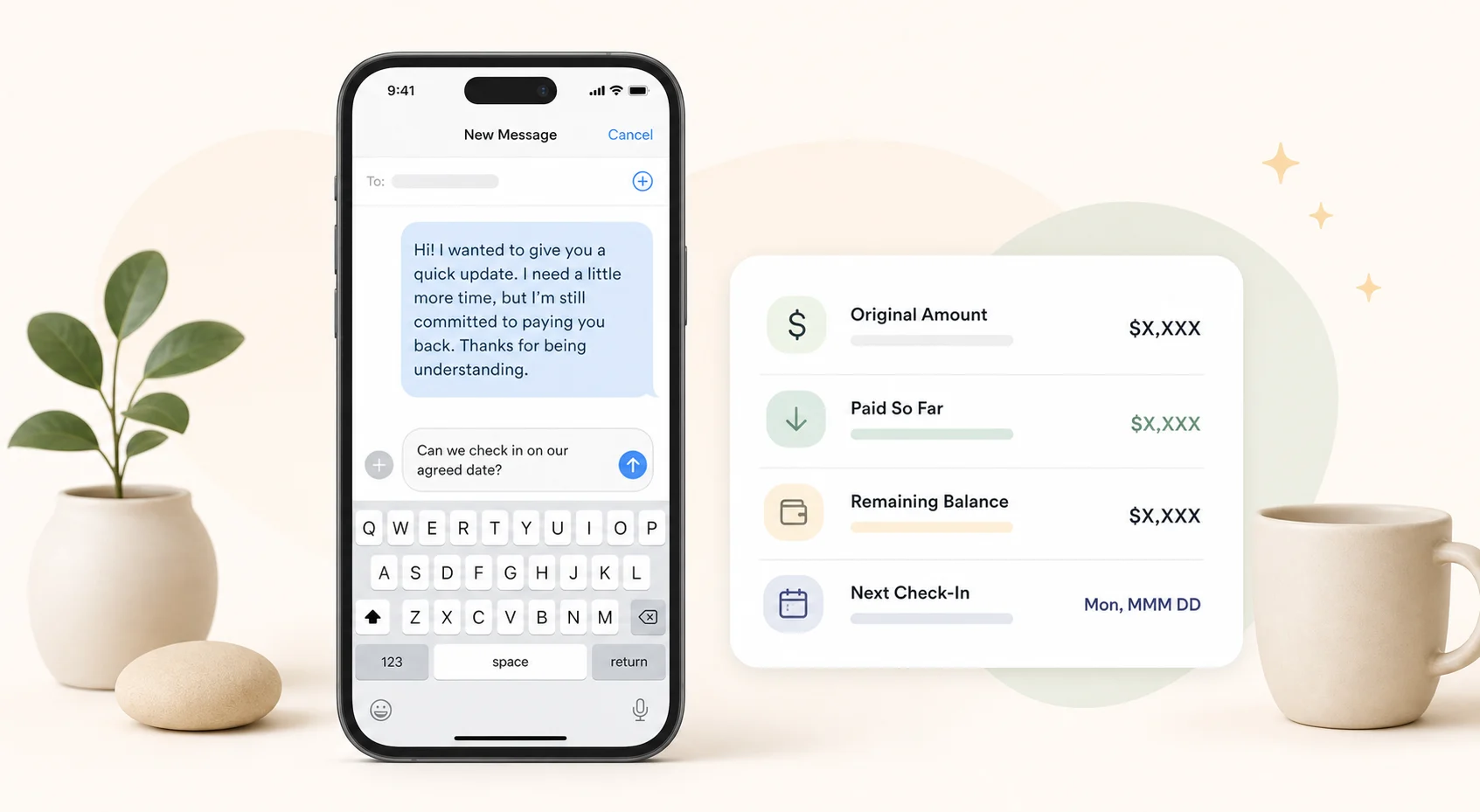
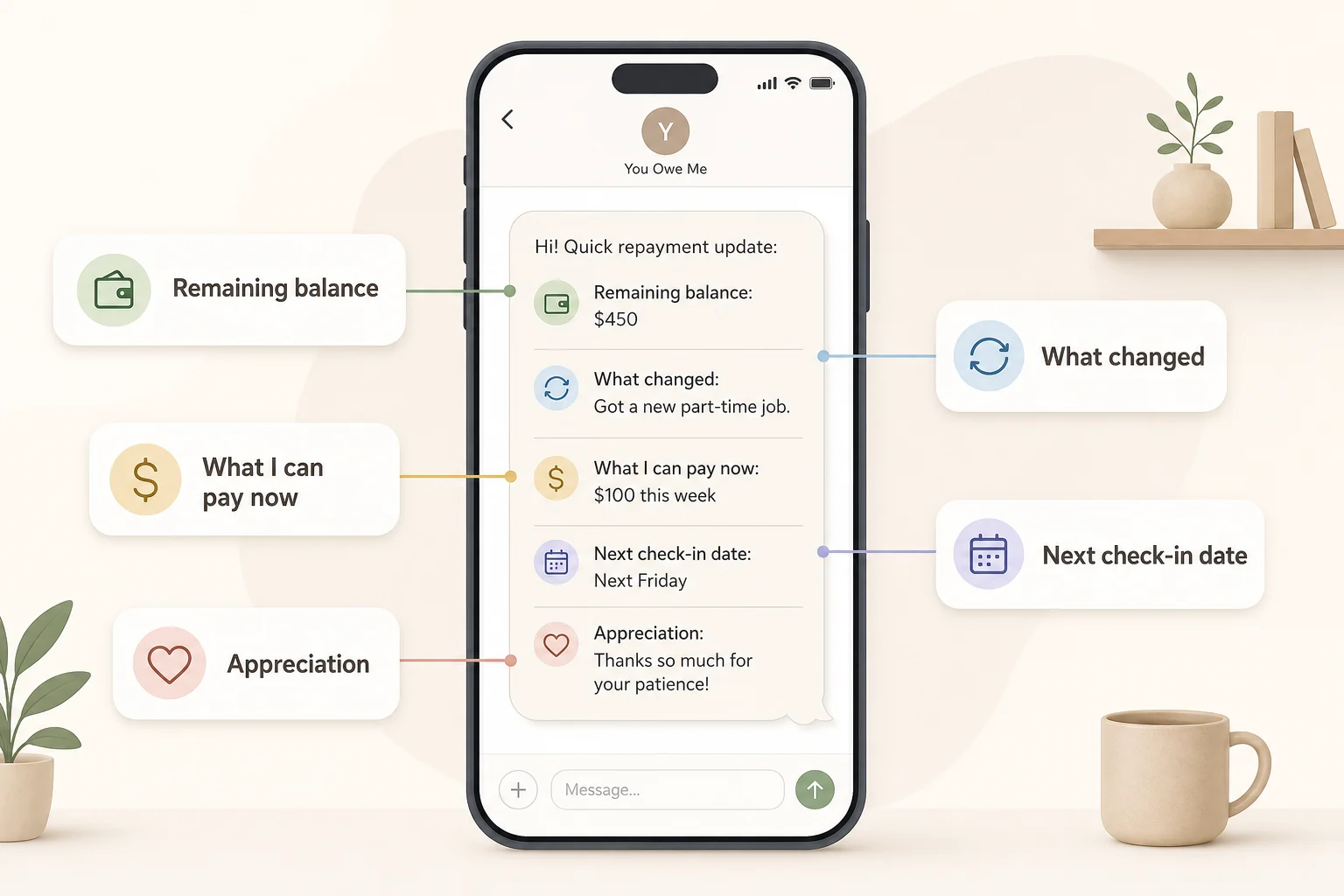
Say it early, keep it specific, and avoid promising a date you do not trust. A good message should include five things: the balance that is still open, what changed, what you can pay now if anything, the next realistic payment or check-in date, and appreciation for their patience.
This works because it does not disappear, does not overexplain, and does not leave the other person guessing what happens next.
This guide is for the person who owes money and needs more time. If someone else paid you only part of what they owe and you are waiting for the rest, use the partial repayment follow-up guide instead.
Choose the answer or situation that matches you
Common situations
The repayment update formula
When you need more time, the message does not need to be long. It needs to remove uncertainty.
Name the open balance
Give the other person the number you are both working from.
I still have $520 remaining from rent and groceries.
Explain what changed briefly
Keep this short. You do not need to prove your whole situation.
My paycheck is arriving later than I expected.
Say what you can do now
If you can send a partial repayment, say so. If you cannot, say what the next realistic step is.
I can send $100 this Friday.
Give a realistic date or check-in
A realistic check-in is better than a confident promise you may miss.
I can check in again on July 20 about the next payment.
Close with appreciation and clarity
The tone should show that you are not ignoring the balance.
Thank you for being patient - I want to keep this clear.
Combined message
Repayment update messages you can copy
Use these as starting points. Replace the amount, reason, payment date, and check-in date with details that are true for your situation. Do not promise a date unless you are confident you can meet it.
If you are the person waiting for repayment instead, browse the repayment reminder text examples for reminder-side wording.
Need one more week
Use when: You expected to repay soon, but need a short extension.
Can make a partial repayment now
Use when: You cannot pay the full amount, but you can send part of it.
Need to change the repayment plan
Use when: The original repayment schedule is no longer realistic.
Income or payment is delayed
Use when: You are waiting for a paycheck, freelance payment, client payment, transfer, or other income.
No exact date yet
Use when: You genuinely do not know when you can pay, but you still want to communicate responsibly.
Already missed the date
Use when: You already missed a date and need to reset expectations without disappearing.
Family helped with rent or bills
Use when: A parent, sibling, or relative helped with rent, groceries, bills, travel, or another temporary cost.
Friend covered a bill
Use when: A friend covered a utility bill, ticket, trip cost, dinner, or emergency expense.
Roommate covered your share
Use when: A roommate paid your part of rent, utilities, groceries, household supplies, or another shared cost.
Partner covered more temporarily
Use when: A partner covered more during an uneven month and you want clarity without making the relationship feel cold.
Short version
Use when: You need a concise text message.
Warmer version
Use when: The relationship is close and you want the message to feel human.
More direct version
Use when: You want the update to be short and specific without too much emotional language.
What not to send when you need more time
Most repayment updates go wrong when they are vague, too optimistic, or silent for too long.
| Bad | Better | Why |
|---|---|---|
| “I’ll send it soon.” | I can send [amount] on [date], and I will check in again on [date] about the rest. | “Soon” makes the other person guess. |
| “Sorry, things are crazy.” | This month changed more than I expected, so I cannot send the full amount yet. I can send [amount] on [date]. | A short explanation is better than a vague apology. |
| “I promise I’ll pay everything next week.” | I do not want to overpromise. I can send [amount] next week and check in again after that. | A realistic update protects trust better than an uncertain promise. |
| Saying nothing | I wanted to update you before you had to ask. | Silence can make the other person feel ignored, even if you still plan to repay. |
| Overexplaining defensively | Here is what I can do now, and here is when I will update you again. | The other person usually needs clarity more than a long explanation. |
Examples of repayment updates with real numbers
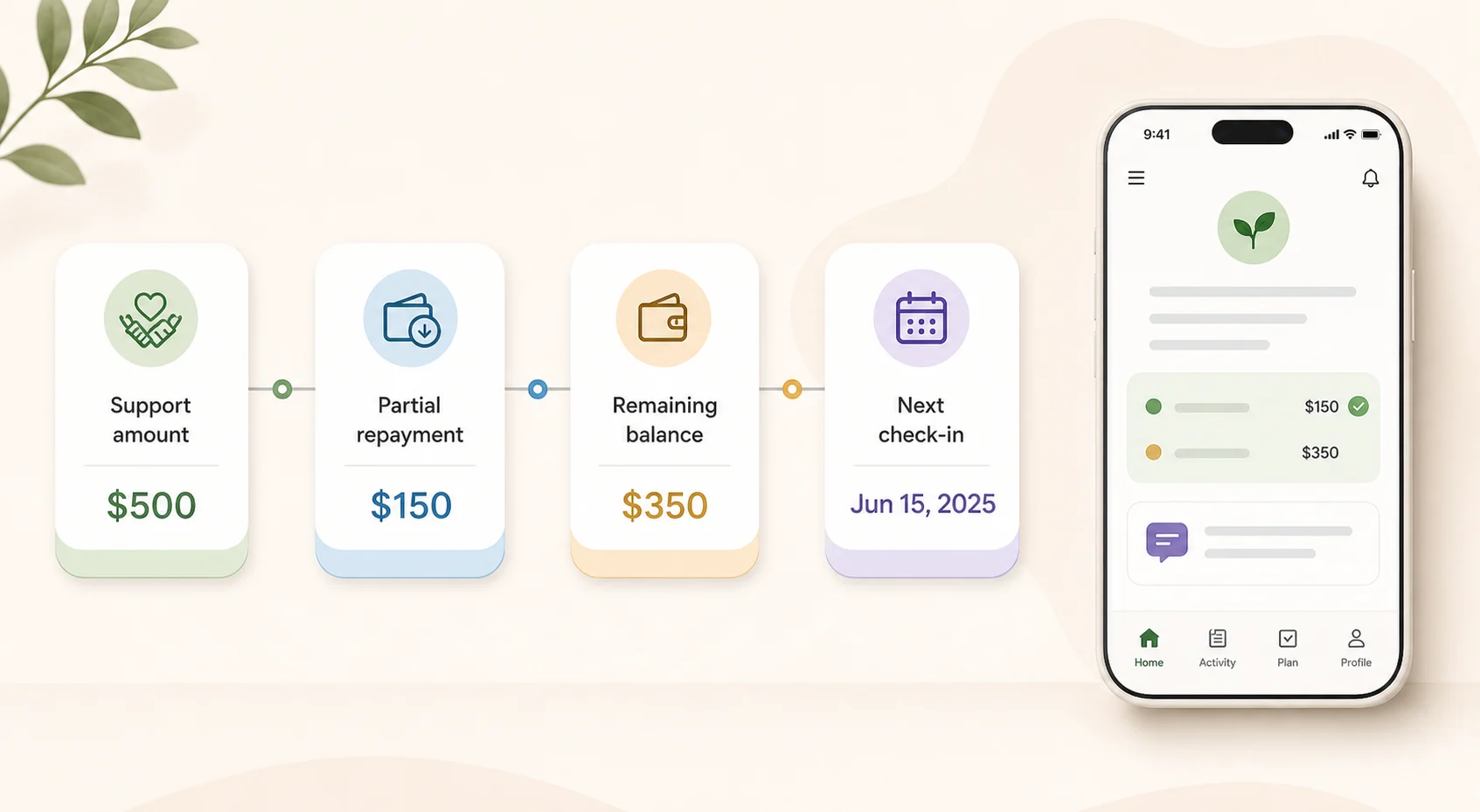
Numbers make the message easier to trust. You do not need a formal agreement - just a clear current balance and next step.
Family rent help
- Original support
- $720
- Already repaid
- $200
- Remaining balance
- $520
- Can pay now
- $100
- Next check-in
- July 20
Friend covered a bill
- Original support
- $180
- Already repaid
- $60
- Remaining balance
- $120
- Can pay now
- $40
- Next check-in
- next Friday
Roommate covered utilities
- Original share
- $95
- Already repaid
- $0
- Remaining balance
- $95
- Can pay now
- $50
- Next payment
- $45 next week
Partner covered more this month
- Extra support
- $340
- Already repaid
- $100
- Remaining balance
- $240
- Can pay now
- $80
- Check-in
- after payday
When should you send the update?
Send the update as soon as you know the original plan will not work. You do not need to wait until the other person asks. In most personal money situations, an early update feels more respectful than silence.
Send an update now if:
- you already know you will miss the repayment date
- you can only make a partial repayment
- your income or payment is delayed
- the other person covered something important like rent, groceries, bills, or travel
- you previously said “soon” but now need a clearer plan
- the helper has already asked once and you still need more time
If the only hard part is timing - not the wording - use the guide on when to ask for money back or send a repayment update.
If you can pay part now, say what remains
A partial repayment is usually better when it comes with a clear remaining balance. Otherwise, the other person may know you paid something but still not know what is open.
If the hard part is calculating what remains after one known amount has been repaid in parts, use the Partial Repayment Calculator. If new expenses and payments are mixed together, use the Running Balance Calculator. After money is actually repaid, use the Repayment Receipt Generator.
If the repayment plan needs to change, make the new plan realistic
A changed plan is not automatically a broken promise. It becomes a problem when the other person has to guess what changed. If the old plan no longer works, name the remaining balance and suggest a new realistic step.
| Situation | Better next step |
|---|---|
| You can still pay, but slower | Suggest a smaller recurring amount |
| You can pay something now | Send a partial repayment and name what remains |
| You cannot pay now | Give a check-in date instead of a fake payment date |
| New support was added | Update the balance before discussing timing |
| You are unsure what you can afford | Use the Payment Plan Calculator before sending the message |
Before you suggest a new date, calculate a realistic repayment plan using the remaining amount and timing that actually fits.
What if you do not know when you can repay?
Do not invent a date just to make the message sound better. It is usually more responsible to give a check-in date than to promise a payment date you may miss.
The check-in date matters. It tells the other person when they can expect to hear from you again, even if the payment timing is not final yet.
How to keep trust when you need more time
Update before they ask
A short update sent early usually feels better than a long explanation sent late.
Use the real number
Say what is still open. Do not make the other person reconstruct the balance from old messages.
Avoid overpromising
A smaller realistic step is better than a big promise you may miss.
Offer a partial repayment if possible
Even a smaller payment can show movement if you clearly say what remains.
Set a check-in date
If you do not know the payment date, at least give the next update date.
Keep the record somewhere
When support, repayments, and dates keep changing, memory becomes unreliable.
When a message is enough — and when tracking matters more
Not every repayment update needs an app. Sometimes a clear message is enough. Tracking matters when the situation keeps changing.
A simple message is enough when:
- there is one amount
- the balance is clear
- you only need one short delay
- no new support or expenses are being added
- both people are comfortable with one message
You Owe Me helps when:
- repayments happen in parts
- an existing repayment plan needs to change without erasing its history
- the remaining balance keeps changing
- the original support included multiple bills or expenses
- you need reminders or check-ins
- you want a clear repayment history
- you want to send updates based on the real balance
- you want to share a clear summary without forcing the other person to install the app
Keep the balance in one place before the next update
You Owe Me does not lend money or collect payments. It helps you keep the record clear after people have already arranged money between themselves. Create or open the Loan Record, add a repayment plan when a schedule helps, and record payments against that same balance.
If the original plan no longer works, revise it from the current outstanding balance. The earlier plan remains in history, while the new version sets out the future payments, projected payoff, and next reminder. That makes the written update match the record instead of quietly rewriting what was previously expected.
For the broader product flow, see the app to track money owed, review all You Owe Me features, or start with the Quick Start guide.
When the delay is part of temporary financial support
Needing more time often happens when someone close helped with rent, groceries, bills, travel, or another temporary cost. In those situations, the record should feel calm, not formal or cold.
A good support record should answer:
- What was covered?
- Was it a gift, repayment, flexible support, or undecided?
- How much is still open?
- What has already been repaid?
- When is the next payment or check-in?
- What happens if the timing changes again?
For a fuller record, use the temporary financial support tracker or create a copyable note with the temporary financial support record template.
Related tools and guides
Repayment update FAQ
What should I say if I need more time to pay someone back?
Say the remaining amount, explain briefly what changed, say what you can pay now if anything, and give a realistic payment or check-in date. For example: I still have $520 remaining. I cannot send the full amount this week, but I can send $100 on Friday and check in again on July 20.
Is it better to say nothing until I can pay?
Usually no. Silence can make the other person feel ignored or uncertain. A short update is often better than waiting until you have the full amount, especially if the repayment date has changed.
What if I cannot pay anything right now?
Do not invent a payment date you do not trust. Acknowledge the balance and give a check-in date. For example: I do not want to promise a repayment date before I am sure, but I can check in again on Friday with a clearer update.
How do I ask for more time without sounding irresponsible?
Be specific and realistic. Avoid vague promises like soon. Say what is still open, what changed, and what the next step is. Updating early usually sounds more responsible than waiting for the other person to ask.
Should I send a partial repayment if I cannot pay the full amount?
If you can afford it, a partial repayment can help, but make the remaining balance clear. Say what you sent, what remains, and when you will update them again.
How do I change a repayment plan politely?
Acknowledge that the plan changed, name the remaining balance, and suggest a new realistic plan. Do not overpromise. It is better to propose smaller payments you can actually make than a larger date you may miss again.
Can I use this for family help?
Yes. This works for informal family help, such as rent, groceries, bills, travel, or temporary support. Keep the tone appreciative and clear, especially if the relationship matters.
Does You Owe Me lend money or process repayment?
No. You Owe Me does not lend money, approve loans, process payments, collect debts, or enforce repayment. It helps people keep a clear record of money already arranged between people they know.
When should I use You Owe Me instead of just sending a message?
Use a message when the situation is simple and the balance is clear. Use You Owe Me when repayments happen in parts, timing changes, another amount may be added, reminders matter, or you want a clear history instead of scattered messages.
Keep the repayment clear before the next update
When repayment timing changes, the hardest part is often not the math. It is explaining what changed and what is realistic now. You Owe Me keeps the old plan in history and lets the revised plan start from the current balance, so the next update can match the record.
Published · Updated