Repayment plans
How to Suggest a Repayment Plan to Someone Who Owes You Money
If the full balance is not realistic right now, suggest smaller repayments as a conversation—not a demand. Confirm what is still owed, ask what amount and timing would be manageable, agree on the first payment and check-in, and write down the plan so neither person has to rely on memory.
For informal money between people who know each other. This guide does not create a legal agreement, process payments, add fees, or enforce repayment.

Choose the right next step
Is a repayment plan actually the right next step?
A repayment plan is useful when both people agree that money is still open, but paying the full amount at once is not realistic. It is not the right first step when the balance, the repayment expectation, or the responsibility is still disputed.
If the amount itself is not agreed, use the reconciliation worksheet to separate accepted rows from unresolved items before suggesting installments.
Use the situation below that most closely matches what is happening now.
| Current situation | Best next step |
|---|---|
| Both people agree on what remains, but full repayment is difficult. | Suggest a repayment plan. Turn one difficult payment into smaller, answerable steps. |
| Several expenses or repayments make the balance unclear. | Calculate the current balance first with the Running Balance Calculator. |
| One or more partial repayments already happened. | Calculate what remains first with the Partial Repayment Calculator. |
| The person can probably repay the full amount soon. | Send a normal, specific reminder rather than creating a schedule that may not be needed. |
| A repayment plan already exists, but the timing changed. | Use the repayment-update guide so the person repaying can explain what changed and propose the next realistic step. |
| The other person disputes that repayment was expected. | Clarify whether the money was a gift, repayable help, or another arrangement before discussing installments. |
| The person is ignoring the balance or an already agreed plan. | Use a clearer private follow-up rather than creating another unacknowledged schedule. |
| The situation involves threats, coercion, financial abuse, or personal safety. | Do not rely on a repayment script or tracker as the solution. Prioritize appropriate trusted or professional support. |
Before you suggest terms
Confirm the starting balance first
Do not build a repayment plan around a vague memory. Before discussing future payments, confirm the number both people are using and what that number includes.
The goal is not to create a formal statement. The goal is to prevent the conversation from becoming harder later because one person remembers a different amount, repayment, or purpose.
Before you suggest a plan, confirm these five things
- The amount still openUse the remaining balance after every real repayment already received.
- What the money was forName the expense, support, reimbursement, or informal IOU so the amount has clear context.
- What has already been repaidInclude every partial repayment, correction, or amount that should no longer be open.
- Whether repayment is acknowledgedA payment schedule cannot solve a disagreement about whether the money was repayable in the first place.
- What is making repayment difficultClarify whether the problem is the full amount, the timing, or both.
Balance-confirmation example
Before we work out a plan, I have $400 remaining from the car repair after the $60 you already sent. Does that match what you have?
Use this when one or more repayments have already changed the original balance.
Choose your starting point
Ask first, suggest a starting point, or revise an existing plan
The right opening depends on how much you already know. Do not assume what another person can afford. Choose the approach that makes the next answer easiest and most honest.
Ask first
Ask what is realistic
Use when
You know the balance, but you do not know what amount or payment rhythm the other person can realistically manage.
Start with the open balance and an invitation to suggest workable terms.
Would smaller payments make this easier? I have $400 remaining. What amount and timing would be realistic for you?
Suggest a starting point
Offer an option, not an instruction
Use when
The other person has asked for a suggestion, shared their general timing, or already indicated what they may be able to pay.
Make the amount clearly optional and leave room for a more realistic counterproposal.
Would $75 every two weeks starting on Friday work, or would another amount be more manageable?
Revise
Update a plan that no longer matches reality
Use when
Both people already agreed on a schedule, but the amount or timing is no longer working.
Do not keep pretending that the original schedule is still active. Reopen it calmly and agree on a replacement.
It looks like the current plan is no longer working. Can we update the amount or timing so we are both working from something realistic?
The core workflow
The 5-step repayment-plan conversation
A useful conversation moves from a known balance to a plan both people understand. Keep each step specific, neutral, and easy to answer.
1 Confirm the remaining amount
Start with the exact balance both people are using. Include the context and any repayment already received.
I have $400 still open from the car repair after the $60 you sent.
2 Name the practical problem without assigning blame
If the full amount seems unrealistic, say that without judging the other person’s character or financial choices.
It sounds like paying the full $400 at once may not be realistic right now.
AvoidYou clearly cannot manage your money.
3 Ask whether smaller payments would help
Invite a useful answer instead of assuming that installments are wanted or possible.
Would smaller payments make this easier?
4 Agree on the details that remove uncertainty
A workable plan should make the payment amount, rhythm, first date, check-in, and change process clear.
- What can be paid now, if anything
- The regular payment amount
- Weekly, every two weeks, monthly, or another rhythm
- The first payment date
- The next check-in date
- What should happen if timing changes
- How received repayments will be confirmed
5 Send a neutral written confirmation
The confirmation should summarize what both people accepted. It should not introduce stricter terms after the conversation has ended.
That works. I’ll note $50 this Friday, then $75 every two weeks after that. If the timing changes, please let me know before the next payment date and we can update the plan.
Interactive example
See how a suggestion becomes an agreed plan
A proposed schedule is not yet an agreement. Use the stages below to see how one open balance can move from a question to a plan both people understand.
This example does not calculate payment dates. Use the Payment Plan Calculator when you need the actual schedule.
Repayment plan conversation
Select a stage to see what changes. This is a fixed $400 car-repair example, not an editable calculator.
1. Proposed
Start with the balance and a question
The person who is owed money opens the discussion without deciding the payment amount for the other person.
Would smaller payments make this easier? I have $400 still open from the car repair. What amount and timing would be realistic for you?
- Remaining balance
- $400
- Payment now
- Not agreed
- Regular payment
- Not agreed
- Frequency
- Not agreed
- Status
- Awaiting a response
2. Discussing
The other person explains what is realistic
The response turns a vague repayment intention into a concrete counterproposal.
I can send $50 this Friday, then $75 every two weeks.
- Remaining balance
- $400
- Payment now
- $50 this Friday
- Regular payment
- $75
- Frequency
- Every two weeks
- Status
- Discussing terms
3. Agreed
Confirm only what both people accepted
The final confirmation repeats the agreed terms and explains what to do if timing changes.
That works. I’ll note $50 this Friday, then $75 every two weeks after that. If the timing changes, please let me know before the next payment date and we can update the plan.
- Remaining balance
- $400 before the first payment
- Payment now
- $50 this Friday
- Regular payment
- $75
- Frequency
- Every two weeks
- Change rule
- Update the plan before the next payment date
- Status
- Agreed
4. Revised
Update the plan without erasing what already happened
After $125 has been repaid, the remaining balance is $275. The future schedule changes, but the previous repayments stay part of the record.
Thanks for letting me know before the next payment. I’ve updated the plan to $50 every two weeks starting August 14. The remaining balance is $275. We can check in again if the timing changes.
- Remaining balance
- $275
- Regular payment
- $50
- Frequency
- Every two weeks
- First revised payment
- August 14
- Status
- Revised
Copyable template
Repayment plan summary
Use this only after both people have agreed on the details.
Repayment plan summary
Remaining balance: [amount]
What it covers: [reason]
Payment now: [amount or none]
Regular payment: [amount]
Frequency: [weekly / every two weeks / monthly / other]
First regular payment: [date]
Next check-in: [date]
If timing changes: [agreed next action]
Why this conversation works
The balance is specific
Both people know which amount and situation the discussion is about.
The person repaying helps choose the terms
The plan is not based on a guess about what someone else can manage.
The final message confirms rather than invents
Only the terms both people accepted are presented as the plan.
The plan includes a way to handle change
A changed date or amount leads to an update, not silence or a hidden assumption.
Use the free calculator for payment amounts, dates, final smaller payments, and estimated completion.
Once the plan is agreed and payments begin, use the Personal Loan Payment Tracker to compare the schedule with what actually happened.
Copyable messages
Copy a script for the part of the conversation you are in
Use these as starting points. Replace the brackets with the real balance, context, amount, and timing. Do not send a proposed schedule as though it has already been agreed.
Invite them to suggest what is realistic
Use when
You know the balance but do not know what amount or timing they can manage.
Would paying this back in smaller steps make it easier? I have [amount] remaining from [what it was for]. What amount and timing would be realistic for you?
Offer a starting point
Use when
They asked for a suggestion or already shared enough context for you to offer an option.
Would [amount] every [week / two weeks / month] starting [date] work, or would another amount be more manageable?
Confirm their counterproposal
Use when
Use after the other person suggests terms that work for both of you.
Thanks for suggesting that. I’ll record [amount] every [frequency] starting [date], with the remaining balance updated after each payment.
Use a check-in when they cannot commit yet
Use when
Use when they cannot confirm a payment amount or date today, but both people need a clear next contact point.
If you cannot confirm the payment amount yet, could we agree to check in again on [date] rather than leaving the timing open?
Confirm a revised plan
Use when
Use after both people agree to replace the previous amount or timing.
I’ve updated the plan to [new amount] every [frequency] starting [date]. The remaining balance is [amount], and we’ll check in again if the timing changes.
Final clarity check
Before you call the plan agreed
The agreement does not need to sound formal. It does need to remove the main uncertainties that would otherwise create another awkward conversation later.
- The remaining balance is confirmed.
- Both people know what the balance covers.
- Any immediate payment is clear.
- The regular payment amount is clear.
- The payment rhythm is clear.
- The first payment date is clear.
- A smaller final payment is understood if the schedule requires one.
- The next check-in date is clear when the full schedule is still uncertain.
- Both people know what should happen if timing changes.
- Both people know how a received repayment will be confirmed.
- The current balance will be kept somewhere both people can return to.
Once the plan is agreed, the next job is keeping the schedule aligned with what actually happens. In You Owe Me, the plan uses the same balance and payment history as the loan: a smaller payment leaves the rest of the installment visible, while a larger payment can move the plan ahead. The projected payoff and next reminder update with both.
Once the plan is agreed, use the personal-loan tracking guide to keep the opening balance, actual payments, and future installments in one clear record.
When the answer is still unclear
When the conversation does not produce a workable plan
One message does not always resolve the situation. Use the unresolved detail—not frustration—to decide what to ask next.
They give an amount but no start date
Ask when the first payment can actually happen. A payment amount without a first action still leaves the plan open-ended.
Thanks. What date should we use for the first $50 payment?
They give a date but no payment amount
Ask whether they expect to pay the full balance or only part of it on that date.
Thanks. On Friday, are you expecting to send the full $400 or a partial payment?
They cannot commit to an amount yet
Do not force a pretend schedule. Agree on a specific check-in date instead of accepting “whenever I can” as the whole plan.
I understand that the amount is not clear yet. Could we check in again on July 24 so the balance does not stay open-ended?
They make a partial payment before the plan starts
Update the remaining balance before confirming the future schedule.
Use the Partial Repayment Calculator when more than one payment or correction makes the remaining number hard to verify.
They miss one planned payment
Ask whether the plan still works before immediately escalating. A missed payment may mean the schedule needs to change.
I noticed the planned payment did not happen. Does the current plan still work, or should we update the amount or timing?
They repeatedly miss payments without updating you
The issue is no longer only the schedule. Ask for a clear response and decide whether you should keep covering costs or allowing new balances with this person.
Use the clearer private follow-up guide when an agreed plan is repeatedly ignored.
They dispute the amount or say the money was a gift
Stop discussing installments. Clarify the original expectation before creating a schedule.
Use the gift-or-loan clarification guide when both people remember the arrangement differently.
The situation feels unsafe
A repayment script, calculator, or tracker is not an adequate response to threats, coercion, financial abuse, or personal-safety concerns. Prioritize appropriate trusted or professional support.
Use the lightest method that works
When a message and calculator are enough—and when a lasting record helps
A simple plan should stay simple. A message and calculator may be enough for one predictable balance. A lasting record becomes more useful when real payments, reminders, notes, or changes need to stay connected.
| A message and calculator may be enough when… | A lasting record is more useful when… |
|---|---|
| One known amount is being repaid. | Several repayments will happen over time. |
| The schedule is simple and unlikely to change. | Payment timing or amounts may change. |
| No additional expenses or support will be added. | New expenses, corrections, or support may be added later. |
| One confirmation message is enough. | Reminders, receipts, notes, or repayment updates matter. |
| Both people are comfortable keeping the summary manually. | The full repayment history needs to stay connected. |
| Nobody needs an always-current shared view. | The other person may need a Live Link or statement. |
When the plan becomes real
Keep the agreement connected to what actually happens
You Owe Me does not create the agreement or force repayment. It helps one person keep the agreed schedule with the loan that is actually being repaid.
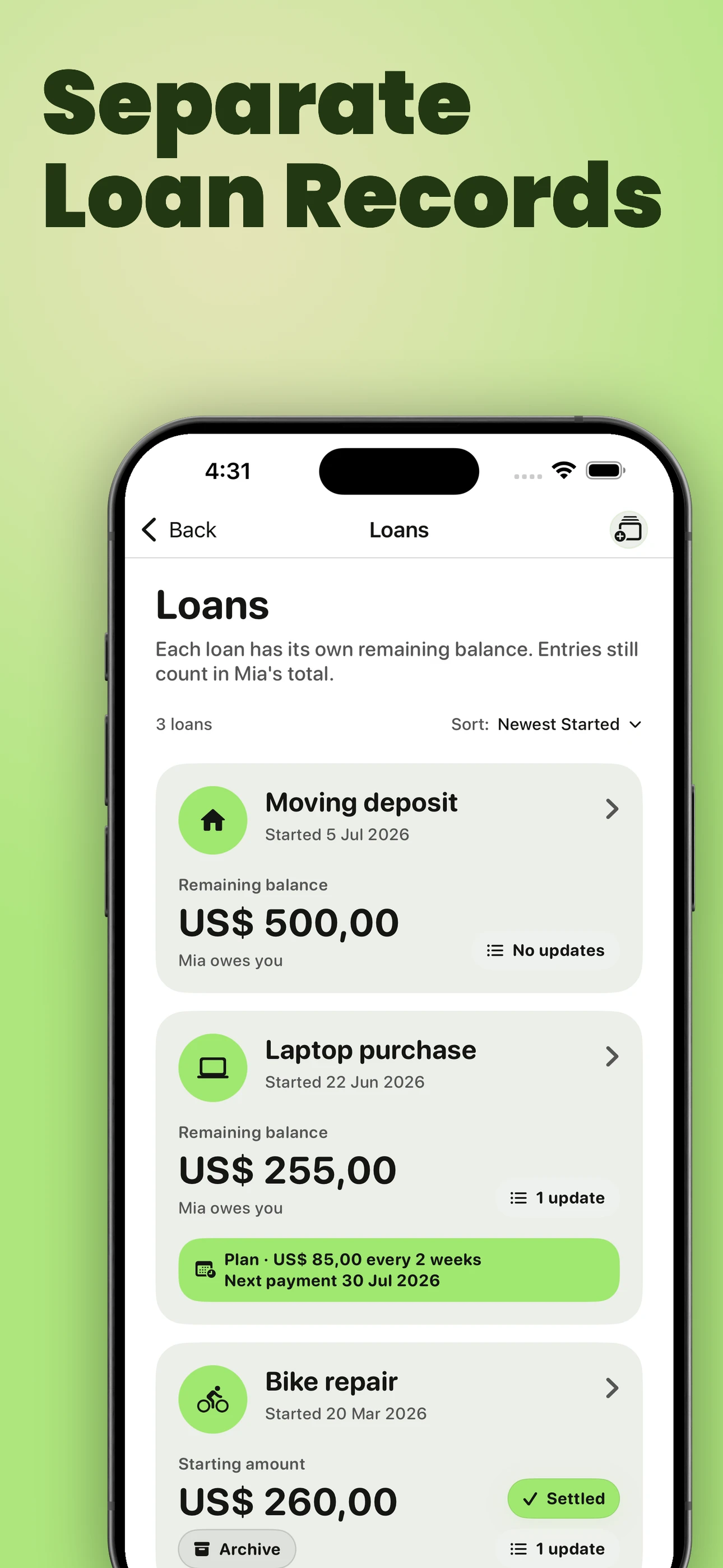
Choose a weekly, every-two-weeks, or monthly rhythm. Compare lower, balanced, and faster options, or build around the payment amount or payoff date both people accepted. As payments happen, record them against the same loan. Partial and extra amounts update progress, the future schedule, projected payoff, and next reminder.
Timeline keeps plan changes and plan-linked payments beside the wider money and communication history. A focused loan PDF can optionally include the current plan summary when a clean record is useful.
- Separate Loan Record
- Loan-linked repayment plan
- Partial and extra payments
- Current next reminder
- Projected payoff
- Timeline history
You Owe Me does not lend money, process payments, create legal agreements, or enforce repayment.
Frequently asked questions
Repayment plan FAQ
Is it rude to suggest a repayment plan?
No—not when the balance is acknowledged and paying everything at once is difficult. Keep the suggestion calm, ask what amount and timing are realistic, and leave room for the other person to propose different terms. A plan should reduce uncertainty, not create pressure.
Should I choose the repayment amount or ask what they can manage?
Start by asking what is realistic when you do not know their situation. You can offer a starting amount when they have asked for a suggestion or already shared enough context, but frame it as an option rather than a decision you made for them.
What if they say they cannot pay anything right now?
Do not force an unrealistic schedule. Ask whether a small payment is possible, and if it is not, agree on a specific check-in date. A clear check-in is more useful than a vague promise to talk “later.”
Should repayments be weekly or monthly?
Choose a rhythm that matches when money is realistically available. Weekly payments may suit regular weekly income, while every-two-weeks or monthly payments may be easier for other situations. The best rhythm is the one both people understand and can realistically maintain.
What if they miss one planned payment?
Ask whether the current plan still works before assuming bad intent. If the amount or timing needs to change, confirm a revised plan. If payments are repeatedly missed without any update, use a clearer private follow-up and reconsider future money arrangements with that person.
What if part of the balance has already been repaid?
Subtract every real repayment before discussing future installments. Use the Partial Repayment Calculator when several payments or corrections make the remaining balance hard to confirm.
Is this the same as a legal loan agreement?
No. This page provides a practical communication and record-clarity framework for informal money between people who know each other. It does not create a legal agreement, determine enforceability, calculate interest or penalties, or provide legal, tax, accounting, or debt-management advice.
Does the other person need You Owe Me?
No. One person can keep the record. The other person does not need to install the app, and they can view a Live Link in a browser when the person keeping the record chooses to share one.
Can one person keep the repayment-plan record?
Yes, but recording a plan does not mean the other person agreed to it. Confirm the terms first, then use the record to keep the balance, repayments, notes, reminders, and later changes clear.
What if we remember the original amount differently?
Stop planning future installments until the current balance is clear. Reconstruct the original amount, repayments, corrections, and context together. If the disagreement is about whether repayment was expected at all, clarify whether the money was a gift or something to repay before creating a schedule.
After you agree
Keep the plan clear after the conversation ends
A repayment plan is useful only when it stays aligned with the loan. You Owe Me updates what is due next, the remaining schedule, projected payoff, and reminder as payments are recorded.
The app is a record and planning aid. It does not process payments or make the agreement enforceable.
Clear records support clearer conversations. They do not guarantee repayment or replace professional advice when a situation becomes serious.
Updated