Free browser template
Temporary Financial Support Record Template
Write down temporary help, bills covered, repayment expectations, and check-in details without making it feel like a formal loan agreement.
When someone helps with rent, groceries, a bill, travel, or another short-term cost, the details can feel too personal to formalize — but too important to leave to memory. Use this template to create a simple record both people can understand.
If you have not asked yet, start with how to ask to borrow money from a friend so the amount, purpose, repayment expectation, and check-in date are clear before you write the record.
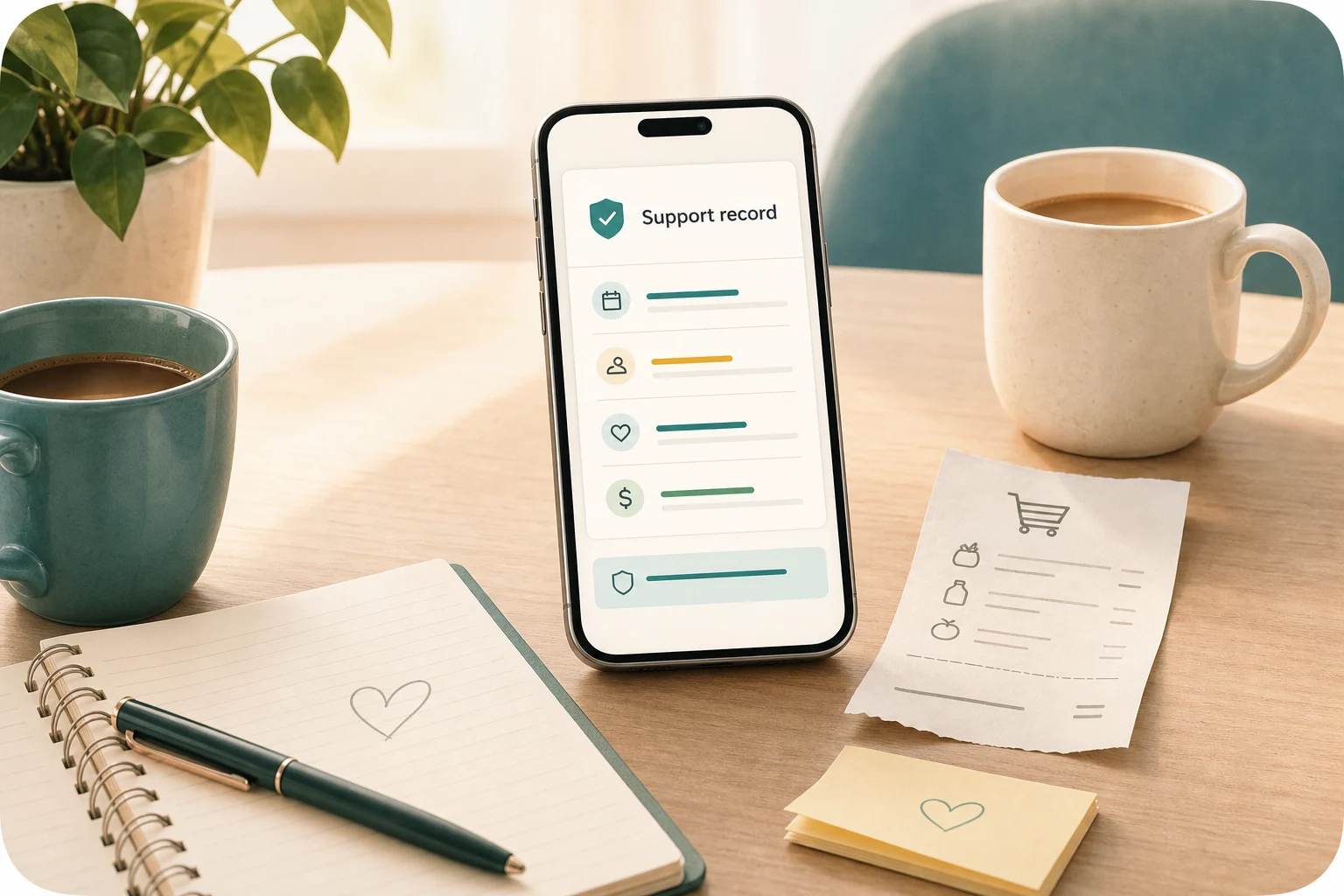
A simple record, not a formal contract
This template is not legal advice, tax advice, a formal loan document, payment processing, lending, or collection. It is a simple conversation and record template for private support between people who already know each other.
If you have not asked yet, start with the guide on how to ask family for temporary financial help without making it awkward. If the help has already been agreed and you only need to write it down, use this record builder.
If you are still deciding whether to help, how much to offer, or whether the support should be a gift, repayable, or flexible, read the helper-side guide before creating the record.
Record builder
Start with what you know
You can leave anything undecided. If the agreement is not clear yet, the template will create a draft message instead of pretending the record is final.
Not sure which option is accurate? Read how to clarify whether the money was a gift or something to repay before finalizing the record.
Load example
Your record
Generated outputs
Example preview shown until you add your own details.
Simple record
Best for saving privately or pasting into notes.
Message to send
Best for confirming the same understanding with the other person.
You Owe Me note
Best for saving with an entry or Loan Record if the situation continues.
Suggested next step
Best for deciding whether to use a message, calculator, receipt, or the app.
Quick choice guide
Which option should I choose?
If you are not sure which option matches your situation, use this quick guide before generating the record.
| Situation | Choose | Why |
|---|---|---|
| The other person said, “Don’t pay me back.” | No repayment — it was a gift | The record should not show an amount owed. |
| Both people agree the full amount should be repaid. | Repay the full amount | The record can show the support amount, repayment timing, and any amount already repaid. |
| One part is a gift and only the rest should be repaid. | Repay part of it | The gift part stays in the note, and only the repayable part becomes the balance. |
| Repayment is expected, but timing is not exact. | Repay when possible / check in later | A check-in date and update expectation matter more than a fixed due date. |
| You are not sure what the other person expects. | Not clear yet | The tool should create a clarification message instead of a final record. |
Examples
Examples of temporary support records
These examples show how temporary support can be written down without making the relationship colder. The point is not to formalize every personal money situation. The point is to avoid confusion later.
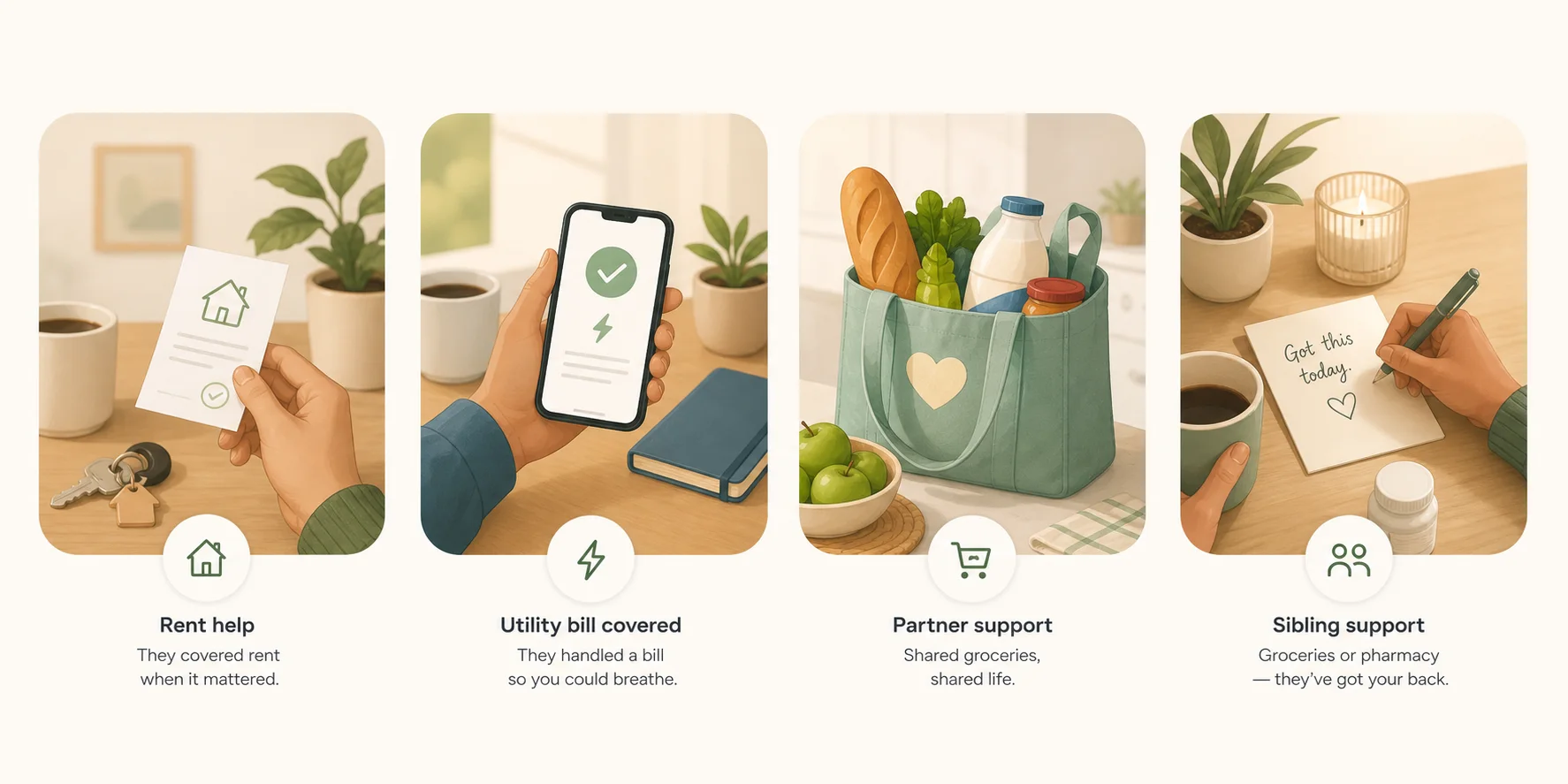
Parent helps with rent
A parent covers $600 of rent and $120 of groceries while Maya's income is uneven. Maya has already repaid $200. A clear record shows what was covered, what has been repaid, what remains open, and when they will check in again.
Sample record
Parent helped Maya with $720 for rent and groceries on July 1. They agreed the full amount should be repaid. Maya has repaid $200. The remaining amount to track is $520. Next check-in: July 15.
Friend covers a utility bill
A friend pays a $95 utility bill before it becomes late. Alex sends $40 back right away and plans to send the rest later. The record keeps the original bill, partial repayment, and remaining amount clear.
Sample record
Sam helped Alex with a $95 utility bill on August 3. Alex repaid $40. Remaining amount to track: $55. They agreed to check in after the next payday.
Partner covers shared costs during a job transition
One partner covers groceries and household items for a few weeks. They do not want to turn the relationship into a spreadsheet, so they only record the part they both agree should be repaid.
Sample record
Jordan covered $310 of shared groceries and household items during a temporary income gap. They agreed that $150 should be repaid and the rest is shared support. Next check-in: September 1.
Sibling helps with groceries
A sibling covers groceries and a pharmacy run. Part of it is a gift, and part should be repaid later. A simple record prevents both people from remembering it differently.
Sample record
Nina helped Leo with $180 for groceries and pharmacy items. They agreed $80 is a gift and $100 is the amount to repay when possible. Next check-in: October 10.
Before memory takes over
What to clarify before relying on memory
Temporary support often feels clear in the moment. Confusion usually appears later, when one person remembers the amount, timing, or expectation differently.
Money between people becomes difficult when memory replaces records. Clear records reduce misunderstandings. Clear communication reduces friction. The goal is clarity, not confrontation.
- Was this a gift, something to repay, part gift / part to repay, or a flexible check-in situation?
- What amount or bill was covered?
- Is repayment expected?
- Is partial repayment okay?
- Is there a repayment date, payment plan, or check-in date?
- What should happen if timing changes?
- Should the receiver send updates before the helper has to ask?
- Where will both people look if they forget the details later?
If timing or circumstances already changed after support was arranged, use the repayment update guide to write a clear message before the other person has to ask.
Honest fit
When this template may be enough
You do not need an app for every personal money moment. Sometimes a simple written note is enough.
- The support happened once.
- The amount is small.
- No repayment is expected.
- Both people only need a simple written note.
- There will be no ongoing repayments, reminders, or changing balance.
- The support is already finished and both people agree on what happened.
For ongoing support
When You Owe Me is better than a one-time template
Use the template once. Use You Owe Me when the support, repayments, or updates continue.
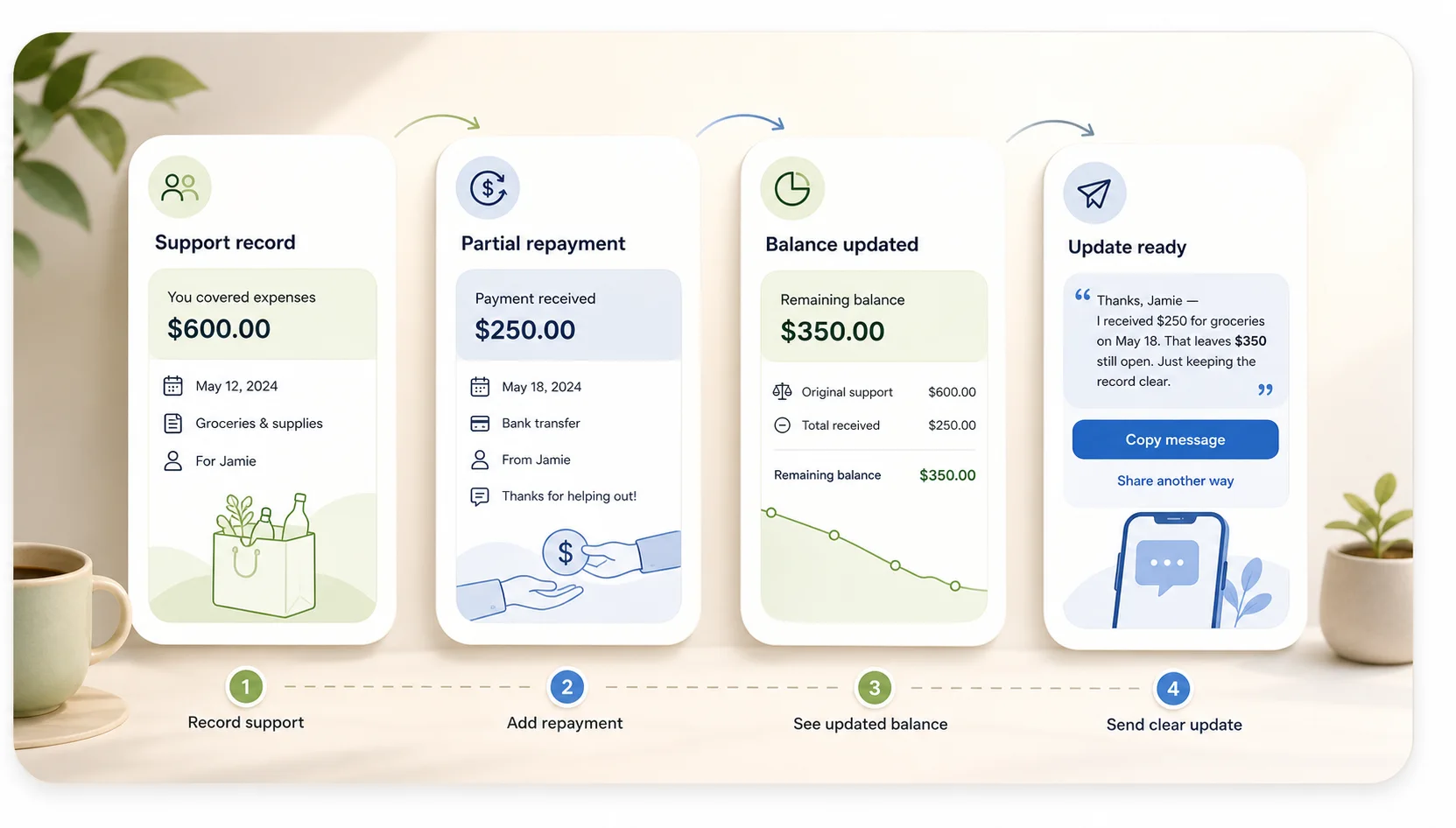
A template creates the first record. You Owe Me helps when the balance changes, repayments happen in steps, or someone needs a calm update later.
- Repayment is expected.
- Support happens more than once.
- The person may repay in smaller parts.
- Timing may change.
- One person needs more time.
- You want reminders or check-ins.
- You want a running balance and repayment history.
- You want to send calm updates from a clear record.
- The other person may need to see the current record without installing anything.
In You Owe Me, one running balance, repayment history, partial repayments, reminders, Money Conversations, Live Links, PDF statements, and receipts stay connected to the actual support history.
Common mistakes
Common mistakes that make temporary support harder later
Most confusion does not come from bad intentions. It comes from missing details, silence, or trying to reconstruct everything later.
Not saying whether it is a gift or something to repay
If one person thinks “don’t worry about it” and the other thinks “I should pay this back,” the relationship can become tense later. Write down the expectation early, even if the timing is flexible.
Relying on scattered messages
Chat history is useful, but it is not a clear record. Important details can get buried between normal conversation.
Not recording partial repayments
A small repayment can feel obvious today and become hard to remember later. Record the date and amount when it happens.
Waiting until the helper has to ask
If timing changes, a short update is usually better than silence. A clear record makes that update easier to send.
Overpromising repayment timing
A realistic check-in date is usually better than a promise that may need to change.
Temporary support record questions
Is this a formal loan document?
No. This is a simple record template for private support between people. It is not legal advice, tax advice, a formal loan document, collection, or repayment enforcement.
Does You Owe Me provide temporary financial support?
No. You Owe Me does not lend money, approve loans, transfer payments, or connect people with lenders. It helps people track and communicate about support already arranged between people they know.
Should I use this for gifts?
Only if both people want a simple record. If no repayment is expected and the support will not continue, a thank-you message may be enough.
What if we have not agreed whether it is a gift or something to repay?
Use the “not clear yet” option and confirm the missing details before relying on memory. It is also okay if the answer is mixed: for example, one part is a gift and one part should be paid back. The important thing is that both people understand the same record.
What if repayment will happen in steps?
Use this template to record the original support and agreement. Then use the Payment Plan Calculator to decide what can be paid weekly, monthly, or after a specific date.
What if someone already made a partial repayment?
Add the amount already repaid if you know it. The record can show what was originally covered, what has already been repaid, and what still needs to be tracked.
When should I use You Owe Me instead of this template?
Use You Owe Me when support continues, repayments happen in parts, timing changes, or you want reminders, history, notes, receipts, and clearer update messages.
Next step
Keep the first record simple. Keep ongoing support clear.
This template helps you write down what happened today. If support continues, repayments happen in steps, or timing changes, You Owe Me gives you one place to track the balance, history, reminders, and updates.
Updated