Temporary support
How to Ask Family for Temporary Financial Help Without Making It Awkward
To ask family for money help or temporary financial help, be specific about the amount, explain what it covers, say whether you are asking for a gift, repayable support, or flexible help, and suggest a realistic repayment or check-in plan.
The goal is not to make the conversation formal. The goal is to make it clear enough that nobody has to guess later.
Family money conversations can feel uncomfortable because the relationship matters. A clear ask can reduce pressure on both sides.
If you are asking a friend rather than family, use how to ask to borrow money from a friend instead; this page keeps the family-specific version separate.

The simplest way to ask
Direct answer
A clear family money ask has six parts
- What happened
- The amount or bill
- Whether this is a gift, a loan, or flexible support
- A realistic repayment plan or check-in date
- Room for them to say no
- A short confirmation afterward
Simple template
Use this as the basic shape for almost any family money ask.
This works because it gives the other person enough context to answer without making them guess what you need, what the money is for, or what happens next.
Before you ask, decide what you are really asking for
The most awkward family money conversations often start vague. Before you send a message or bring it up in person, decide the details you can honestly explain.
Amount
How much do you need?
Purpose
What is it for: rent, groceries, a utility bill, travel, a temporary income gap, or something else?
Timing
When do you need it?
Type of help
Are you asking for a gift, a loan, flexible support, or something you want to discuss?
Repayment
What can you realistically repay, and when?
Check-in date
If you cannot promise repayment yet, when will you update them?
Record
Where will you keep the details so nobody has to reconstruct them later?
Do not invent a repayment plan just to sound responsible. A clear but realistic plan is better than an optimistic promise you may need to change later.
If you want to check what a realistic weekly or monthly plan looks like before you ask, use the Payment Plan Calculator first.
Is this a gift, a loan, or flexible support?
Family help becomes confusing when two people quietly assume different things. One person may think it is a gift. The other may think it should be repaid. Sometimes both people want repayment, but the timing is flexible.
| Type of help | What it means | Example wording |
|---|---|---|
| Gift | No repayment is expected. | “Would you be open to helping with this as a gift?” |
| Loan between you and family | Repayment is expected between the two of you. | “I’d like to repay this in monthly steps.” |
| Flexible support | Repayment is expected, but timing may change. | “Could we set a check-in date and adjust the plan if needed?” |
| Partial gift / partial repayment | Part of the help is a gift, and part is repaid. | “Would you be comfortable making part of this help and part something I repay?” |
| Undecided | You need to discuss what feels fair. | “I’m not sure what arrangement would feel right to both of us. Can we talk through it?” |
You do not need to use formal language. You just need both people to understand the expectation.
If family already helped and you now disagree about whether the money was a gift or something to repay, use the clarification guide before sending a repayment message or creating a balance.
Copyable messages for asking family for temporary financial help
Use these as starting points. Replace the amount, reason, repayment plan, and check-in date with details that are true for your situation.
Gentle ask to a parent
Use this when the relationship is close, but the topic still feels emotionally sensitive.
Ask with a repayment plan
Use this when you already know what repayment schedule is realistic.
Ask when you do not know the exact repayment date
Use this when you want to be responsible without overpromising.
Ask a sibling for temporary help
Use this when you want the message to feel casual but still clear.
Ask when your income or payment is delayed
Use this when the problem is timing, not a permanent need.
Ask for help with rent
Use this when the amount and deadline are specific.
Ask for help with groceries or a household bill
Use this for smaller practical costs that still need a clear record.
Ask without assuming they will say yes
Use this when you want to give the other person a clear way to say no.
Confirm the agreement after they say yes
Use this after the conversation, so both people remember the same details.
Turn the agreement into a simple record
If they said yes and you need more than a short confirmation text, use the Temporary Financial Support Record Template to write down the amount, purpose, expectation, when to check in, and what should happen next.
Create a support recordReply respectfully if they cannot help
Use this when you want to protect the relationship even if the answer is no.
If you are the person receiving a request like this and you need to decline without making the relationship colder, use the guide on how to politely say no when people ask for money.

Need to keep the details clear after they agree?
If the help becomes repayable, repeated, or flexible, save the amount, reason, repayments, and next check-in in one place.
What not to say when asking family for money
You do not need perfect wording. But some messages make the other person feel pressured, confused, or responsible for managing the whole situation.
Too vague
Avoid: “Can you help me with some money?”
Better: “Could you help me with $300 for rent until July 15?”
Vague asks make the other person guess the amount, purpose, and timing.
Too much pressure
Avoid: “You’re the only person who can save me.”
Better: “I understand if you cannot help, but I wanted to ask clearly.”
Give them room to answer honestly. Pressure can make the conversation heavier.
Overpromising
Avoid: “I’ll definitely pay everything back next week.”
Better: “I can repay $100 next week and check in again on the remaining balance.”
A realistic partial plan is usually better than a confident promise you may not be able to keep.
Making them manage the details
Avoid: “I’ll pay you back sometime.”
Better: “I’ll send you an update on Friday, even if I cannot repay yet.”
If they have to chase you later, the support can start to feel awkward.
How to make the ask feel respectful, not transactional
Asking clearly does not make the relationship cold. In many cases, clarity is what keeps the relationship warm because it removes guessing.
- Ask for a specific amount instead of making them pull the number out of you.
- Explain the purpose briefly, without turning the message into a long confession.
- Say whether repayment is expected or needs to be discussed.
- Give them space to say no.
- If you need more time later, update them before they have to ask.
- Write down the agreement while it is fresh.
- Do not treat the record as pressure. Treat it as shared clarity.
The goal is not to prove that anyone is right or wrong. The goal is for both people to understand what happened and what is still open.
After they say yes, confirm the details while they are fresh
The best time to record temporary support is right after the conversation, before the details disappear into chat history and memory.
If you want the record assembled for you, use the Temporary Financial Support Record Template and then copy the result into a message, note, or You Owe Me entry.
Simple temporary support record
Helper:
Receiver:
Amount:
Purpose:
Date:
Gift, loan, or flexible support:
Repayment plan:
Check-in date:
Notes:
Example
Helper: Mom
Receiver: Maya
Amount: $720
Purpose: Rent and groceries
Date: July 1
Type: Temporary support with repayment expected
Repayment plan: $200/month
Check-in date: July 15
Note: Timing can change if income is delayed.
This kind of record does not need to be legal or formal. It just keeps both people from having to reconstruct the situation later.
If the repayment plan or check-in date changes after support is arranged, use how to send a repayment update when you need more time to explain the new timing clearly before the other person has to ask.
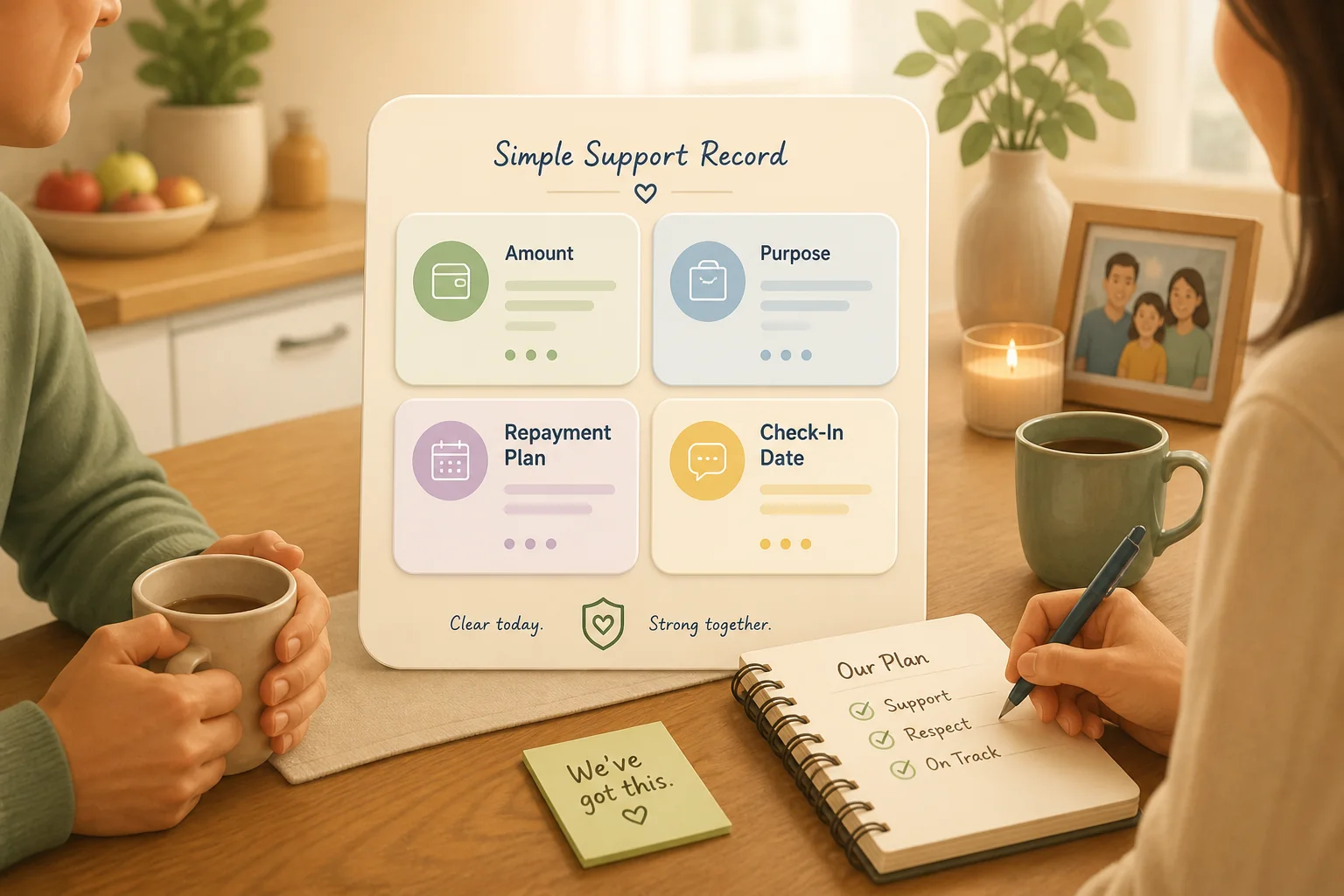
When a simple note is enough - and when You Owe Me helps
Not every family money situation needs an app. Sometimes a simple note or message is enough.
A simple note is enough when:
- It is a one-time gift.
- No repayment is expected.
- The amount is small.
- Nobody needs reminders or updates.
- Both people are comfortable leaving it informal.
You Owe Me helps when:
- Repayment is expected.
- Support may happen more than once.
- The person may repay in smaller parts.
- The repayment timing may change.
- You want to send updates before the other person has to ask.
- You want one clear history instead of scattered messages.
- The relationship matters enough that memory is not a good system.
How You Owe Me helps after the conversation
You Owe Me is not a lender and does not process payments. It helps you keep a clear record after people have already agreed on support between themselves.
The app does not create the agreement for you or move money between people. It helps you remember what was agreed, what was repaid, and what still needs a calm update.
This page is for informal communication clarity and personal recordkeeping. It is not legal, tax, accounting, or financial advice, and You Owe Me does not approve loans or connect people with lenders.
- Save the support amount, person, date, and reason.
- Keep one running balance with that person.
- Add partial repayments as they happen.
- Record notes so the context does not disappear.
- Set reminders or check-ins for the next update.
- Send repayment updates from a clear balance.
- Create a repayment receipt after money is paid back.
- Use a Live Link or statement when both people need the same view.
Keep temporary support clear without making it awkward
After the conversation, use You Owe Me to keep the amount, repayment plan, partial repayments, and updates in one calm record.
What to do next
If you are on the other side of this conversation and someone has asked you for help, read how to support someone financially without confusion so you can clarify gift vs repayment, boundaries, and check-in timing before money moves.
If you have not asked yet
Use one of the message templates above and make the amount, purpose, and next step clear.
Jump to templatesIf they already helped you
Use the temporary financial support tracker page to understand how to keep the balance, repayment plan, and updates clear.
Open temporary support trackerIf the agreement is fresh
Create a temporary support record while the helper, receiver, amount, purpose, expectation, and check-in date are still easy to confirm.
Create a support recordIf you need repayment wording later
Use ready-made repayment reminder examples when the balance is clear but the wording is hard.
Browse examplesIf they paid you back
Use the repayment receipt generator to confirm what was paid, what it covered, and whether anything remains open.
Create a receiptIf this is part of broader family spending
Use the family reimbursement tracker when family members often pay for each other and settle up later.
Open family reimbursement trackerPersonal recordkeeping note
This page is for personal communication and recordkeeping between people who know each other. It is not legal, financial, tax, or accounting advice. For formal loans, tax questions, legal obligations, or emergency assistance, use qualified local resources.
Frequently asked questions
What should I say when asking family for money help?
Say the amount, what it is for, whether you are asking for a gift, a loan, or flexible support, and when you can repay or check in. Keep the wording calm and specific so the other person does not have to guess what you need.
How do I ask family for help with rent or bills?
Use a calm, specific version such as: “I’m short on rent by this amount” or “I need help covering this bill before this date.” Explain whether you expect to repay it or need flexible help, and do not promise a repayment date you cannot realistically keep.
How do I ask family for financial help politely?
Ask for a specific amount, explain what it is for, say whether you are asking for a gift, loan, or flexible support, and give a realistic repayment plan or check-in date. Keep the wording calm and give them room to say no.
Should I ask for a gift or a loan?
It depends on the situation and the relationship. The important part is not to leave expectations unclear. If you hope it can be a gift, say that gently. If you expect to repay it, say how and when. If you are unsure, ask what arrangement would feel fair to both of you.
What if I do not know when I can repay?
Do not promise a date you cannot trust. It is better to suggest a check-in date and explain that you will update them when you know more. For example: “I do not want to promise an exact date before I’m sure, but I can check in again on Friday.”
Should I write down money help from family?
Yes, if repayment is expected, support may continue, or timing may change. A simple written record can prevent confusion about the amount, purpose, repayments, and what is still open.
Is it rude to use an app to track family money help?
No, not if the tone is respectful. The point is not to pressure the other person. The point is to keep the details clear so neither person has to rely on memory or old messages.
Does You Owe Me lend money or process repayments?
No. You Owe Me does not lend money, approve loans, process payments, or connect people with lenders. It helps people track and communicate about temporary support, repayments, and balances already arranged between people who know each other.
Related guides and tools
Published · Updated