Money boundaries
How to Say No When Someone Asks for Money — Examples for Friends & Family
You can say no kindly by being clear, brief, and not over-explaining. Acknowledge the request, say you are not able to lend money, and stop before the answer starts to sound negotiable. The best response is usually short, respectful, and final.
Quick example
“I’m really sorry you’re dealing with this, but I’m not able to lend money. I hope you understand.”
This works because it shows empathy without opening a debate. You are not judging the person, blaming them, or giving a long excuse. You are simply setting a boundary.

Answer summary
The short version
The best way to say no is to keep the message kind, short, and final: acknowledge the situation, say you are not able to lend money, and avoid long explanations. Use scripts like “I’m sorry, but I’m not able to lend money” or “I care about you, but I’m not comfortable lending money.” If you decide to lend anyway, write down the amount, reason, repayment expectation, and partial repayments so the situation stays clear later.
If the answer is not a clear no and you may want to help, use the guide on how to support someone financially without confusion to clarify the amount, gift-vs-repayment expectation, and check-in date before you send money.
If you are on the other side and need to make the request, use how to ask to borrow money from a friend so your ask is clear, specific, and easy to decline.
How to say no when someone asks to borrow money
When someone asks to borrow money, the clearest answer is often the kindest one. Say no without judging the request, and avoid adding details that make the boundary sound negotiable.
- “I’m sorry, but I’m not able to lend money.”
- “I care about you, but I’m not comfortable lending money.”
- “I’m not in a position to help financially, and I don’t want to be unclear.”
Direct answer
The polite no formula
Empathy + clear no + optional alternative + stop talking.
The most common mistake is trying to make the no feel painless by adding too much detail. Too much detail often gives the other person something to argue with. A clear sentence is usually kinder than a long, guilty explanation.
The simplest polite way to say no
If you want one safe sentence, use this:
“I’m sorry, but I’m not able to lend money.”
It may feel too simple, but that is the point. It is polite, direct, and hard to misunderstand.
If you want it warmer, add empathy before the boundary:
“I’m really sorry you’re in this position, but I’m not able to help financially.”
If you want it firmer, remove the extra apology:
“I’m not comfortable lending money, so I need to say no.”
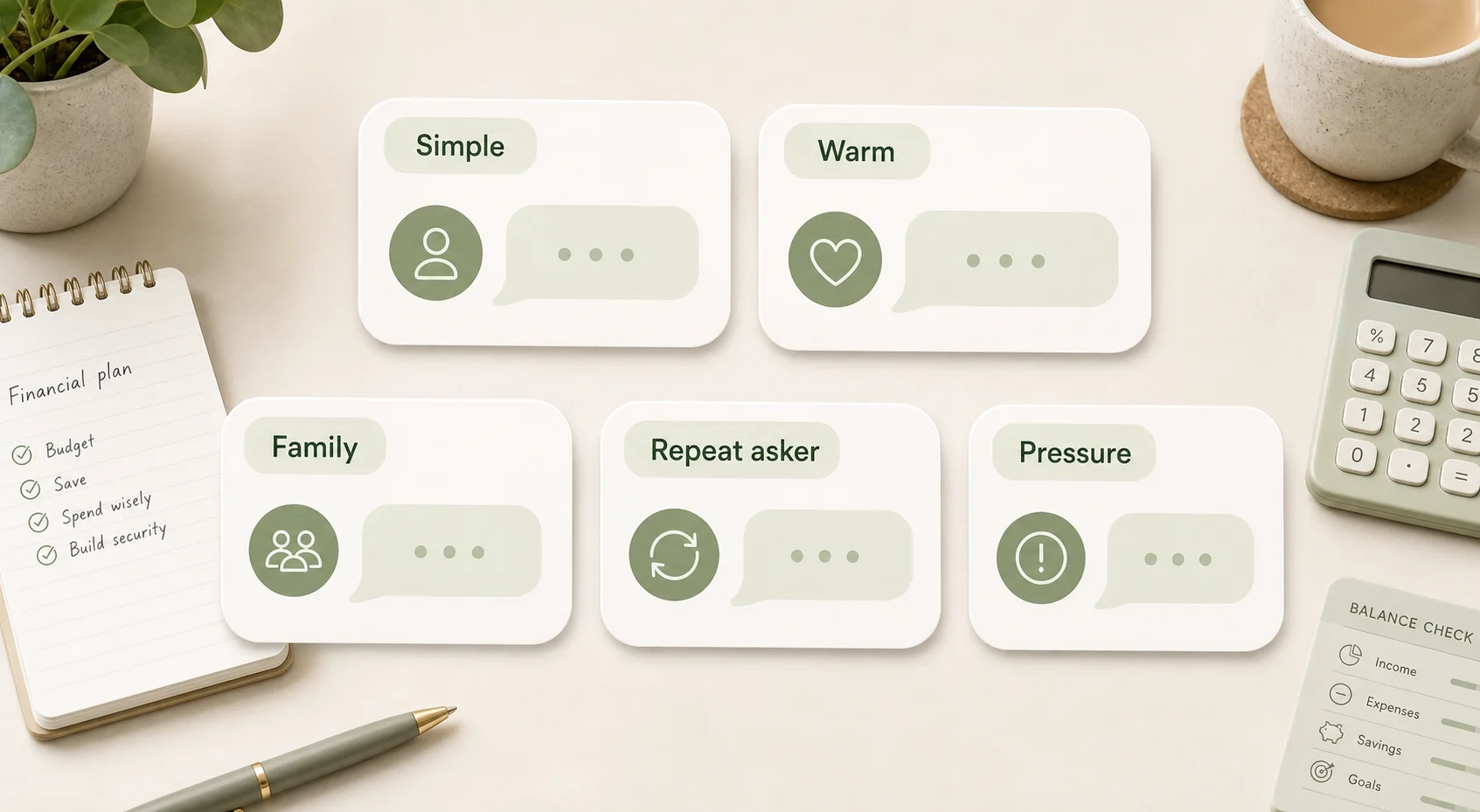
Examples and text messages for saying no to someone asking for money
These examples are short enough to send as text-message replies, but clear enough that the answer does not turn into a debate.
Short text message
Use this when you want the cleanest possible answer and do not want to explain your finances.
Warm but clear
Use this when the person is struggling and you want the message to sound caring without saying yes.
When a friend asks to borrow money
Use this when the relationship matters and you want to protect the friendship from money tension.
When family asks for money
Use this when family pressure makes it tempting to soften the answer into a maybe.
When they have asked before
Use this when you want to reset a pattern without turning it into a personal attack.
When they keep asking for money
Use this when the person keeps trying to negotiate after you already answered.
When you want to help, but not with cash
Use this when you genuinely want to support them in a non-financial way.
When you can give a small amount without expecting repayment
Use this only if you truly feel okay giving the money as a gift. Do not use this if you will resent it later.
A smaller loan is not always a better boundary. If you are only offering a smaller amount because saying no feels uncomfortable, it may still create resentment later.
Why saying no feels so hard
Money requests create pressure because they are rarely only about money. They can feel like a test of loyalty, generosity, trust, family duty, or friendship.
- You may feel guilty because the person is struggling.
- You may worry they will think you are selfish.
- You may feel responsible because you have helped before.
- You may be afraid the relationship will change.
- You may say “maybe” because “no” feels too harsh.
But discomfort is not the same as obligation. You can care about someone and still decide not to lend them money.
Why a clear no is often kinder than a reluctant yes
A reluctant yes often feels kind in the moment, but it can create a bigger problem later.
Reluctant yes
- You lend money you did not really want to lend.
- You start watching for repayment.
- You feel awkward reminding them.
- You become resentful if they delay.
- The relationship starts to feel heavy.
Respectful no
- The boundary is clear early.
- There is no hidden expectation.
- The other person knows where you stand.
- You avoid months of quiet tension.
- The relationship has less financial confusion.
A reluctant yes often turns into the harder problem later: figuring out how to ask someone to pay you back without being rude.
This is why simple loans between friends often do not stay simple once memory, expectation, and repayment timing enter the relationship.
The goal is not to punish the person for asking. The goal is to avoid creating a money situation you already know you do not want.
What not to say
If you want to protect the relationship, avoid messages that sound vague, guilty, sarcastic, or judgmental.
Avoid
“Maybe, let me see.”
Better
“I’m sorry, but I’m not able to lend money.”
Maybe keeps the pressure alive and invites follow-up.
Avoid
“Only this once.”
Better
“I’m not comfortable lending money.”
Only this once can create a new expectation next time.
Avoid
“You really need to manage your money better.”
Better
“I’m sorry you’re dealing with this, but I can’t help financially.”
Advice can sound like judgment when the person is asking for help.
Avoid
“Fine, but you better pay me back.”
Better
“I’m not able to lend money.”
A resentful yes is usually worse than a respectful no.
Avoid
“I can’t because I have bills, and then next month maybe...”
Better
“I’m not in a position to lend money.”
Long explanations can make the no sound negotiable.
You do not need a detailed excuse
Many people think a polite no needs a convincing reason. It usually does not.
A short reason is fine. A long explanation often weakens the boundary because it gives the other person something to solve, question, or negotiate.
If you say:
“I can’t this month because things are tight.”
They may hear: “Ask me again next month.”
A clearer version is:
“I’m not able to lend money.”
You are allowed to keep your financial details private. Saying no does not require opening your budget for discussion.
How to say no to family asking for money
Family money requests often feel harder because they come with history, obligation, and emotional pressure.
Examples of pressure phrases:
- “Family helps family.”
- “If I can’t ask you, who can I ask?”
- “You know I would do it for you.”
- “It’s only temporary.”
If you are on the other side of the conversation and need to ask family for help clearly, use the guide on how to ask family for temporary financial help.
Simple family no
“I understand this is important, but I’m not able to lend money.”
Warmer boundary
“I care about you, but I can’t be the financial solution here.”
No false hope
“I don’t want to be unclear or give false hope. I’m not able to lend money.”
When your son or daughter asks for money
“I love you, but I can’t keep helping with money. I’m not able to lend or send money this time.”
If they push, repeat: “I hear you, but my answer is still no.”
With family, repetition is often better than explanation. If you keep adding new reasons, the conversation can turn into a debate. Repeat the boundary calmly.
If family money is already moving back and forth because of parent bills, sibling reimbursements, shared purchases, or recurring support, use the Family Reimbursement Tracker to keep the record clear without turning every conversation into a confrontation.
How to say no to a friend asking for money
With friends, the fear is usually awkwardness. You may worry that saying no will make the friendship feel cold or transactional.
But friendship is often damaged more by unclear lending than by a clear boundary.
Protect the friendship
“I care about you, but I’m not comfortable lending money.”
Name the tension
“I don’t want money to create tension between us, so I’m going to say no.”
Kind and brief
“I’m sorry, but I can’t help financially. I hope things get easier soon.”
A good friend may feel disappointed, but disappointment is not the same as betrayal. A clear no gives the friendship a better chance than a yes that turns into resentment.
If you already lent money and now need the opposite conversation, read how to remind someone they owe you money politely.
If the money is already owed and the wording is the hard part, use the Polite Payback Reminder Generator to create a calm message from the amount, relationship, and tone.
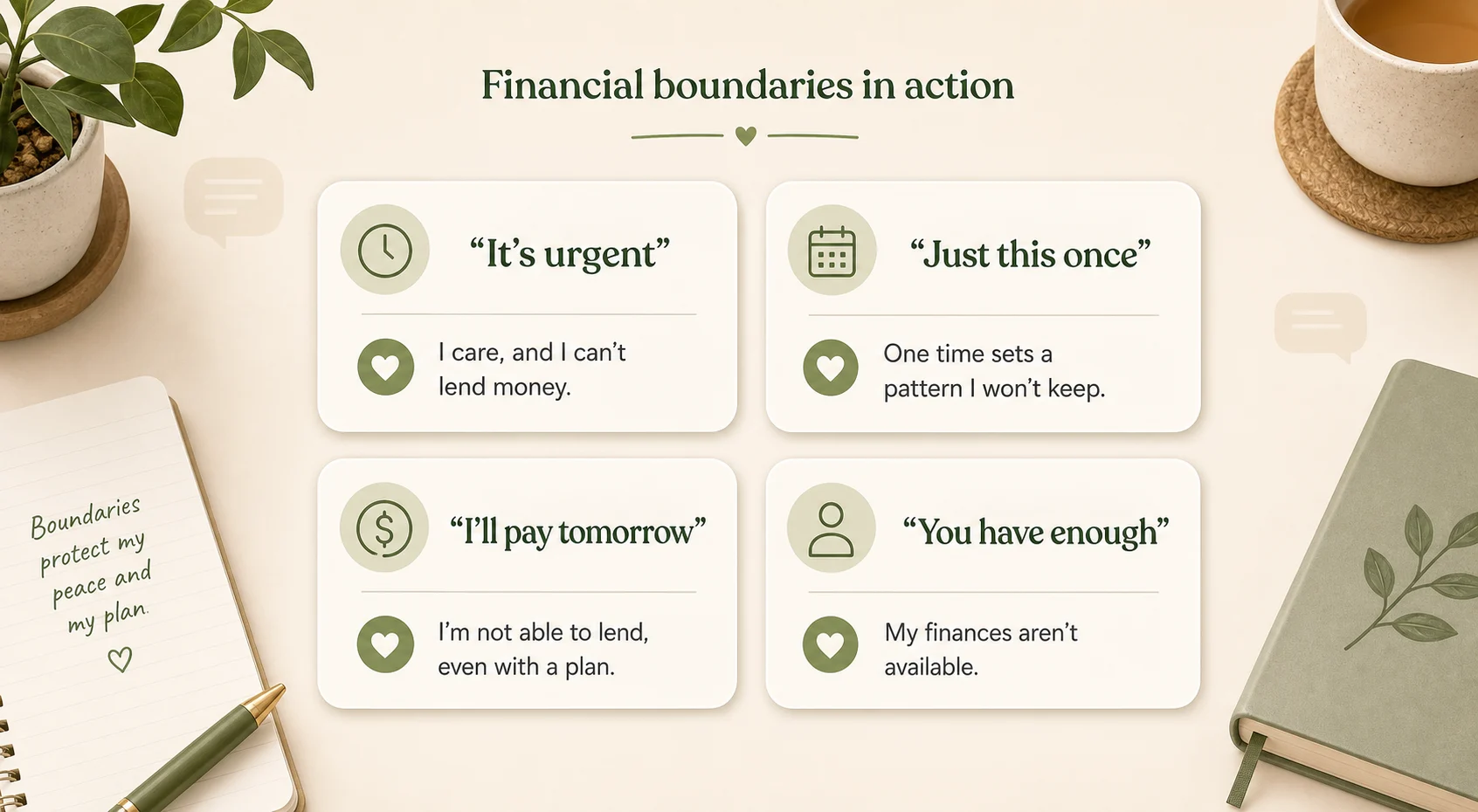
How to respond when they push back
The hardest part is often not the first no. It is what you say when the person pushes back.
How to help without lending money
Saying no to lending money does not mean you cannot help at all. Sometimes the healthiest answer is no to cash, yes to another kind of support.
- Help them list possible next steps.
- Help review a bill, deadline, or payment plan.
- Help them compare options before making a rushed decision.
- Offer food, transport, or a specific item directly instead of cash.
- Give a small amount as a gift only if you truly do not need it back.
- Share a resource, contact, or practical idea.
Options help
“I’m not able to lend money, but I can help you think through the options.”
Specific support
“I can’t send cash, but I can help with groceries this week.”
Planning support
“I’m not comfortable lending, but I can sit with you and look at what needs to be paid first.”
Do not offer alternative help just to soften the discomfort if you do not actually want to do it. A forced alternative can create the same resentment as a forced loan.
If someone already owes a known amount and repayment needs a clear schedule, the Payment Plan Calculator can help structure the timing. If you are covering rent, bills, groceries, or urgent costs and repayment may happen later, see the Temporary Financial Support Tracker.
When saying no is the better choice
There is no universal rule, but saying no is usually wise when the loan would create stress, resentment, or confusion.
- You cannot afford to lose the money.
- You would feel anxious until it is repaid.
- The person has not repaid you before.
- They are pressuring you for an immediate answer.
- The amount is larger than you are comfortable with.
- You are saying yes only because you feel guilty.
- You know you will be upset if repayment is late.
- The relationship already feels financially imbalanced.
Never lend money you cannot emotionally or financially afford to lose.
Even if the person fully intends to repay you, delay, confusion, and changed circumstances can still happen. If the idea of that happening already makes you tense, saying no may be the healthier answer.
If you decide to lend anyway, make it clear from the start
Sometimes the honest answer is not no. You may decide to help because the person is close to you, the situation is real, and you are comfortable with the risk.
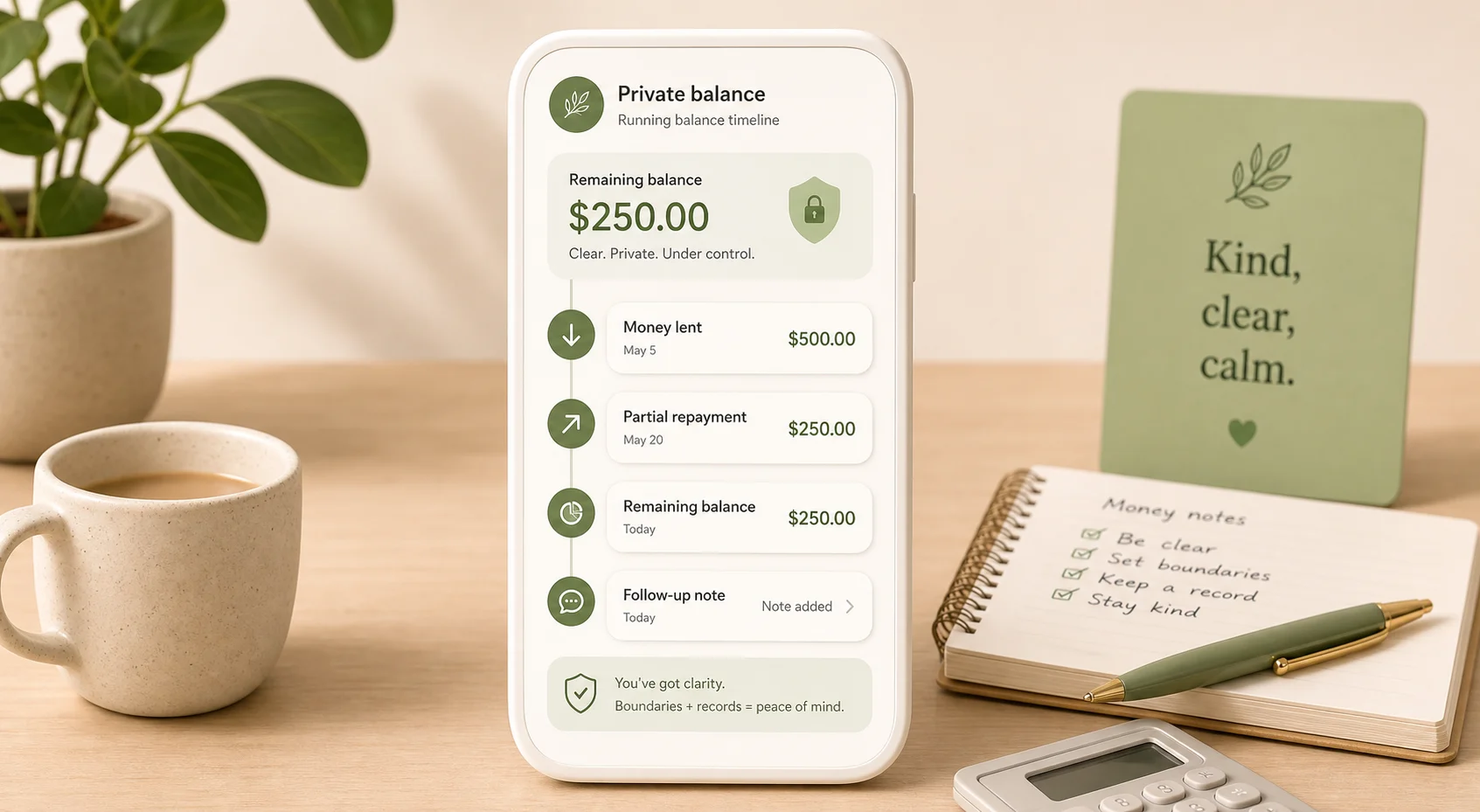
If you do lend money, clarity matters from the beginning.
- Write down the amount.
- Write what it was for.
- Agree whether it is a loan or a gift.
- Agree when repayment is expected.
- Record partial repayments when they happen.
- Keep the balance clear if more money moves later.
If repayment will happen in steps, use the Payment Plan Calculator before you agree on weekly, biweekly, or monthly repayments.
If the situation is temporary support for rent, groceries, bills, or urgent costs — and repayment may happen later — the Temporary Financial Support Tracker is the better next page.
If you choose to lend, YouOweMe helps you keep the amount, reason, repayments, partial repayments, reminders, and running balance clear in one private money-owed record.
YouOweMe does not lend money or process repayments. It helps people keep private IOUs, temporary support, repayments, partial repayments, reminders, and running balances clear after money has been agreed or exchanged.
What if you already said yes too often?
If you have lent money before, the person may assume they can keep asking. That does not mean you have to stay in the same pattern.
New policy
“I’ve realized I need to change how I handle lending money, so I’m not doing that anymore.”
Past help, new boundary
“I know I helped before, but I can’t keep lending money.”
Future boundary
“I need to be more careful with financial boundaries from now on.”
This works because it frames the boundary as a new personal policy, not a personal rejection.
You do not need to prove that the past loans were a mistake. You only need to be clear about what you are willing to do now.
If the issue is not one request but the same friend borrowing again and again, use the guide on what to do when a friend keeps borrowing money to separate the current ask from the old balance and the pattern.
If you are already paying their bills or sending money regularly, use the guide to set final dates for support that is already happening instead of treating it like one new request.
What should you do next?
Copyable template
Use this when you want to write your own version:
Examples:
- “I’m sorry you’re dealing with this, but I’m not able to lend money. I hope you understand.”
- “I know this is stressful, but I’m not in a position to help financially.”
- “I care about you, but I’m not comfortable lending money.”
- “I’m not able to lend money, but I can help you think through other options.”
Keep money clear before it becomes awkward
A clear no can prevent a money problem before it starts.
And when you do choose to lend, cover a cost, or help someone temporarily, a clear record prevents a different problem later: forgotten amounts, partial repayments, vague promises, and awkward follow-ups.
YouOweMe helps you keep private money between people clear with running balances, repayment history, reminders, partial repayments, and calmer money conversation context.
Frequently asked questions
What is the most polite way to say no when someone asks for money?
The most polite way is to be kind but clear: “I’m sorry, but I’m not able to lend money.” You can add empathy, but avoid long explanations that make your answer sound negotiable.
Can you give examples for saying no when someone asks for money?
Yes. Try: “I’m sorry, but I’m not able to lend money,” “I care about you, but I’m not comfortable lending money,” or “I hear you, but my answer is still no.”
How do I say no to lending money without sounding rude?
Acknowledge the situation, state your boundary, and avoid blame. For example: “I’m really sorry you’re dealing with this, but I’m not in a position to help financially.”
What should I say when someone asks for money by text?
Keep the text short and clear. Try: “I’m sorry, but I’m not able to lend money.” If you want it warmer, add: “I hope you understand.”
How do I say no when someone asks to borrow money?
Say no directly without a long explanation. Try: “I care about you, but I’m not comfortable lending money,” or “I’m not in a position to help financially, and I don’t want to be unclear.”
How do I say no to my son or daughter asking for money?
Keep it loving but firm: “I love you, but I can’t keep helping with money. I’m not able to lend or send money this time.”
How do I say no when a family member asks for money?
Keep the message calm and repeatable. Try: “I understand this is important, but I’m not able to lend money.” If they push, repeat: “I hear you, but my answer is still no.”
How do I say no to a friend who wants to borrow money?
Use a warm but clear boundary: “I care about you, but I’m not comfortable lending money.” This protects the friendship better than a reluctant yes that may turn into resentment later.
Do I need to explain why I cannot lend money?
No. You can give a short reason if you want, but you do not need to explain your full financial situation. Long explanations often invite negotiation.
What should I say if they keep asking after I said no?
Repeat the boundary without adding new reasons: “I hear you, but my answer is still no. I’m not able to lend money.” The more you explain, the more negotiable the boundary can seem.
Is it better to give money as a gift instead of lending it?
Sometimes, but only if you truly do not need the money back. A small gift can be cleaner than a loan, but do not call it a gift if you will resent not being repaid.
What if I decide to lend money anyway?
Make the amount, reason, and repayment expectation clear from the start. If repayments, partial payments, or future expenses may happen, track the balance in a tool like YouOweMe so you are not relying on memory or old chats.
Related guides and tools
Choose the next page based on what happened next:
Published · Updated