Balance reconciliation
What to Do When You Disagree About How Much Money Is Still Owed
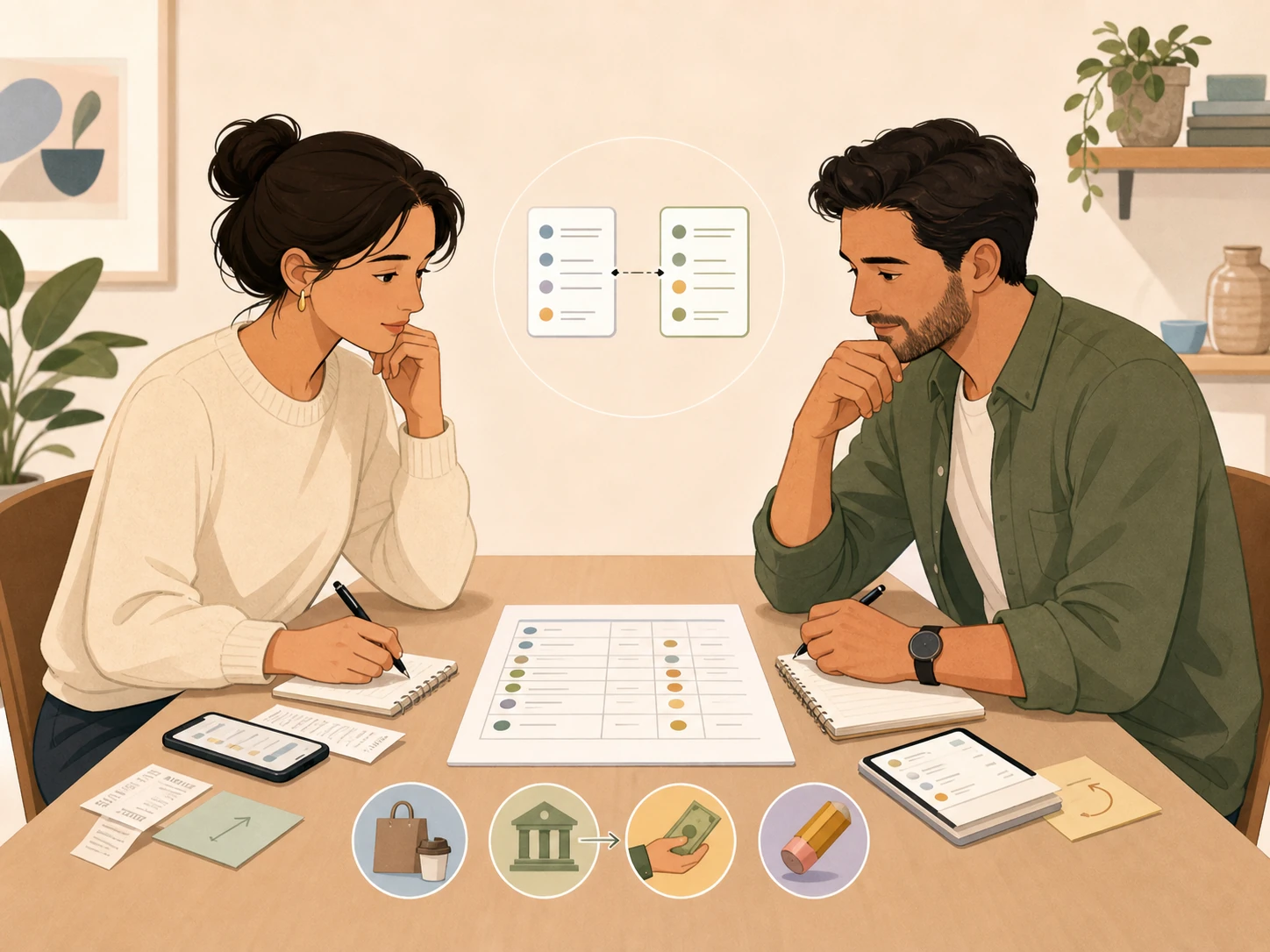
If you both agree repayment was expected but disagree about the amount still open, rebuild the history instead of arguing over the final number. Compare each expense, repayment, offset, or correction row by row, calculate only what you both accept, and keep unresolved items outside the agreed balance.
No app is required to use this worksheet.
First, make sure this is the right problem
Use this page only when both people already understand that the money was meant to be repaid. If the real disagreement is whether the money was a gift, a loan, or temporary support, settle that question first.
Repayment itself is unclear
You disagree about whether the money was a gift, temporary help, or something that should be repaid.
Clarify gift or loanRepayment is agreed, but the history or amount is unclear
You agree repayment was expected, but expenses, payments, offsets, or corrections are remembered differently.
Use this reconciliation workflowThe amount is agreed, but the timing no longer works
You agree on the current balance and need to discuss installments, a later date, or a changed repayment plan.
Plan the next repayment stepIf you are rebuilding the history because a relationship has ended, use the breakup closeout guide to set the cutoff and define the final shared-expense scope.
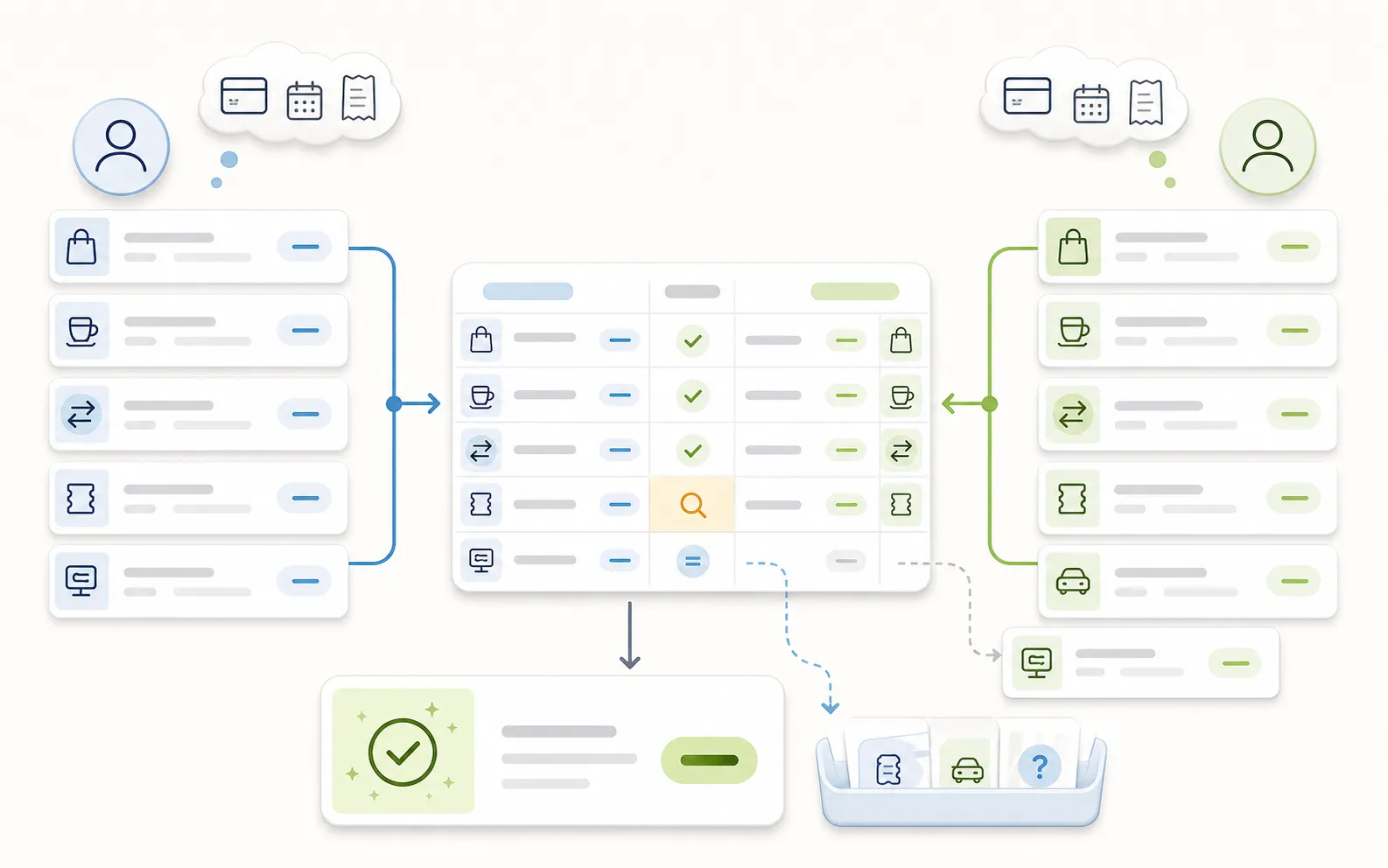
Rebuild the balance in five steps
Do not start by defending one final total. Build the history from the oldest point you both accept, then review what happened in order.
Collect both versions
Each person lists the expenses and payments they remember. Give both versions a place before treating either total as final.
Choose the oldest confirmed starting point
Start from zero or from a balance both people already accept. Do not hide older uncertainty inside the starting number.
Review one row at a time
Compare the date, amount, direction, purpose, and any shared reference for each expense, repayment, offset, or correction.
Classify each row
Mark the row as Agreed, Unverified, Disputed, Duplicate, Correction, or Unrelated before assigning any balance effect.
Confirm only the agreed result
Only accepted rows change the agreed balance. Keep unresolved items visible but separate, then confirm the amount and date in writing.
Once the rows are agreed, see how a running balance changes as expenses and repayments move both ways.
Use the balance-reconciliation worksheet
The worksheet gives both versions a place before either one is treated as final. Work from oldest to newest and add one row for each expense, repayment, offset, duplicate, or correction.
- Describe the event neutrally.
- Record each person’s memory in their own column.
- Add a shared reference only when it genuinely helps both people identify the event.
- Choose a status before assigning any balance effect.
- Do not include an unresolved amount in the agreed balance.
Worked example: the agreed balance is $26, with one $10 payment still unresolved
Maya and Eli agree that Eli was repaying shared costs Maya had covered. Their totals differ because Eli remembers a $10 cash payment and the restaurant offset was entered twice.
| Date | Expense or payment | Direction and amount | Maya remembers | Eli remembers | Shared reference | Status | Agreed balance effect |
|---|---|---|---|---|---|---|---|
| Jan 4 | Train tickets | Maya paid $80; Eli’s agreed share was $40 | Eli would repay $40 | Eli would repay $40 | Booking receipt | Agreed | +$40 owed by Eli to Maya |
| Jan 12 | Bank repayment | Eli sent Maya $20 | Received $20 for the tickets | Paid $20 for the tickets | Bank transfer | Agreed | −$20 |
| Jan 20 | Groceries | Maya paid $30; Eli’s agreed share was $15 | Eli would repay $15 | Eli would repay $15 | Receipt and message | Agreed | +$15 |
| Jan 25 | Cash repayment | Eli says he paid Maya $10 | Does not remember receiving it | Paid $10 in cash | None found | Unverified | $0 in the agreed balance |
| Feb 2 | Restaurant offset | Eli paid $18; both had agreed Maya’s $9 share would reduce the balance | The balance should reduce by $9 | The balance should reduce by $9 | Receipt and message | Agreed | −$9 |
| Feb 2 | Duplicate restaurant row | The same $9 offset was entered twice | Duplicate | Duplicate | Same receipt | Duplicate | $0 |
Agreed current balance
Eli owes Maya $26 as of February 2.Kept separate
A $10 cash repayment on January 25 remains unverified and is not included in the agreed balance.Copy the blank worksheet
Use this version in a note, document, message draft, or shared conversation. Add one row for every event that may affect the balance.
BALANCE RECONCILIATION WORKSHEET

People:
Review date:
Agreed starting point:

ROW

Date:
Expense or payment:
Direction and amount:
Person A remembers:
Person B remembers:
Shared reference:
Status: Agreed / Unverified / Disputed / Duplicate / Correction / Unrelated
Agreed balance effect:

Repeat the row for each expense, repayment, offset, duplicate, or correction.

RECONCILIATION SUMMARY

Agreed starting balance:
Confirmed additions:
Confirmed repayments or offsets:
Agreed corrections:
Agreed current balance:
Agreed balance direction: [name] owes [name] [amount]
Unresolved items kept outside the agreed balance:
Balance confirmed as of:
Notes both people accepted:
Copy a calm summary
Use this after you have separated the agreed balance from anything still unresolved.
Based on the rows we both accepted, [name] owes [name] [amount] as of [date]. This includes [short description of agreed additions] and [short description of agreed repayments or offsets]. We are keeping [unresolved item] separate because we do not yet agree on how it affects the balance. If we later agree on that item, we will add a dated correction rather than silently changing the history.
Once the accepted rows are clear, use the Running Balance Calculator if you still need to calculate the current total.
Classify each row before it affects the balance
A row can stay visible without becoming part of the agreed balance. Choose the label that describes what both people currently understand.
Agreed
Both people accept what happened, the amount, the direction, and how the event affects the balance.
Unverified
One person remembers the event, but there is not yet enough shared context for both people to accept the row.
Disputed
Both people recognize the event but disagree about its amount, purpose, share, or effect on the balance.
Duplicate
The same expense or payment appears more than once. Keep the row visible, but give the duplicate no balance effect.
Correction
Both people agree that an earlier amount, direction, share, or entry was wrong and should be corrected with a dated change.
Unrelated
The event happened, but both people agree that it did not belong to this balance.
Why two balances often do not match
Most mismatches come from a small number of practical problems. Identify the problem before changing the total.
A cash repayment was not recorded
Ask when it happened, how much it was, and what it was meant to cover. A missing receipt does not prove that the payment did not happen. Until both people accept the row, mark it Unverified and keep it outside the agreed balance.
Ask: Can we place the cash payment on the timeline and check what it was meant to cover?
A transfer had no context
A bank transfer may have covered this balance, another shared cost, or something unrelated. Confirm its purpose before applying it.
Ask: What did we understand this transfer to cover when it was sent?
When one accepted payment needs a clear record of what it covered, use the Repayment Receipt Generator.
A shared expense was treated as repayment by one person
Paying for dinner, groceries, or another shared cost reduces an older balance only when both people understood it as an offset. Otherwise, record it as a separate expense and agree on its share.
Ask: Did we both understand this expense as reducing the older balance, or was it a separate shared cost?
The same expense appears twice or has the wrong share
Keep the original row visible, mark the duplicate, and add a dated correction if the amount or share was wrong. Do not silently erase the history.
Ask: Are these two separate events, or is the same expense listed twice?
One payment was applied to a different amount
If several informal balances existed, identify which one the payment covered. A single payment should not reduce two balances.
Ask: Which expense or balance did we understand this payment to reduce?
Use language that invites a review, not a verdict
Keep the messages short. The worksheet should do most of the explaining.
Start the reconstruction
I think we agree that repayment was expected, but our current totals do not match. Can we rebuild the expenses and payments one row at a time and calculate only what we both recognize?
Raise a missing payment
I remember paying [amount] by [method] on or around [date]. Can we check what that payment covered before we finalize the balance?
Clarify an offset
I had understood the [expense] as reducing the balance. Did you understand it that way too, or did you see it as a separate shared cost?
Keep an item unresolved
We do not seem to agree on this row yet. Let’s keep it outside the agreed total instead of presenting either version as final.
Confirm the result
Based on the rows we both accepted, the current balance is [amount] as of [date]. We are keeping [item] separate because it is still unresolved.
Choose the result you actually reached
The correct next step depends on what became clear. Do not treat every reconciliation as an open balance that needs more tracking.
Fully reconciled
You both accept the rows and the current balance. Calculate the final number, confirm the date, and discuss timing only if money remains open.
Calculate the agreed balancePartly reconciled
You have an agreed balance plus one or more unresolved rows. Share them separately. Do not fold the unresolved amount into the final number.
Copy the reconciliation summaryNothing remains open
The accepted repayments and offsets close the balance. Send a short confirmation and stop tracking it.
Create a repayment confirmationRepayment itself is unclear
The real disagreement is whether the money was a gift, temporary support, or something to repay. Leave this workflow and clarify the expectation first.
Clarify gift or loanUse the lightest tool that solves what remains
A simple message or free tool is often enough. Use an ongoing record only when the balance will keep changing.
| Situation after reconciliation | Lightest useful action |
|---|---|
| One or two agreed rows, and nothing remains open | Send the short written confirmation from this page. Use the summary template |
| Several agreed rows need one final calculation | Enter only the accepted rows in the Running Balance Calculator. Calculate the balance |
| One repayment just happened | Create a clear confirmation showing what the payment covered and whether anything remains. Create a repayment confirmation |
| One original amount has several accepted repayments | Use the Partial Repayment Calculator to see the remaining amount. Calculate partial repayments |
| The balance is clear, but repayment needs installments | Use the existing repayment-plan guide or Payment Plan Calculator. Plan the repayment steps Calculate a payment plan |
| Future expenses or repayments will keep changing the balance | Keep the agreed history in one ongoing record. See how money-owed tracking works |
When the balance will keep changing
Keep the agreed history clear from this point forward
You Owe Me does not decide which version is correct. It becomes useful after you have agreed what should be tracked.
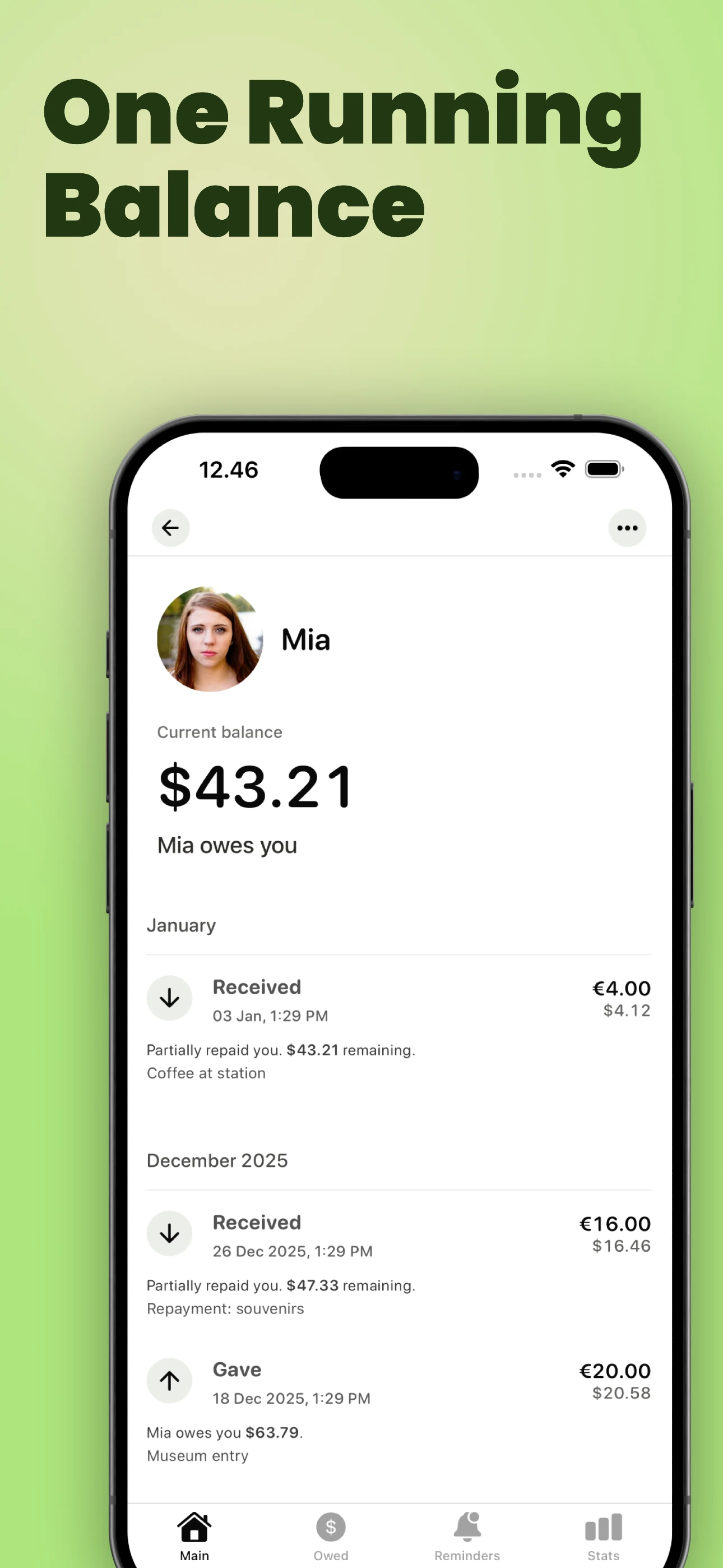
One person can keep the record; the other person does not need to install the app. Later expenses, repayments, partial repayments, corrections, notes, and reminders stay connected to the same running balance instead of being scattered across messages.
Use it when the balance will continue changing or when a clear history will make future check-ins calmer. If the balance is settled, no app is needed.
- Keep later expenses and repayments in one running balance.
- Record partial repayments and dated corrections without losing the history.
- Share a clear update when the other person needs context.
Keep future changes in one clear record.
You Owe Me is a personal record and communication tool for money between real people. It is not a bank, lender, payment processor, debt collector, accounting system, or legal proof service.
See how You Owe Me handles privacy and data.
Questions before you finalize the balance
What if only one person has records?
Use those records as a starting point, not an automatic verdict. Share the dates, amounts, and purpose, invite corrections, and classify each row according to what both people currently accept. A record held by one person can help reconstruct the history, but it does not turn a disputed row into an agreed balance.
What if a repayment was made in cash?
Place the cash payment on the timeline with the approximate date, amount, and purpose. Ask what it was meant to cover. If both people accept it, mark it Agreed. If not, keep it Unverified or Disputed and outside the agreed balance.
What if we still disagree after reviewing everything?
Confirm the part you both accept and list the unresolved rows separately. Do not present one person’s full total as a shared result. This page does not provide mediation, enforcement, or legal advice.
Should I enter a disputed amount in an app?
Do not label a disputed amount as an agreed balance. You may keep a private note that an item remains unresolved, but add it to the shared running balance only if both people later accept how it should be treated.
What if the amount is large or legally significant?
This page is for informal personal communication and recordkeeping. It does not determine legal responsibility, authenticate evidence, or prove a loan. Seek qualified local advice for formal, high-value, estate, divorce, contract, bankruptcy, tax, or enforcement questions.
Published · Updated