Comparison guide
Splitwise Alternative for Ongoing Expenses, IOUs, and Group Paybacks
Splitwise is strongest when a group wants one shared place where several people add expenses and settle together. You Owe Me is built for the money relationship itself: one running balance, repayment history, Group Paybacks, Live Links, calm follow-ups—and Balance Sync when exactly two people both want to update the same balance.
Best when the hard part is not only the split. It is keeping the balance, history, and next step clear—whether one person keeps the record or two people keep it in sync.
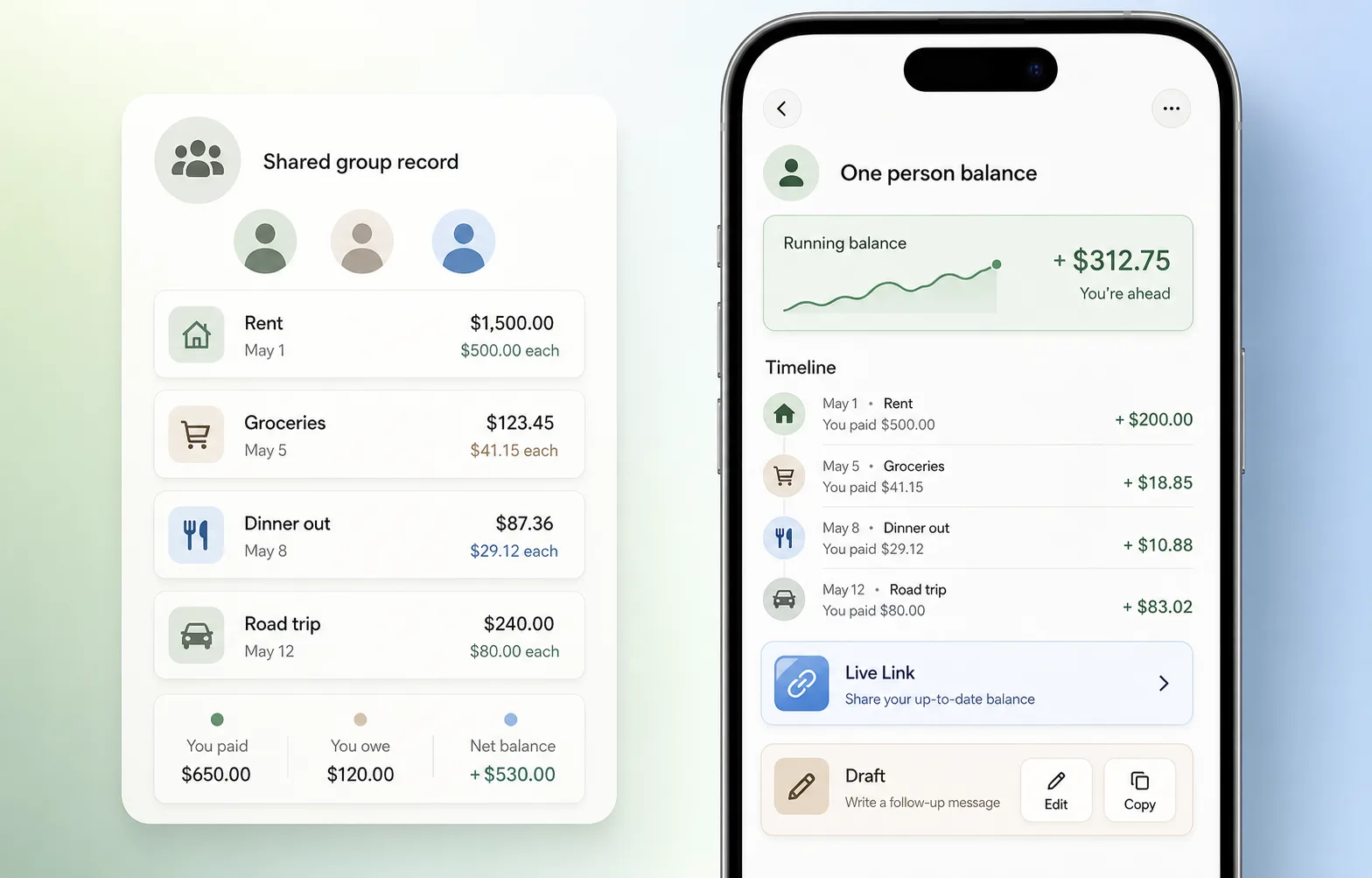
Direct answer
Splitwise alternative for ongoing expenses, not just trips
Splitwise is strongest when several people collaborate inside one shared expense space, especially trips, shared houses, and plans where the group needs to add and settle expenses together.
You Owe Me is strongest when one continuing money relationship needs a durable record: a running balance, repayment history, partial repayments, reminders, Live Links, and calmer communication. One person can keep the record, or exactly two You Owe Me users can privately connect it with Balance Sync.
Use Splitwise when the group owns the ledger
Best when several people need to participate, add expenses, and settle together inside one shared group record.
Use You Owe Me when one money relationship needs to stay clear
Best for per-person balances, repayment history, follow-ups, Live Links, and an optional private Balance Sync connection between exactly two users.
Model comparison
Ledger vs Splitwise
A ledger is a record of balances, repayments, and history over time. Splitwise is a collaborative splitting and group-expense product. They can overlap, but they are not the same job.
You Owe Me behaves more like a personal money ledger for real-life IOUs, repayment history, follow-ups, and changing balances, with sharing available through Live Links, statements, and Group Payback flows.
Quick verdict
Choose the tool that matches the money problem
Choose Splitwise when the group wants a shared place where multiple people add expenses together. Choose You Owe Me when you want to split shared costs, keep clean per-person balances, and handle the repayment history, Live Links, and follow-up messages that come after.
If you are still deciding between notes, spreadsheets, calculators, payment history, split apps, and an IOU tracker, compare the best way to track IOUs between people first.
Choose Splitwise if...
- Everyone wants to participate in the same shared expense record.
- Several people need to add expenses themselves.
- The main job is a group trip, group dinner, or shared house ledger.
- You mainly want a collaborative group ledger where everyone settles together.
Choose You Owe Me if...
- You want to split shared costs without building a shared group ledger.
- You paid for one shared thing and want to track who paid, who partially paid, and who still owes.
- You want the shared cost organized in one place while each person's balance stays correct in their own history.
- You want each person's share to become a clean running balance.
- The balance keeps changing through repayments, partial repayments, and recurring costs.
- The awkward part is the follow-up message, not only the math.
- You need a per-person history, Live Link, statement, or repayment update.
- Exactly two people both want to add or update supported entries for one ongoing balance.
- Each person should see who owes whom correctly from their own perspective.
- You want private two-person participation rather than a shared group workspace.
If your situation is one shared cost you paid for first, start with the guide to tracking who paid you back for a group expense before choosing a full group-expense app.
The real difference: group splitting vs. money relationship history
Splitwise is designed around shared expenses with groups. You Owe Me also lets you split shared costs, but it is designed to keep the result inside the money relationship you have with each person. That difference matters when the situation lasts longer than one bill: family reimbursements, roommate utilities, partner spending, long-running IOUs, client balances, or money that is repaid in pieces.
Group Paybacks make that difference clearer. If you paid for Nina’s gift, tickets, dinner, a deposit, or a shared booking, you can keep that shared cost together as one Group Payback while each person’s share still lives in their own balance history. You can see who is paid up, who partly paid, and who still owes without turning the situation into a full collaborative group ledger.
If the main question is when friends should contribute to a fixed hotel, Airbnb, ticket, or deposit before the trip, use the booking-payment timing guide instead of starting with a collaborative ledger.
Collaborative group ledger
Best when several people want to add expenses, view the same shared record, and settle the group together.
Split once, then keep per-person clarity
Best when one person wants to split a shared cost, save accurate entries for each person, and keep the balance, repayment history, statements, and follow-up context clear over time.
Balance Sync
A private two-person balance—not a group ledger
Balance Sync privately connects one supported balance between exactly two You Owe Me users. Add or update an entry on either phone, and both apps stay aligned without copying screenshots, forwarding every change, or maintaining two separate lists.
This makes You Owe Me substantially stronger for couples, two roommates, friends, family members, or any two people who both want to maintain the balance. It does not turn You Owe Me into a collaborative group-expense workspace.
Two-way
Either connected person can add, edit, archive, or delete supported entries.
Separate records
The recipient receives a new person record. Balance Sync never merges into an existing record, and each person keeps their own app record.
Perspective-aware
The underlying activity stays consistent while each person sees who owes whom from their own perspective.
Conflict-safe
If both people edit the same entry, that entry pauses until one complete version is chosen. Changes are not silently overwritten.
Balance Sync is limited to exactly two users and does not currently synchronize Group Paybacks. A collaborative group ledger remains the better fit when several people need to add expenses and settle together in one workspace.
See how Balance Sync works
Split Entry and Group Payback
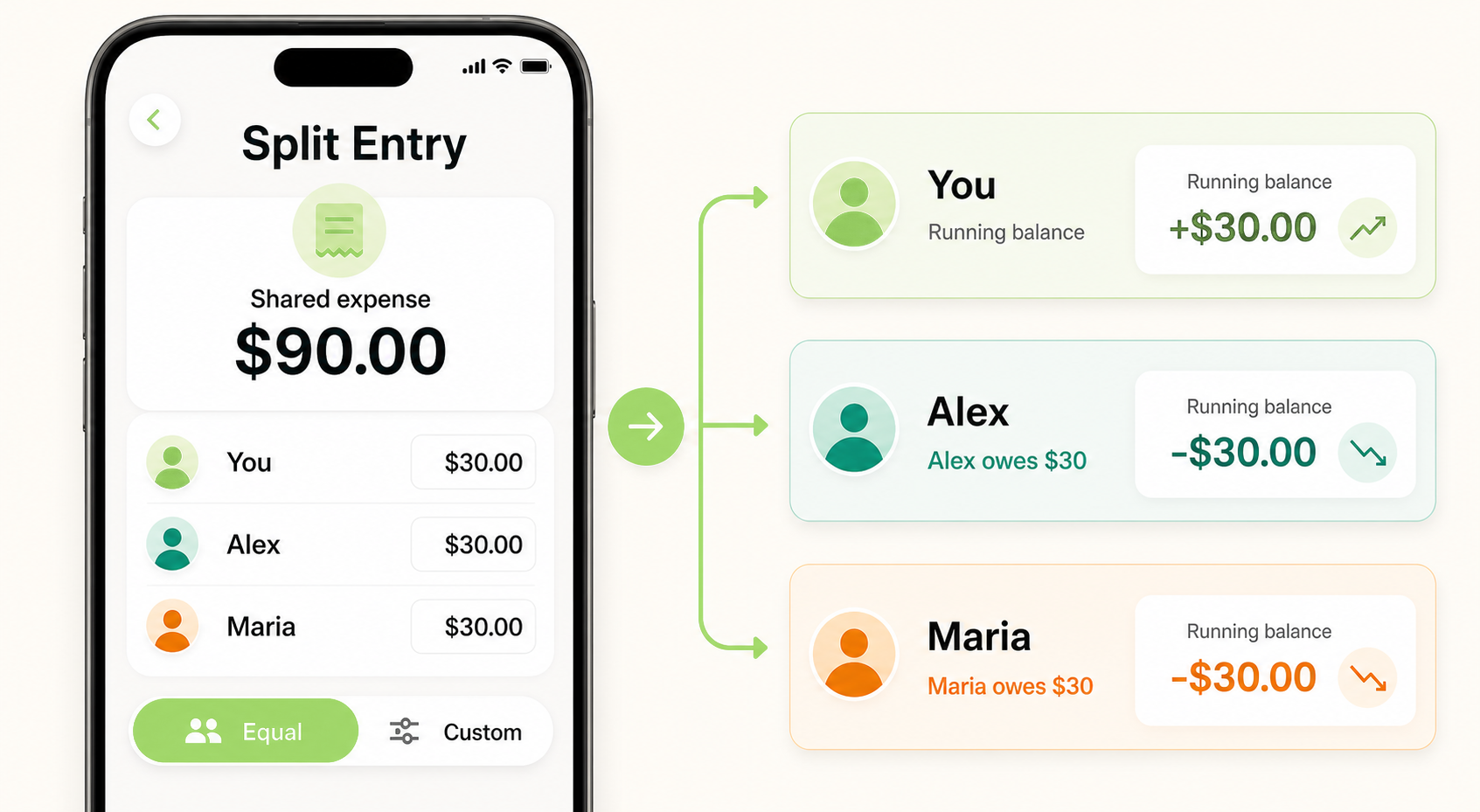
You Owe Me can split shared costs — and now track payback progress too
Some shared costs only need a quick split. Others need a place to stay open until everyone pays their share.
You Owe Me keeps both jobs personal: one person can create the record, and each person’s real balance stays connected to their own history.
Quick Split
Use Quick Split when you only need to divide one cost and save clean per-person entries. It is best for simple one-time splits where the next step is just recording each person’s share.
Group Payback
Use Group Payback when you paid for one shared thing and want to track it until everyone pays. You can see who paid, who partially paid, and who still owes, while each person’s real balance stays in their own history.
Still not a collaborative group ledger
Group Paybacks do not turn You Owe Me into a shared collaborative expense system. Other people do not need to join, edit the group, or manage a shared ledger.
Clean per-person balances
You keep the record, and the app keeps each person’s payback connected to their real balance.
You Owe Me is still not a collaborative group ledger. It is best when one person wants to keep the record accurate and share the details when needed.
Group Paybacks: one shared thing, clear payback progress
A Group Payback is useful when you paid first and everyone agreed to send their share later. Instead of checking messages one by one, you can open the Group Payback and see the status of the shared cost in one place.
If you want to check the status before choosing an app workflow, the Group Payback Calculator shows who paid, who partly paid, and what is still open for one shared cost.
Who paid?
See which people have already paid their share.
Who partially paid?
Track partial paybacks without losing the remaining amount.
Who still owes?
Keep the open amount visible without rebuilding the math from memory.
Each person’s balance stays correct
The Group Payback organizes the shared cost, while the real money entries still live in each person’s balance history.
Add another cost when you paid again
If you cover another related cost, add it to the Group Payback instead of starting the story from scratch.
Settle or archive when done
When everyone is paid up, the record can move out of the way without losing the history.
This is best when you paid for the group. It is not meant for full group trip accounting where several people add different expenses or settle with each other inside one collaborative ledger. Explore the Group Payback Tracker.
Group Paybacks remain a one-person tracking workflow. Balance Sync is separate: it connects one supported balance between exactly two You Owe Me users, not a Group Payback or multi-person group ledger.
Money Conversations
When the hard part is what to say
A balance is only part of the problem. The next message is often the harder part: reminding someone without sounding rude, explaining a delay without damaging trust, or asking for help without making the conversation heavier than it needs to be.
If the situation is specifically temporary support - for example one person covered rent, bills, groceries, or another cost while repayment happens later - see the Temporary Financial Support Tracker.
You Owe Me's Money Conversations help turn the real balance and history into follow-up, repayment-update, and ask-for-loan messages you can review, edit, copy, or share.
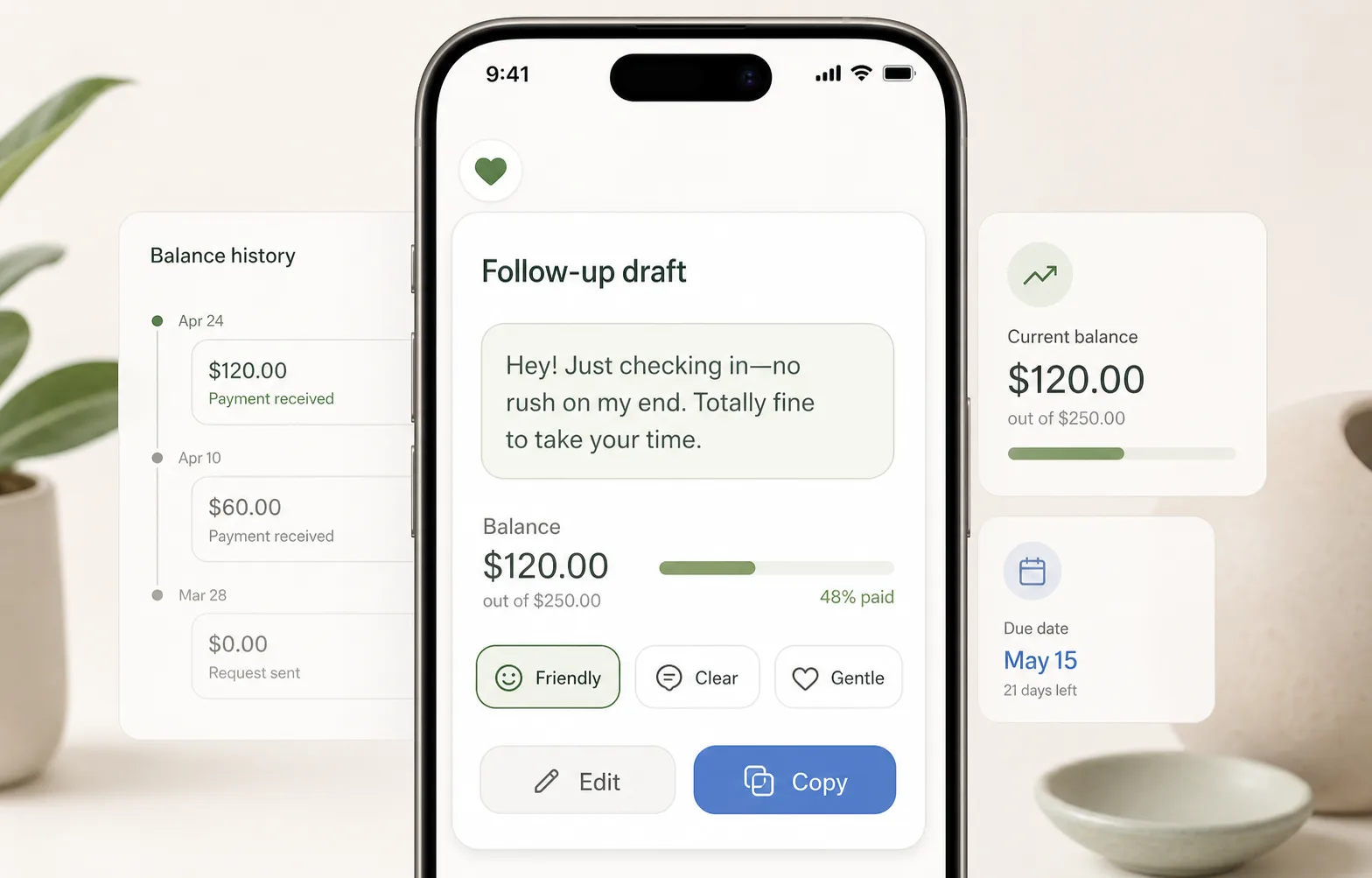
You stay in control. You Owe Me helps draft the wording, but it does not automatically send messages.
Live Link
Share the balance without asking everyone to install another app
Some money situations do not need a shared group record. You may simply need to keep an accurate balance yourself and show the other person the details when it matters.
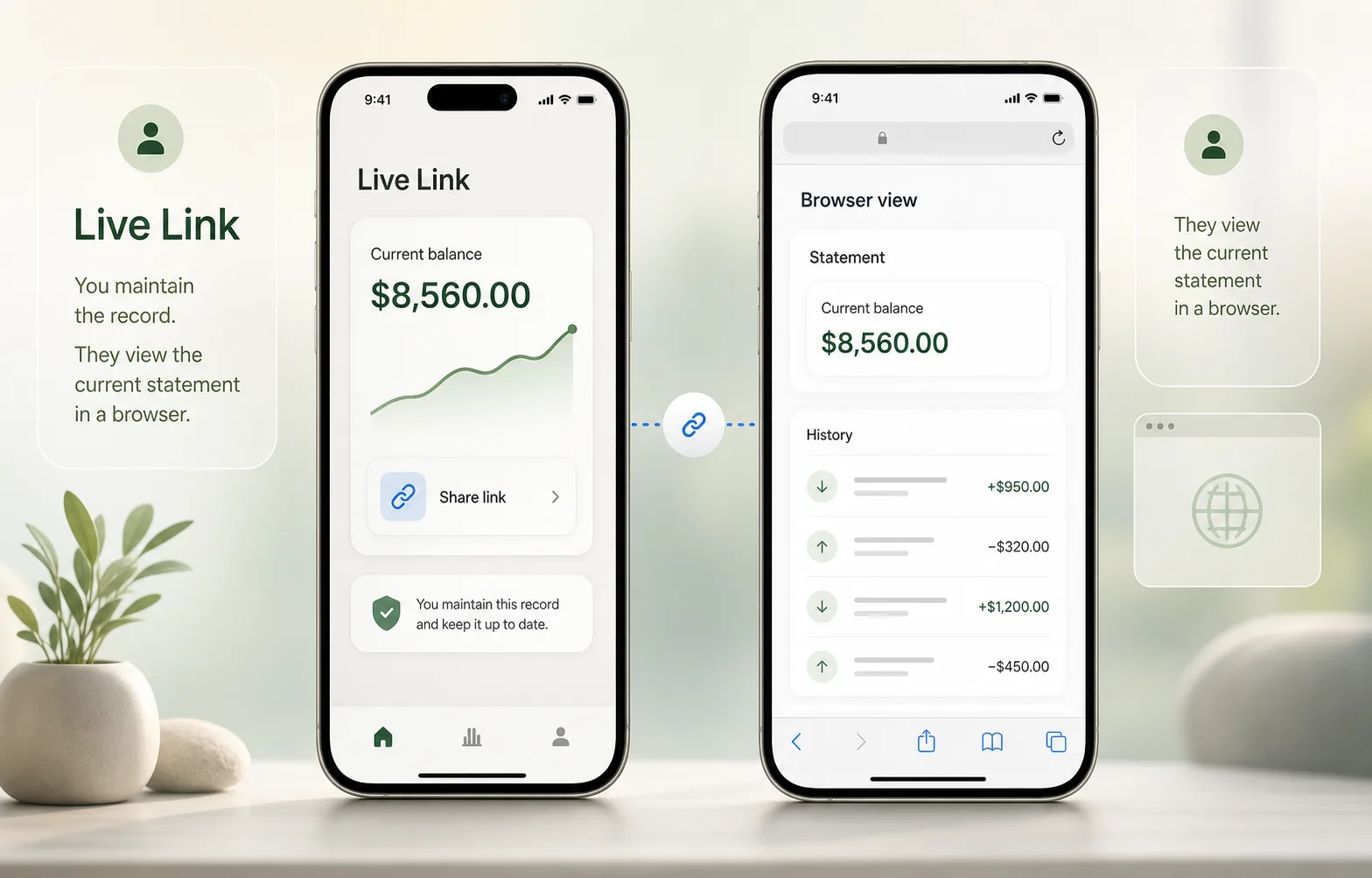
With Live Link, You Owe Me lets you share a current statement in the browser, so the other person can see the balance and history without installing You Owe Me.
For the broader decision, read how one person can track shared money without everyone installing the same app.
Example
You paid for groceries, pharmacy items, and a subscription for a family member. Instead of sending screenshots or rewriting the list in chat, share one current Live Link so they can see what is still open.
Choose Live Link or Balance Sync
Use Live Link when one person maintains the balance and the other person only needs an always-current, read-only browser view without installing the app.
See one-person sharingBalance Sync
Use Balance Sync when exactly two people both use You Owe Me and want supported entries changed on either phone to stay aligned.
See Balance SyncRelationship Timeline
A money relationship history, not just an expense list
You Owe Me's Relationship Timeline is designed to answer the bigger questions: when the balance started, how it changed, whether repayment progress happened, whether a follow-up was already sent, whether a statement was shared, and whether the balance is now settled.
It turns entries, loans, statements, and money messages into one clear story for each person.
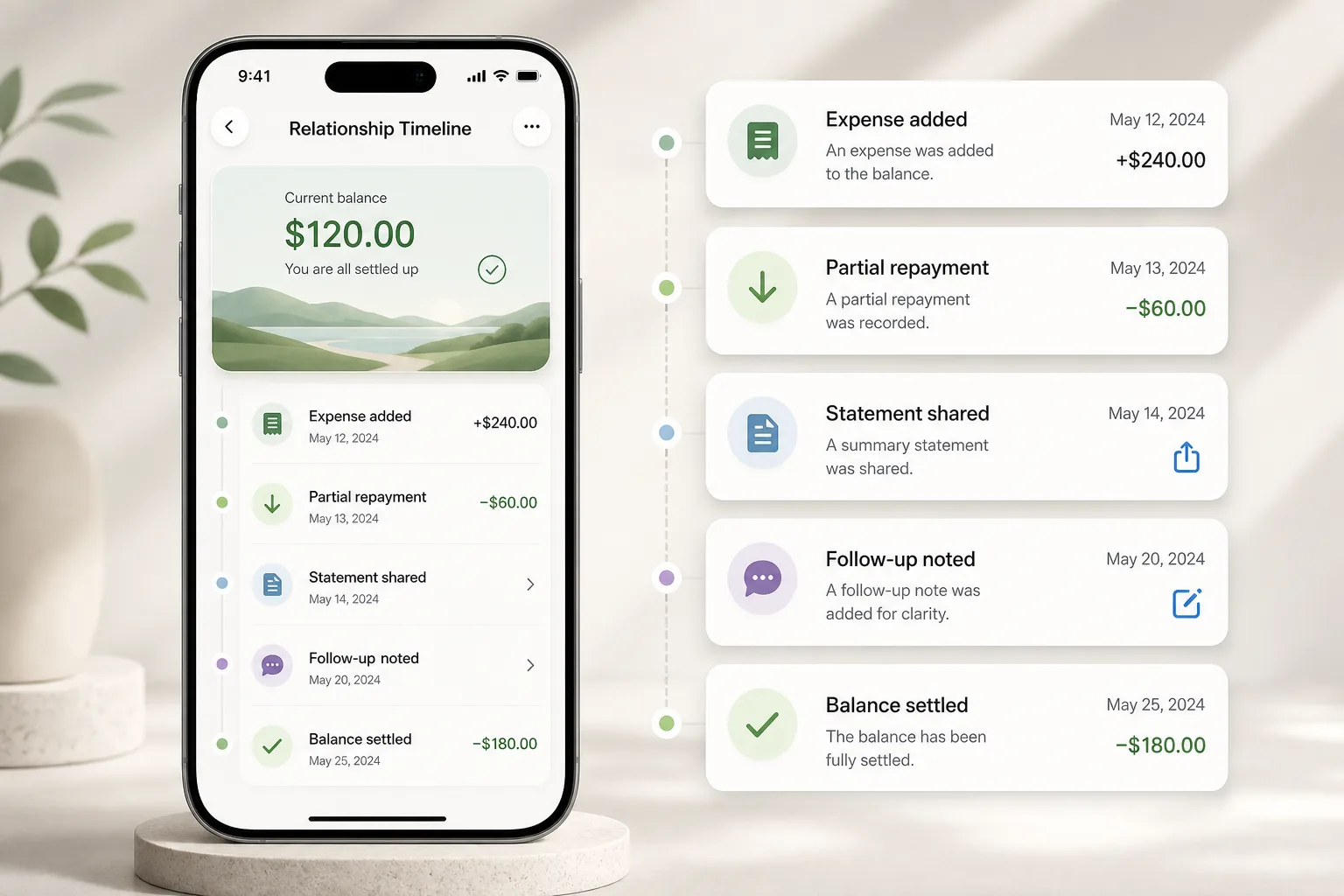
That context matters because money problems are rarely only arithmetic. They are also memory, timing, and communication.
Smart Money Check-Ins
Know when a reminder makes sense
Generic reminders can be too early, too late, or too blunt. You Owe Me can help surface when a follow-up or repayment update may make sense based on the actual relationship history: current balance, recent activity, repayment progress, reminders, promised dates, previous messages, and shared statements.
It does not pressure anyone or send messages for you. It is a calmer way to decide the next step.
You stay in control. You decide whether to act, edit, copy, share, or do nothing.
Balance Replay
Replay the balance instead of reconstructing it from memory
When a balance feels confusing, scroll back. Balance Replay lets the balance follow your history, showing who owed what around the entry you are viewing.
For entries with percentage interest, historical balances stay tied to the date being viewed, so the past is shown in the context of that moment. For fixed interest, the agreed extra amount stays attached to the entry without time-based calculation.
Running balances are the center of You Owe Me
You Owe Me is built around the running balance with each person. Every expense, repayment, partial repayment, recurring cost, and loan update changes the same relationship balance, so you can always see where things stand now. If you want the plain-English definition first, read what a running balance between two people means.
For one original amount repaid in parts, a Partial Repayment Calculator may be enough. For ongoing shared expenses or long-running balances, You Owe Me is built around the full history.
Private record first
Not every money situation needs a shared group ledger. Sometimes you need a private, accurate record first, then a clean statement or message when it is time to share context.
Balances can shrink, settle, or flip
You paid for them, they paid for you, someone repaid part, and the balance changed. The history stays inside one per-person record.
Built for sensitive relationships
Family, partners, friends, roommates, and informal clients often need clarity without making the relationship feel like a scoreboard.
Separate Loan Records for larger or longer-running balances
Some balances deserve their own focused record. In You Owe Me, a personal loan, rent deposit, repair, or larger purchase can live inside a separate Loan Record while still staying connected to the person’s full balance history.
When the loan needs a schedule, add a repayment plan. Compare lower-payment, balanced, and faster-payoff options, or build around a payment amount, target payoff date, or number of payments.
The plan uses the same balance and payment history as the loan. A smaller payment leaves the rest of the installment visible. A larger payment can move the plan ahead. Additional borrowing or corrections update the remaining schedule, projected payoff, and next reminder.
Interest can be left out, added as one agreed fixed amount, or calculated annually on the declining unpaid balance.
- Keep each named loan separate from everyday IOUs and other loans.
- Link repayments and updates to the right record.
- Choose a realistic schedule and see what is due next.
- Let real payments update plan progress and the projected payoff.
- Keep the person’s full balance accurate at the same time.
Where each app fits best
| Situation | Splitwise | You Owe Me |
|---|---|---|
| Group trip where everyone wants to add expenses | Usually the better fit | Good if one person is keeping the record; not a collaborative group ledger |
| One person paid for a shared dinner, taxi, tickets, or groceries | Good fit | Strong fit: Quick Split for simple splits; Group Payback if you need to track payback progress |
| One person paid for a group gift, tickets, deposit, dinner, or booking and wants to track paybacks | Good if the whole group wants a shared ledger | Strong fit: Group Paybacks show who paid, partly paid, and still owes while each person’s balance stays correct |
| Ongoing IOU with one person | Can track balances | Strong fit: running balance, history, follow-ups |
| Family reimbursements | Possible if everyone participates | Strong fit: private record, statements, Live Link |
| Elderly parent expenses | Not the clearest fit | Strong fit: one person can keep records and share context |
| Roommate bills over time | Strong for shared roommate groups | Strong when one person pays often, splits shared bills, and needs per-person balances plus follow-ups |
| Couple spending | Useful for shared splitting | Strong when shared costs need clarity without turning the relationship into a scoreboard |
| Partial repayments | Can record settlements | Strong fit: repayments stay inside the running balance and history |
| Awkward follow-up | Can show what is owed | Strong fit: message generation and timing context |
| Other person does not want another app | Less central to the model | Strong fit: you can maintain the record and share a Live Link |
| Long-term balance | Possible | Strong fit: Timeline, Balance Replay, statements, recurring entries |
| Personal loan with a repayment schedule | Not the main focus | A named loan plus an optional plan that updates after partial, extra, or changed payments |
| Two people both want to update one ongoing balance | Strong when the balance belongs inside a broader collaborative expense ledger. | Strong fit with Balance Sync: exactly two users can privately keep supported entries aligned across both apps. |
Feature comparison
| Feature | Splitwise | You Owe Me |
|---|---|---|
| Collaborative group expense ledger | Excellent | Not the main model. Balance Sync connects one supported balance between exactly two users; it is not a group ledger. |
| Split one shared expense into per-person balances | Excellent | Strong: equal splits, custom amounts, and clean separate entries |
| Track payback progress for one shared cost | Part of the group ledger model | Group Paybacks: track who paid, partially paid, and still owes, while keeping per-person balances |
| One shared cost organized without a collaborative group ledger | Not the main model | Strong: one person keeps the record and each person’s share stays tied to their own balance |
| Uneven or custom split amounts | Strong | Strong: visual adjustment for quick splits and manual exact amounts for precision |
| One running balance per person | Available through balances | Core product idea |
| Separate records for specific loans or repayment plans | Not the main focus | Loan Records keep a specific balance in its own view while linked entries still update the full person balance |
| Loan-linked repayment plans that adapt to actual payments | Not the main focus | Compare payoff options, follow installment progress, and update the schedule, payoff, and next reminder after partial or larger payments |
| Interest on money owed | Not the main focus | Supports percentage interest over time or one fixed interest amount added once |
| Private record managed by one person | Less central | Strong |
| Follow-up message generation | Not the main focus | Built in with Money Conversations |
| Repayment update messages | Not the main focus | Built in |
| Ask-for-loan messages | Not the main focus | Built in |
| Timeline of money and communication events | Expense history | Relationship Timeline with entries, loans, statements, Live Links, and money-message events |
| Share current balance without app install | Not the main positioning | Strong fit: one person maintains the record and shares an always-current Live Link without requiring the other person to install the app. |
| Private two-way balance between exactly two users | Available through its broader collaborative expense model rather than a relationship-only mode. | Balance Sync keeps supported entries aligned while each person retains a separate record and perspective. |
| Balance replay while scrolling history | Not the main positioning | Balance Replay |
| Family reimbursements / parent expenses | Possible | Strong fit |
| Long-running IOUs and partial repayments | Possible | Strong fit |
| Group trips where everyone participates | Strong fit | Better when one person keeps the record; not a collaborative shared ledger |
When Splitwise is probably better
Balance Sync makes You Owe Me much stronger for exactly two people, but it does not change the recommendation for a collaborative group. Splitwise is still usually the better fit when several people need to add expenses, manage a shared workspace, or settle across the group.
- Everyone wants to participate in the same shared expense record.
- Several people need to add expenses themselves.
- You need several people to add their own expenses to the same group over time.
- You want borrower-to-borrower settlement inside the group rather than one person tracking what others owe them.
- The main goal is a collaborative group ledger, not one person keeping the record.
- You need broad cross-platform group participation.
- Group-level expense organization, spending categories, charts, or payment integrations matter more than personal follow-up messages.
- The situation ends when the group settles, and you do not need a long per-person money history afterward.
When You Owe Me is probably better
You Owe Me is the better fit when the money relationship continues over time and the hard part is keeping the context clear.
- You want to split a shared expense and turn it into clean per-person balances.
- You paid for a group gift, tickets, dinner, deposit, or booking and want to track each person’s payback status.
- You want one shared cost organized without asking everyone to join a collaborative ledger.
- You want partial paybacks to stay connected to each person’s running balance.
- You want one running balance with each person.
- You have a larger or longer-running loan that needs its own record while still staying part of the person’s full balance.
- You are the only person who wants to maintain the record.
- The other person does not want to install another app.
- You need to handle partial repayments without losing the story.
- You want to share a current statement through a Live Link.
- One person wants to keep the record and share an always-current Live Link without requiring the other person to install the app.
- Exactly two people want one ongoing balance updated from either phone.
- You want private two-way balance activity without creating a group workspace.
- Each person should retain a separate record and see the balance from their own perspective.
- You want offline changes to synchronize after connectivity returns.
- You want explicit conflict resolution instead of silent overwrites.
- You need calmer follow-up or repayment-update wording.
- You want to know when a reminder makes sense.
- You are tracking family reimbursements, parent expenses, roommate bills, partner spending, shared meals, tickets, trip costs, or long-term IOUs.
- You want a timeline of entries, repayments, statements, and money messages.
Scenario walkthroughs
A friend paid part after a shared expense
You paid $86 for tickets and dinner. In You Owe Me, you can split the original shared cost, save your friend's share into their balance, and record the $40 they sent later. The problem is no longer only the original split — it is what remains, whether they already saw the details, and how to follow up without sounding pushy.
Splitwise angle: A collaborative shared expense app can show the group expense and settlement.
You Owe Me angle: You Owe Me keeps the split, the partial repayment, the remaining balance, and the follow-up context inside that person's running history. If needed, you can share a statement or Live Link instead of rewriting the details in chat.
You paid once for several people
You covered a taxi, groceries, a meal, or tickets for several people. You do not want to create the same entry by hand again and again.
You Owe Me angle: Create one Split Entry, include yourself if needed, choose equal or custom shares, and save. You Owe Me creates the correct separate entries so every person's balance stays accurate.
You paid for a group gift and people repay at different times
You paid $120 for Nina’s birthday gift. Four people agreed to share it. Two people sent their full share, one person sent part, and one person has not paid yet.
Splitwise angle: A collaborative expense app can put the gift inside a group ledger if everyone wants to participate there.
You Owe Me angle: A Group Payback keeps the gift together so you can see who paid, who partially paid, and who still owes. At the same time, each person’s share and repayment still stays connected to their own balance history, so the real money record remains personal and accurate.
One person has a separate loan and everyday IOUs
You lent someone money for a rent deposit, but you also pay for small shared things sometimes. In You Owe Me, the rent deposit can stay inside its own Loan Record while groceries, tickets, and partial repayments still appear in the full balance with that person.
You pay for family purchases over time
You buy medicine, groceries, subscriptions, or appointments for a parent or family member. Some items are reimbursed, some are not, and the other person may not want to manage a shared expense app.
You Owe Me angle: You keep the record privately, then share a clear statement when needed.
One roommate pays first most of the time
Rent, internet, utilities, groceries, and household supplies do not always land evenly. One person often pays first, another repays later, and partial repayments make chat history messy.
You Owe Me angle: You Owe Me keeps the running balance and helps turn the remaining amount into a calm message.
Related You Owe Me resources
If you are comparing collaborative shared expense apps with You Owe Me, these pages help you choose by feature, relationship, or starting point.
Frequently asked questions
Is You Owe Me a Splitwise alternative for ongoing expenses, not just trips?
Yes, when the important job is an ongoing balance, repayment history, partial repayments, reminders, or clearer communication. One person can keep the record and share an always-current Live Link, or exactly two users can privately connect one balance with Balance Sync. Splitwise remains stronger for collaborative groups where several people add and manage expenses in one shared ledger.
What is the difference between a ledger and Splitwise?
A ledger is a record of balances, repayments, and history over time. Splitwise is a collaborative splitting and group-expense product. You Owe Me behaves more like a personal money ledger for real-life IOUs, repayment history, follow-ups, and shareable context.
Can I use You Owe Me as a Splitwise alternative for small business?
You Owe Me can help with simple client payment records, informal balances, and repayment follow-up context. See the simple client payment records workflow for more detail. It is not accounting, invoicing, tax, payroll, or bookkeeping software.
Is You Owe Me better than Splitwise?
It depends on the workflow. Splitwise is usually better for collaborative group expense ledgers, especially trips and households where several people add expenses. You Owe Me is stronger for per-person running balances, repayment history, Group Paybacks, Live Links, calmer follow-ups, and private two-way Balance Sync between exactly two users.
Can You Owe Me split expenses like Splitwise?
Yes. Quick Split creates clean per-person entries, and Group Paybacks track one shared cost until everyone pays. For an ongoing balance between exactly two app users, Balance Sync lets either person add or update supported connected entries. You Owe Me still does not provide a full collaborative group ledger where several people manage one shared workspace.
Does You Owe Me have group payback tracking?
Yes. Group Paybacks are for situations where you paid for one shared thing - like a group gift, tickets, dinner, deposit, or booking - and want to track who paid, who partially paid, and who still owes. It keeps the shared cost organized while each person's real balance stays in their own history.
Is Group Payback the same as a Splitwise group?
No. Group Payback is not a full collaborative group ledger. It is best when you paid for the group and want to track paybacks from each person. Splitwise is usually better when several people need to add expenses, edit the same group record, or settle with each other inside one shared ledger.
Can I use You Owe Me if the other person does not install the app?
Yes. One person maintains the record in You Owe Me, while the other person opens one always-current, read-only browser link to see the latest balance and history. The viewer does not need the app or an account.
Can both people add and update entries in You Owe Me?
Yes, for a supported balance connected with Balance Sync. Exactly two authenticated You Owe Me users can add, edit, archive, or delete connected entries from either phone. This does not apply to Group Paybacks and is not a multi-person group ledger.
Is Balance Sync the same as a Splitwise group?
No. Balance Sync privately connects one supported balance between exactly two users. It does not create a group workspace, support several participants, merge existing person records, or synchronize Group Payback activity.
Does Live Link still work without the other person installing the app?
Yes. One person maintains the record in You Owe Me, while the other person opens one always-current, read-only browser link to see the latest balance and history. The viewer does not need the app or an account.
Is You Owe Me only for loans?
No. You Owe Me can track loans, but it is also useful for IOUs, shared expenses, family reimbursements, roommate bills, couple spending, recurring costs, partial repayments, and long-running balances between people.
Does You Owe Me automatically send reminders?
No. You stay in control. You Owe Me can help you see when a follow-up or repayment update may make sense and can help draft the message, but you choose what to send.
What makes You Owe Me different from a normal expense splitter?
A normal expense splitter focuses on calculating who owes what. You Owe Me can split shared expenses too, but it also keeps the result inside a per-person running balance with repayment history, statements, Live Links, reminders, and money-message context. It is designed for money relationships that keep changing after the first split.
When should I still use Splitwise?
Use Splitwise when several people need to join one shared ledger, add expenses themselves, manage group costs, and settle across the group. Use You Owe Me when the important job is a durable per-person balance, repayment history, reminders, communication, an always-current Live Link, or a private Balance Sync connection between exactly two people.
Can You Owe Me help with awkward repayment conversations?
Yes. Money Conversations can help generate follow-up messages, repayment updates, and ask-for-loan messages based on the real balance and history, so the message has context instead of sounding vague or emotional.
Can You Owe Me track partial repayments?
Yes. Partial repayments are part of the running balance history, so the balance can shrink, settle, or even flip direction as money moves between people.
Can You Owe Me track a separate loan inside a person’s balance?
Yes. A Loan Record keeps one named loan and its real remaining balance separate while linked entries still update the full balance with that person. You can add a repayment plan that recalculates the remaining schedule, projected payoff, and next reminder after partial or larger payments.
Choose the tool that matches the record you need
If everyone needs to add group expenses to one shared ledger, Splitwise may be the better fit. If one person needs to keep IOUs, named loans, partial repayments, or a repayment plan tied to the changing balance, You Owe Me is designed for that kind of record.
Updated