Roommate money guide
How to Split Rent, Utilities, and Groceries With Roommates Without Confusion
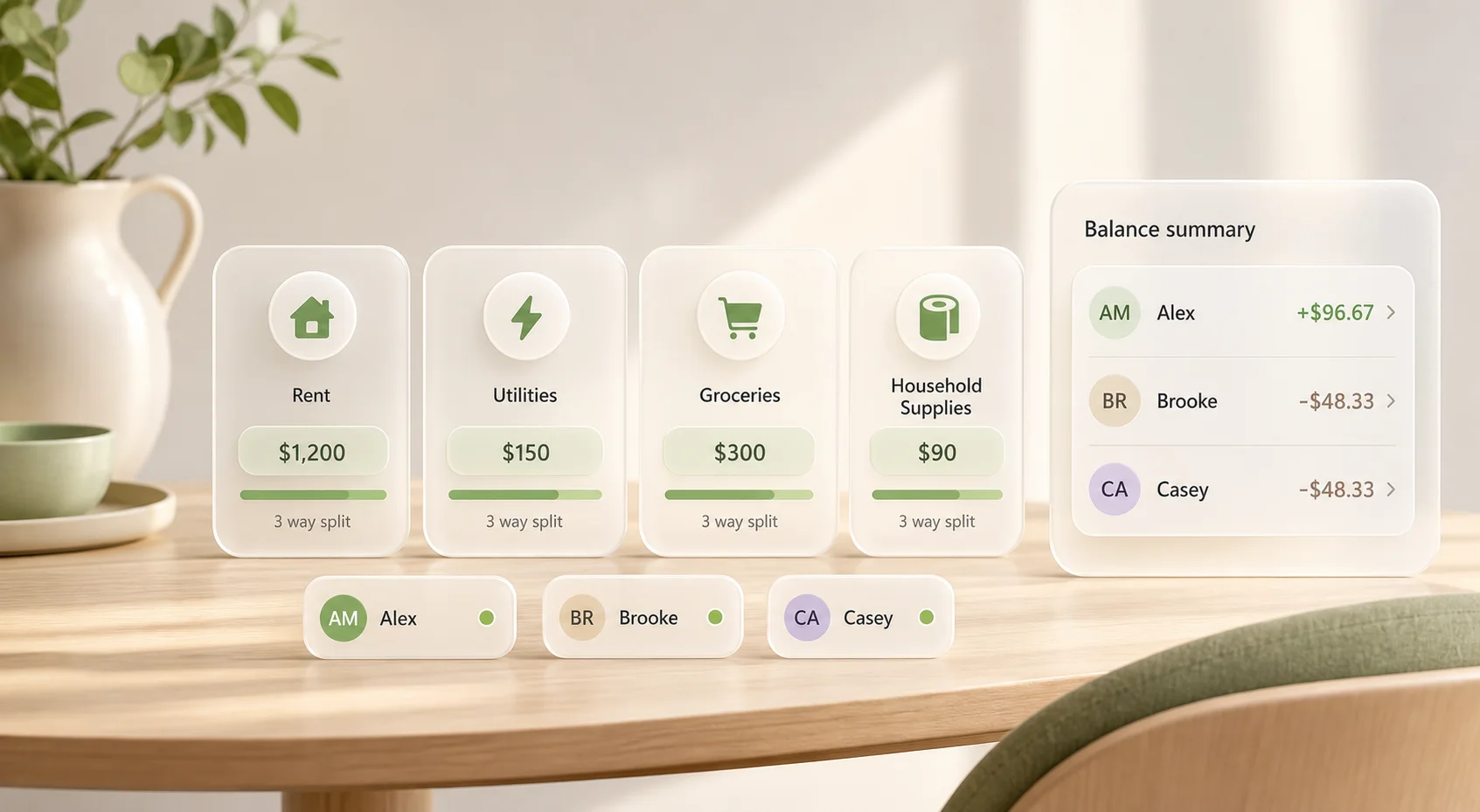
To split roommate bills fairly, start by deciding which costs are shared, who is included in each cost, and whether each bill should be split equally or by custom shares. Rent, utilities, groceries, and household supplies often need different rules — and the clearest system is the one everyone can understand later.
The goal is not to track every tiny detail forever. The goal is to agree on simple rules, count repayments clearly, and avoid rebuilding the month from chats, receipts, and memory.
Direct answer
The simple rule
To split rent, utilities, and groceries with roommates fairly, decide three things before calculating: what counts as shared, who was included, and whether the cost should be split equally or by custom shares. Rent may need custom shares, utilities are usually split evenly, and groceries should only be split between the people who actually shared them.
The most common mistake is treating every household cost the same. Rent, electricity, internet, shared groceries, personal food, cleaning supplies, subscriptions, and repayments all behave differently. A fair roommate system keeps those differences clear without turning the apartment into an accounting project.
Rule of thumb
Split shared household costs by agreement, not by memory. Record who paid, who was included, what rule applies, and whether any repayment already happened.
If the rules are already clear and you need a long-term record, use the full guide on how to track money between roommates.
This guide is for everyday household cost sharing, not legal, rental, tax, or accounting advice.
The fair roommate bill-splitting rule
A fair roommate split is not always an equal split. Equal is simple, but fair means the split matches how the cost was actually shared.
Define the bill
Rent, electricity, groceries, internet, cleaning supplies, repairs, or something else.
Choose who is included
Only include the roommates who actually shared or agreed to share that cost.
Choose equal or custom shares
Use equal shares for simple shared costs. Use custom shares when rooms, usage, or agreements are different.
Count repayments separately
A repayment is not a new bill. It reduces what someone still owes.
What should roommates split equally?
Some roommate costs are naturally shared by the whole household. Others should only include the roommates who used them, agreed to share them, or caused them.
| Cost | Usually split how? | Notes |
|---|---|---|
| Rent | Equal or custom shares | Equal rent is simple if rooms are similar. Use custom shares when one room is larger, has a private bathroom, includes parking, or a couple shares one room. |
| Electricity | Equal | Usually shared by everyone unless one person was away for a long time or the household agreed on a different rule. |
| Water | Equal | Often split equally unless usage is clearly different and everyone agrees to another method. |
| Internet | Equal | Usually shared by everyone who uses the connection. |
| Shared groceries | Only people who shared them | Do not split personal food equally. Shared staples, group meals, and agreed household groceries can be split. |
| Cleaning supplies | Equal | Toilet paper, trash bags, detergent, dish soap, cleaning spray, and kitchen basics are usually household costs. |
| Subscriptions | Only users included | Split only among roommates who agreed to use the subscription. |
| Repairs or damage | Case by case | Use a clear agreement. Do not automatically split damage that belongs to one person. |
| Move-out costs | Case by case | Include final utilities, unpaid shared bills, deposits, repairs, and previous balances only if everyone understands the basis. |
| Repayments | Not split | Record repayments separately. They reduce an existing balance. |
How to split rent when rooms are different
Rent is the one roommate cost where equal splitting is not always the fairest choice. If the rooms are similar, equal rent keeps things simple. If one person has a larger room, private bathroom, parking space, balcony, office space, or another clear advantage, custom rent shares may feel fairer.
Simple options for uneven rent
Equal split
Best when rooms and access are similar.
Room-size split
Useful when one bedroom is clearly larger.
Benefit-based split
Useful when one person has a private bathroom, parking, or extra storage.
Couple-in-one-room split
Decide whether the couple pays one room share, a larger share, or a per-person share for utilities. Do not leave this vague.
Agreement-based split
The best rule is the one everyone accepts before the bill is due.
The rule matters less than consistency. A rent split that everyone understands is usually better than a mathematically perfect split that creates tension every month.
How to split utilities with roommates
Utilities are usually easiest to split equally because everyone benefits from the household being powered, connected, and functional. Electricity, water, gas, internet, and trash service usually belong in the shared household category.
When equal split is usually fine
- Everyone lives there full time.
- Usage is roughly normal.
- The bill covers the whole apartment.
- No one agreed to special treatment.
When you may need a different rule
- One roommate was away for several weeks.
- One person uses unusually high electricity for work, equipment, or air conditioning.
- A bill includes a fee or charge caused by one person.
- Someone moved in or out mid-cycle.
- The household already agreed to custom shares.
Example
Three roommates split a $150 electricity bill equally, so each person’s share is $50. If Maya paid the full bill, Alex owes Maya $50 and Sam owes Maya $50.
When someone was away: separate fixed charges from usage
An absence does not make every household cost disappear. Rent, internet, standing charges, service fees, and other unavoidable costs may stay fixed even when one roommate is away. Electricity, water, or gas may have a usage-based portion that changes with time at home.
If the household wants an adjusted estimate, agree on the fixed portion first and apply the normal household rule to it. Then allocate only the usage-based portion using days present. Days are a practical proxy, not proof of exact consumption: appliances, heating, cooling, and other people may still affect the bill.
An agreed usage weight can help when everyone accepts that one person’s likely use was meaningfully different. A weight of 1 is the neutral starting point; a larger or smaller weight is an assumption chosen by the household, not a meter reading or a judgment about who is right.
Handle a temporary occupant explicitly too. Either give the guest a visible share they pay directly, or calculate that share separately and assign it to a named host. Do not let a guest share disappear into the total or silently make the person a permanent roommate on unrelated bills.
Use the calculator to calculate fixed and usage-based bills when someone was away. It shows the fixed amount, usage amount, days, weights, temporary-occupant share, and the assumptions behind the estimate.
No method is universally fair, and this kind of estimate does not determine lease, contract, deposit, or legal responsibility. Agree on the rule before treating the result as the household settle-up.
How to split groceries without making it weird
Groceries cause roommate tension because not every grocery bag is a household grocery bag. One person’s snacks, protein powder, coffee, or special food should not automatically become a shared bill. The cleanest rule is to separate shared groceries from personal groceries.
Usually shared
- Basic cooking ingredients everyone uses
- Shared meals
- Cleaning/kitchen basics bought during a grocery run
- Agreed household staples
- Groceries for a planned group dinner
Usually personal
- Snacks only one person eats
- Special diet foods
- Alcohol unless agreed
- Supplements or protein powder
- Personal toiletries
- Food bought for guests unless agreed
If a grocery receipt mixes shared and personal items, only add the shared portion to the roommate split. This is more accurate and usually less awkward than splitting the whole receipt and hoping nobody notices.
Example
Sam spends $120 at the grocery store. $80 was shared household food and $40 was personal. Only the $80 should go into the roommate split. If Maya, Alex, and Sam all share that $80, each person’s share is $26.67.
If you only need to divide one grocery run or one simple purchase, the Split Expense Calculator is enough. Use the roommate calculator when several household bills need to be counted together.
What if one roommate pays first?
In many households, one roommate pays rent, another pays internet, and someone else buys groceries. That is normal. The important part is to track who paid first and who still needs to contribute.
If Maya pays a $1,800 rent bill for three roommates, each roommate’s share is $600. Maya already covered her own $600 share, so Alex owes Maya $600 and Sam owes Maya $600.
Do not ask the payer to remember everything at the end of the month. The record should do the remembering.
What if someone already repaid part of their share?
A repayment should reduce the balance, not create a second round of confusion. Count repayments separately from bills.
Maya paid $1,800 rent. Alex’s share was $600. Alex already sent $250. Alex still owes Maya $350.
| Item | Amount |
|---|---|
| Alex’s rent share | $600 |
| Already repaid | -$250 |
| Still open | $350 |
This is why repayments should not be mixed into the grocery or utility rows. They are payments against the balance.
A complete roommate monthly example
Here is how one month can look when different roommate costs use different rules. This example is a ledger, not a full calculator.
Four roommates: Maya, Alex, Sam, and Jordan. Rent is $2,400. Maya has the largest room and pays a $750 share. Alex, Sam, and Jordan each have a $550 rent share. Internet is $80 split equally. Electricity is $160 split equally. Groceries are $180, but only Maya, Alex, and Sam shared them. Cleaning supplies are $60 split between all four. Maya paid rent. Alex paid internet. Sam paid groceries. Jordan paid electricity and cleaning supplies. Alex already sent Maya $200 toward rent.
| Bill | Paid by | Amount | Included roommates | Split rule |
|---|---|---|---|---|
| Rent | Maya | $2,400 | Maya, Alex, Sam, Jordan | Custom rent shares |
| Internet | Alex | $80 | All four | Equal |
| Electricity | Jordan | $160 | All four | Equal |
| Shared groceries | Sam | $180 | Maya, Alex, Sam | Equal among three |
| Cleaning supplies | Jordan | $60 | All four | Equal |
| Repayment | Alex → Maya | $200 | Already paid | Reduces Alex’s balance |
Before simplification
- Alex still owes Maya $350 for rent after the $200 repayment.
- Sam owes Maya $550 for rent.
- Jordan owes Maya $550 for rent.
- For internet, Maya owes Alex $20, Sam owes Alex $20, and Jordan owes Alex $20.
- For electricity, Maya owes Jordan $40, Alex owes Jordan $40, and Sam owes Jordan $40.
- For groceries, Maya owes Sam $60 and Alex owes Sam $60.
- For cleaning supplies, Maya owes Jordan $15, Alex owes Jordan $15, and Sam owes Jordan $15.
What matters
After everything is counted and repayments are included, the household can settle with a short list instead of every person paying every other person. The exact simplified result is what the Roommate Bill Split Calculator is for.
Calculate this month’s roommate billsA simple roommate bill agreement template
The easiest time to prevent roommate money tension is before the bill arrives. You do not need a formal contract for every household, but you do need shared rules that everyone understands.
Copyable roommate bill agreement
Here's how we'll handle shared household costs:

Rent: [Equal split / custom shares / room-based shares]
Utilities: [Electricity, water, gas, internet split equally unless agreed otherwise]
Groceries: [Only shared groceries are split. Personal food is not included.]
Household supplies: [Cleaning supplies, trash bags, toilet paper, kitchen basics split equally]
Subscriptions: [Only split subscriptions that everyone included agrees to use]
Repayments: [Repayments are recorded separately and reduce the open balance]
Settle-up schedule: [Weekly / monthly / after each major bill / before move-out]
If someone already paid: [The amount already sent is counted before calculating what remains]
If someone moves out: [Final utilities, deposits, repairs, unpaid bills, and previous balances are counted before the final settle-up]
Common roommate bill mistakes
Splitting all groceries equally
Only split shared groceries. Personal food should stay personal unless everyone agreed otherwise.
Treating repayments like expenses
A repayment is money reducing a balance. It should not be added as another shared bill.
Letting one person become the unpaid household bank
If one roommate often pays first, the household needs a clear settle-up rhythm.
Starting fresh every month when last month was not settled
If someone still owed money, carry that running balance forward clearly.
Using group chat as the only record
Chats are useful for discussion, but they are not a reliable ledger. Numbers get buried.
Avoiding the conversation until it feels personal
Small bills are easier to discuss while the record is still clear.
When a one-time calculator is enough
A calculator is enough when you only need to settle one month, one move-out period, or one clean set of bills. The Roommate Bill Split Calculator is especially useful when everyone is ready to settle now and you do not need a long-term history.
- You have the bills.
- You know who paid.
- You know who was included.
- Repayments are clear.
- Everyone is settling now.
- You do not need reminders.
- You do not need to carry this into next month.
If the costs will repeat and one person wants to maintain a manual file, open the Roommate Expense Tracker Spreadsheet. It keeps agreed shares, repayments, opening positions, and monthly summaries separate.
Ongoing roommate money
When an ongoing roommate balance helps
A running balance helps when roommate costs keep changing. Instead of rebuilding the whole month each time, each new bill or repayment updates the current balance. If the idea is new, read what a running balance means first.
- Rent, utilities, groceries, or supplies repeat every month.
- One roommate often pays first.
- Partial repayments happen.
- Old balances carry forward.
- Someone needs reminders.
- You want a clear history before asking.
- You want the next message to be based on real numbers, not memory.
You Owe Me is built for the ongoing version of roommate money: shared bills, repayments, recurring costs, reminders, and a clear running balance between real people. For the product workflow, see how the Roommate Expense Tracker keeps roommate expenses clear over time.
When this keeps happening, use You Owe Me
A one-time calculator is useful for one monthly settle-up. You Owe Me is better when rent, utilities, groceries, repayments, and old balances keep changing over time.
Copyable roommate settle-up messages
Once the number is clear, the message can stay short. A good roommate money message should name what was counted and what remains, without turning it into a personal accusation. For more wording help, use the Polite Payback Reminder Generator or browse Repayment Reminder Text Examples.
Frequently asked questions
What is the fairest way to split bills with roommates?
The fairest way is to decide what counts as shared, who was included in each cost, and whether the cost should be split equally or by custom shares. Utilities and household supplies are often split equally, rent may need custom shares, and groceries should only include people who shared them.
Should roommates split rent equally?
Roommates can split rent equally if rooms and benefits are similar. If one person has a larger room, private bathroom, parking space, or a couple shares one room, custom rent shares may be fairer.
How should roommates split utilities?
Utilities are usually split equally because everyone uses the household. A different rule may make sense if someone moved in mid-cycle, was away for a long time, caused a specific charge, or the household already agreed on custom shares.
Should roommates split groceries equally?
Only shared groceries should be split. Personal snacks, special diet food, supplements, alcohol, and personal items should not be included unless everyone agreed to share them.
What if one roommate pays all the bills?
Record each bill they paid, subtract their own share, and calculate what the other roommates still owe. The payer should not have to rebuild the month from memory.
How do you handle partial repayments from roommates?
Record partial repayments separately from expenses. The repayment reduces what that roommate still owes, but it should not be added as another shared bill.
How often should roommates settle bills?
Monthly settle-ups work well for many households because rent, utilities, and supplies often follow a monthly rhythm. Weekly can work for groceries or short-term stays. The most important part is choosing a schedule before the balance becomes confusing.
Is a spreadsheet enough for roommate bills?
A spreadsheet can work if the situation is simple and someone updates it consistently. It becomes harder when bills repeat, repayments happen later, old balances carry forward, or you need reminders and a clear mobile history.
What should roommates do when someone moves out?
Create a final settle-up that includes unpaid bills, final utilities, deposits or repairs if agreed, repayments already made, and any previous balance. Keep the summary factual so the move-out conversation is about the record, not memory.
Can You Owe Me track roommate rent, utilities, and groceries?
Yes. You Owe Me can track roommate shared expenses, repayments, recurring costs, reminders, and running balances, so ongoing household costs stay clear without rebuilding everything from chats and receipts.
Related resources
Related roommate tools and guides
Choose the next step based on whether you need rules, a one-month calculation, or ongoing roommate tracking.
Keep roommate bills clear before they become awkward
Roommate money is easier when the rules are clear before the bill arrives. Decide what is shared, count who paid, record repayments separately, and use one clear balance when the costs keep changing.
Use the calculator for one monthly settle-up. Use You Owe Me when rent, utilities, groceries, repayments, and old balances keep changing over time.
Published · Updated