Everyday shared-expense closeout
How to Settle Shared Expenses After a Breakup
If your relationship has ended but everyday shared expenses are still open, set one cutoff date and review only the costs both of you understood were shared. Count repayments already made, keep gifts, personal purchases, and disputed items outside the agreed total, then confirm the final balance in writing.
No app is required to use the closeout worksheet.
Use this guide for informal everyday expenses and reimbursements. It does not determine rights involving leases, property, joint accounts, formal debts, or legal obligations.
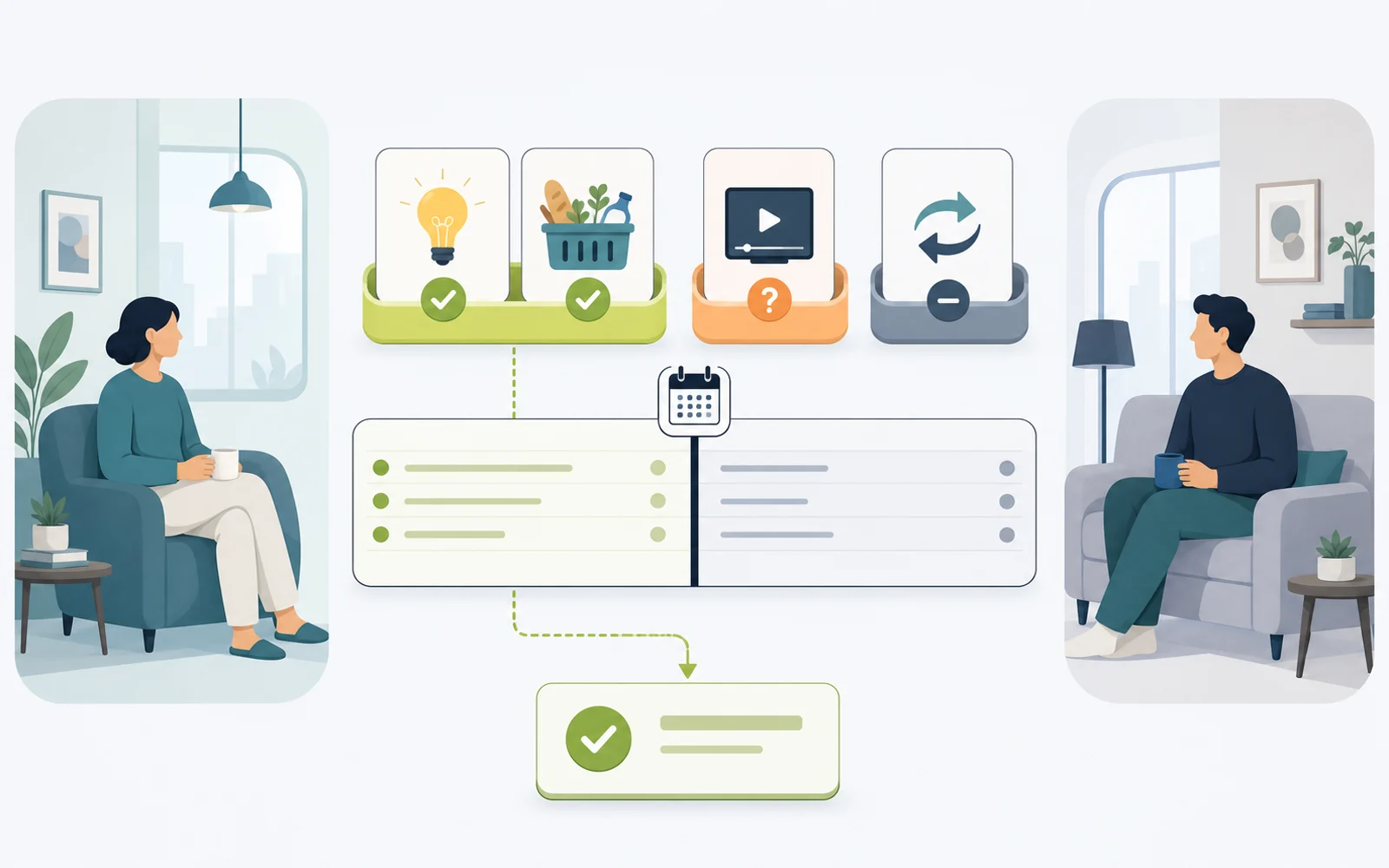
Use this page when the relationship has ended but shared expenses are still open
This closeout works best when both people can identify at least some costs that were understood as shared. The goal is not to re-price the relationship. It is to close a limited set of everyday expenses as clearly as possible.
Use this closeout workflow
Use the worksheet below when the relationship has ended, the issue concerns informal everyday expenses, and both people can identify at least some costs that were understood as shared.
Our transaction history does not match
Use the reconciliation guide when you agree that repayment was expected, but remember an expense, transfer, cash payment, credit, or correction differently.
Rebuild the disputed historyWe never agreed whether this money was repayable
Use the gift-or-loan guide when the real disagreement is whether past money was a gift, flexible support, ordinary uneven spending, or something expected to be repaid.
Clarify gift versus repayable moneyThe issue involves formal finances or ownership
This page cannot determine responsibility for a lease, security deposit, property, furniture, joint account, formal loan, asset, tax matter, or legal obligation. Those questions may require qualified local advice.
Direct contact may be unsafe
Do not prioritize completing an informal money worksheet over personal safety. You do not need to arrange a meeting or send these scripts when contact is unsafe, coercive, or threatening.
Set one cutoff date before reviewing the money
Choose the date after which new spending was no longer part of the shared arrangement. That may be the breakup date, the move-out date, the final day both people used the same household or service, or a specific transition date both people accept.
A bill can arrive after the cutoff and still cover time before it. A cost can also occur before the bill arrives but belong entirely to one person after the shared arrangement ended. Use the period the charge covers—not only the date printed on the statement.
The cutoff does not decide every item automatically. It gives the review a clear boundary so that new spending does not keep entering an arrangement that is supposed to be closing.
Confirm these dates first
- Relationship-ending or separation date
- Move-out or final shared-use date
- Last shared utility billing period
- Last shared subscription cycle
- Final expected refund or credit
- Date after which new spending is separate
- One final review date for any bill that has not arrived yet
Do not invent a legal rule from the cutoff. It is a practical boundary for this informal record.
Decide what belongs in the final closeout
An expense belongs in the agreed closeout because of what both people understood at the time—not because one person adds it later. Before including an item, check whether it was genuinely part of the shared arrangement.
Ask these six questions for every item
- Did both people understand this as shared at the time?
- Does it relate to the agreed shared period or transition?
- Was money actually paid, refunded, transferred, or credited?
- Has it already been settled another way?
- Is its treatment agreed rather than asserted only now?
- Can it be handled as an informal personal record without deciding formal legal rights?
When an answer is unclear, keep the item visible but mark it as disputed. Do not include it in the agreed total merely because one person believes it should count.
What usually belongs—and what should stay outside
| Item | Usually include when | Keep outside when |
|---|---|---|
| Final utility bill | Both people used the service during the covered period and accept the sharing rule. | The charge covers only one person’s later use, or the share itself is disputed. |
| Shared groceries or household supplies | They were bought during the shared period and were mutually treated as shared. | They were personal, a gift, or part of ordinary untracked flexibility. |
| Shared trip, booking, ticket, refund, or credit | Both people previously accepted the share and the final refund, transfer, or replacement contribution is known. | Responsibility itself was never agreed or depends on a formal contract dispute. |
| Subscription transition month | Both people continued using the service during an agreed transition period. | Only one person used or retained it after the cutoff. |
| Repayment or transfer | Both people accept the amount and what the payment covered. | Its purpose, date, or amount remains unclear. |
| Personal purchase | Only when both people clearly agreed it was a shared cost. | It was bought for one person or was never understood as shared. |
| Gift or ordinary generosity | Do not include it retroactively. | There was no shared understanding that it would be balanced or repaid later. |
| Chores, emotional harm, or relationship grievances | Never as expense rows. | Always keep them outside this money record. |
| Property, deposits, accounts, or formal debts | Outside this workflow. | These issues may require a different process or qualified local advice. |
If the real question is whether previous uneven spending was ever meant to be balanced, read what it means when one partner paid more.
Use the Shared-Expense Closeout Worksheet
The worksheet keeps accepted, excluded, disputed, already-settled, and after-cutoff items visible without treating them as the same thing.
Only accepted expenses, confirmed repayments, confirmed credits, and agreed corrections may change the final balance. Excluded, disputed, and after-cutoff items remain visible but do not affect the agreed total.
Worked example
Maya and Leo use July 5 as their cutoff. In this example, a positive balance effect means Leo owes Maya; a negative balance effect means Maya owes Leo. Use any currency that matches your own record.
| Date | Expense, payment, or credit | Why it may be shared | Paid by | Agreed share | Payment or credit already counted | Status | Agreed balance effect | Note |
|---|---|---|---|---|---|---|---|---|
| June 30 | Electricity bill | Both used the home during the covered month | Maya | $60 owed by Leo | $0 | Included | +$60 | Final full billing period before the cutoff |
| June 28 | Household groceries | Bought for the shared home | Maya | $40 owed by Leo | $0 | Included | +$40 | Previously treated as a shared purchase |
| July 3 | Streaming subscription | Both used the final subscription cycle | Leo | $12 owed by Maya | $0 | Included | −$12 | Shared through the agreed transition |
| July 4 | Transfer from Leo to Maya | Payment toward the accepted shared expenses | Leo | — | $50 | Already settled | −$50 | Counted before calculating what remains |
| July 6 | Furniture delivery | Bought for Maya’s new home | Maya | — | $0 | After cutoff | $0 | Created after the shared arrangement ended |
| May 20 | Restaurant bill | Maya now believes it should have been split | Maya | Not agreed | $0 | Disputed | $0 | Kept visible but outside the accepted total |
Example result
The accepted rows produce a final balance of $38 owed by Leo to Maya.
$60 + $40 − $12 − $50 = $38
The restaurant bill and furniture delivery remain visible, but neither changes the agreed total. This example does not decide whether the restaurant bill should have been shared.
Copy a blank worksheet
Duplicate the item block for each expense, payment, credit, refund, or correction you need to review.
SHARED-EXPENSE CLOSEOUT

People:
Person A:
Person B:

Dates:
Relationship-ending or separation date:
Agreed cutoff date:
Final review date:
Balance confirmed as of:

ITEM 1

Date or billing period:
Expense, payment, or credit:
Why it may be shared:
Paid by:
Agreed share:
Payment or credit already received:
Status: Included / Excluded / Disputed / Already settled / After cutoff
Agreed balance effect:
Note:

Duplicate the item block for each row.

SUMMARY

Confirmed shared additions:
Confirmed repayments or credits:
Agreed corrections:
Excluded items:
Disputed items:
Agreed final balance:
Who owes whom:
Next payment date, if any:
Closure confirmed on:
Copy a closeout summary
Use this after the accepted rows have been reviewed. Do not present disputed items as part of the agreed total.
SHARED-EXPENSE CLOSEOUT SUMMARY

Agreed cutoff date:
Balance confirmed as of:

Confirmed shared additions:
Confirmed repayments or credits:
Agreed corrections:
Items excluded from the balance:
Items still disputed:
Agreed final balance:
Who owes whom:
Next payment date, if any:
Closure confirmed on:
Handle the situations that usually cause confusion
A bill spans the cutoff date
Separate the period before and after the cutoff only when both people agree that a time-based split reflects their actual use or prior arrangement. Do not present a prorated amount as agreed when the method itself is disputed.
A subscription renews during the transition
Confirm who used the final cycle, who kept the account, and whether both people understood that cycle as shared. A renewal after the cutoff does not automatically belong in the closeout.
A refund or credit arrives later
Record the refund or credit as a separate dated row. Do not silently replace the original charge or erase the payment history.
One person already paid part of the final amount
Add the transfer before calculating what remains. After the payment is confirmed, keep a short record of how much was received and whether anything is still open.
A transfer exists, but its purpose is unclear
Keep the transfer disputed or unverified until both people agree what it covered. A bank transfer proves that money moved; it does not automatically explain why.
One person paid much more during the relationship
Do not automatically convert all previous uneven spending into a debt. Include only expenses both people understood would be balanced or repaid later.
One final bill has not arrived
Mark it as pending rather than estimating it as an agreed fact. Set one final review date and close the rest of the accepted balance separately when practical.
Calculate only the accepted rows
A calculator can total the numbers. It cannot decide whether an expense belongs in the closeout. Enter only the rows you have accepted.
One final set of partner expenses
Calculate the final partner balance
Use the Couple Shared Expense Balance Calculator when the included expenses, the sharing method, and the payments already made are agreed.
Calculate the final partner balanceExpenses and repayments happened in order
Calculate the agreed rows in date order
Use the Running Balance Calculator when the sequence matters or the balance changed as expenses, credits, and repayments occurred.
Calculate the agreed rows in orderOne accepted amount was repaid in parts
Calculate what remains after partial payments
Use the Partial Repayment Calculator when the starting amount is agreed and you only need to count confirmed partial repayments.
Calculate the remaining balanceSend one calm closeout message
Keep the message short. The worksheet holds the detail. The message should explain the cutoff, the accepted total, and what happens next without reopening the whole relationship.
Invite a review
I would like to close the remaining everyday shared expenses clearly. Can we use [date] as the cutoff and review only the costs we both understood were shared?
Confirm the scope
I included the final utilities, [shared item], and the payments already received. I left gifts, personal purchases, and anything after the cutoff outside the balance.
Share the accepted result
Based on the items we both accepted, [name] owes [name] [amount] as of [date]. The items we still remember differently are listed separately and are not included in that total.
Confirm a partial final payment
Thanks — I received [amount] toward the final shared-expense balance. That leaves [amount] still open.
Confirm closure
Thanks — I received the final [amount]. The everyday shared-expense balance is now settled.
Keep one item unresolved
We do not agree on this item, so I have kept it outside the accepted total rather than treating either version as final.
Do not use these scripts when direct contact is unsafe, coercive, or threatening.
Choose the result you actually reached
The right next step depends on what remains open. Use the lightest tool that solves the real situation.
Nothing remains open
Send the closure message and stop tracking the balance. No app is needed.
Copy the closure messageOne final payment remains
Agree on the accepted amount. After it arrives, create a short repayment confirmation showing whether anything remains open.
Create a repayment confirmationThe balance will be repaid in installments
Use a simple payment plan only after the balance is agreed. An ongoing record may help when several payments will arrive over time.
Plan the remaining paymentsA final bill or refund is still pending
Keep the accepted history and add the later bill, refund, or credit when it arrives. This is a natural use case for an ongoing shared-expense record.
See how ongoing shared-expense tracking worksSeveral partial payments will follow
Keep one current balance and confirm each payment so the remaining amount does not depend on memory.
See the ongoing tracking workflowSome items remain disputed
Confirm only the accepted amount. Keep disputed rows separate and do not add them to the agreed balance.
Rebuild the disputed rowsRepayment expectation itself is unclear
Pause the calculation. First clarify whether the money was a gift, flexible support, ordinary uneven spending, or something expected to be repaid.
Clarify gift versus repayable moneyOnce the cutoff and accepted rows are clear, You Owe Me can carry the closeout forward: keep the remaining balance, add the last bill or refund, record partial repayments, and remember the next check-in. If everything is already settled, save the closeout summary and use the closure message—there is nothing else to track.
If an agreed everyday balance will stay open through partial repayments or final corrections, the Shared Expense Tracker can preserve that history until it closes.
Keep the agreed balance clear until it is closed
Once you agree on the cutoff and starting balance, save that accepted amount in You Owe Me if anything still has to happen. Add the final bill, refund, correction, or repayment when it arrives instead of rebuilding the total from old messages.
The app updates the running balance after each change, keeps the full history together, and lets you set a reminder for the next payment, bill, or check-in. When a follow-up is appropriate, Money Conversations can help you draft a calm message from the actual balance and history.
One person can keep the record. The other person does not need to install the app.
- Start with the accepted closing balance
- Add final bills, refunds, and corrections without recalculating
- Track partial repayments and see exactly what remains
- Set a reminder for the next payment, bill, or check-in
- Draft a calm follow-up from the real balance and history
- Share a Live Link or clear summary without requiring the other person to install the app
- Confirm when the final payment closes the balance
Keep disputed items outside the app record until both people accept how they should be handled. You Owe Me organizes the agreed history; it does not decide legal responsibility.
Review how expenses, repayments, reminders, and history stay connected before deciding whether the app fits your closeout.
Ready to save the agreed balance?
Download You Owe Me and start with the accepted amount. Add each final bill, refund, correction, or repayment as it happens, and keep the balance, history, reminders, and follow-up context in one place.
Save and track the agreed balance in You Owe MeBest when a final bill, refund, installment, correction, or partial repayment is still ahead.
You Owe Me is a personal record and communication tool. It is not a bank, lender, payment processor, debt collector, accounting system, legal agreement, or proof service.
Questions before closing the record
Should gifts or ordinary uneven spending be included?
No—not unless both people previously understood that the money would be balanced or repaid later. A breakup does not automatically turn gifts, generosity, or ordinary uneven spending into debt.
What if my ex sends a list of every purchase from the relationship?
Review only costs that were understood as shared at the time. A retrospective list does not automatically create an agreed balance. Keep newly disputed items outside the accepted total.
What if we agree on most items but not all of them?
Confirm the accepted balance and list the disputed items separately. Do not delay closure of every agreed row merely because one item remains unresolved.
What if contacting the other person is unsafe?
Do not prioritize completing this informal workflow over safety. Avoid direct-contact scripts and seek appropriate trusted or qualified local support for your situation.
Does this worksheet prove what someone legally owes?
No. It is a personal reconciliation and communication aid. It does not determine legal rights, create a contract, or prove a debt.
Close the agreed balance—not the entire relationship history.
A clear cutoff and a limited record are usually more useful than reopening every uneven expense. If nothing remains open, confirm closure and stop.Published · Updated