Couples · Shared expenses
I Pay More Than My Partner for Shared Expenses. What Should We Do?
Maybe you paid for groceries again. Or rent went through your card first. Or you keep covering dinners, subscriptions, household supplies, pet costs, and small shared things that never quite get discussed.
If you pay more than your partner, first decide what the payments are supposed to mean before calculating or tracking anything.
You may not want to make the relationship feel transactional. But you also do not want shared spending to live only in memory.
If you pay more than your partner, start by deciding what kind of money it is: a flexible shared cost, a personal choice, a gift, temporary support, a reimbursement, or a balance that should carry forward.
Use the calculator for one clear month. Use You Owe Me when shared spending keeps changing.
- Works offline
- No mandatory sign-up
- Face ID / Touch ID lock
- Other people can view a Live Link without installing the app

Direct answer
The short answer
If you pay more than your partner, do not start by asking who is right. Start by deciding what those payments are supposed to mean. Some uneven spending is normal and does not need a record. Some shared costs should be split now. Some should be carried forward into a balance. Some are temporary support.
Uneven spending is not always money owed. It only becomes something to track when both people expect it to be balanced later.
- Separate shared costs from personal costs.
- Decide whether the difference should be ignored, settled now, carried forward, or treated as temporary support.
- Use the couple balance calculator for one clear month.
- Use a running balance if this keeps happening.
If the same partner expenses and repayments keep changing, a running balance can be calmer than rebuilding the month from memory.
Why paying more starts to feel stressful
The stress is often not the exact amount. It is the uncertainty around the pattern.
Sometimes it feels like one partner pays more, or like your partner pays less, even when neither person is trying to be unfair.
- Does my partner notice?
- Are we assuming this will even out?
- Is this a gift, a shared expense, or something they should repay?
- Am I being flexible, or am I silently becoming the default payer?
- Are we avoiding the conversation because we do not want to sound petty?
The amount may be small. The tension comes from the missing agreement around it.
First decide what the money is
Before you calculate anything, decide which kind of payment you are looking at. A dinner, rent payment, subscription, grocery run, or bill can mean different things depending on what both partners expected.
When the disagreement is about the rule rather than the payments, compare several couple expense split methods with your monthly incomes and shared costs.
| Situation | What it probably means | What to track | Best next step |
|---|---|---|---|
| One-off small purchase | Normal flexibility | Usually nothing | Let it go unless a pattern forms |
| You paid for shared groceries, dinner, utilities, or household items again | Shared cost may be becoming uneven | Amount, payer, category, agreed split | Calculate the current couple balance |
| Your partner already sent part of the money | Partial settle-up | Original shared cost, transfer, remaining balance | Carry forward only what remains |
| You earn more and agreed to contribute more | Different contribution style, not automatically debt | Only costs both people expect to balance | Use a custom or income-aware split |
| You are covering rent, bills, groceries, or essentials during a hard period | Temporary support may need clearer expectations | What was covered, what is a gift, what should be repaid, check-in date | If this is really temporary support rather than ordinary shared spending, use the temporary support tracker to keep the gift, repayment, and check-in expectations clear. |
| Neither of you expects repayment | Gift, support, or flexible shared life | Nothing, or a note for context | Do not turn it into a balance |
A record helps only when the expectation exists. If there is no expectation to balance it later, tracking can create more tension than clarity.
What if I just keep being the default payer?
Being the default payer can happen accidentally. One partner may have the card ready, manage household errands, book things first, or handle recurring charges. The issue is not automatically selfishness from the other person. The issue is that the pattern is invisible until one person feels it.
Default payer is not the same as agreed payer.
You may need a clearer system if:
- the same person pays first most of the time
- shared expenses repeat every week or month
- repayments happen later
- one partner sends partial transfers
- you are starting to remember payments emotionally
- the balance is too unclear to explain calmly
Need the number first?
Add the month before you define the pattern
Add the shared expenses, transfers, and split method to the Couple Shared Expense Balance Calculator. If the pattern keeps repeating, move the balance into You Owe Me instead of recalculating every month.
If this pattern keeps repeating, the later section explains when to keep the partner balance in You Owe Me instead of recalculating from memory.
Example: one partner paid more this month
Lina and Mark are not trying to split every coffee. They only want shared household costs to feel clear. Lina paid first more often this month, but not every payment belongs in the balance.
| Item | Paid by | Amount | Include? | Why |
|---|---|---|---|---|
| Groceries | Lina | $92 | Yes | Shared household food |
| Household items | Lina | $38 | Yes | Shared supplies |
| Internet | Mark | $60 | Yes | Shared utility |
| Dinner | Lina | $48 | Yes | Shared meal |
| Streaming subscription | Lina | $16 | Yes | Recurring shared subscription |
| Pharmacy item | Lina | $22 | No | Personal purchase |
| Transfer to Lina | Mark | $40 | Yes | Already sent to even things out |
The included shared expenses total $254. If they split those shared expenses 50/50, each partner’s share is $127. Lina paid $194 of included shared costs. Mark paid $60 and already sent Lina $40. After that transfer, Lina has still covered $27 more than her share.
Mark sends $27 now.
They carry $27 forward into next month.
They ignore this month because the amount feels small.
They change the split method if 50/50 no longer feels fair.
The pharmacy item is not included because they did not agree it was shared. That distinction is what keeps the record fair instead of turning into scorekeeping.
Try this kind of monthly check in the Couple Shared Expense Balance Calculator.
What to say to your partner
The goal is to bring up the pattern without turning it into an accusation. Talk about the shared system, not your partner’s character.
| Do not say | Try instead |
|---|---|
| You never pay for anything. | I noticed I have been covering more of our shared costs lately. Can we look at what should be split and what we are okay ignoring? |
| I am tired of paying for everything. | I do not want this to become a fight, but I also do not want us relying on memory. Can we choose a simple way to handle shared costs? |
| You owe me for all of this. | Some of this might just be normal flexibility, but some of it may be shared spending. Can we decide what should carry forward? |
| I keep score because you do not notice. | I think a simple record would help us avoid guessing or feeling weird about it later. |
Gentle first mention
I noticed I have been paying first for more of our shared expenses lately. I do not want to make it weird or turn everything into scorekeeping, but I would like us to decide what we want to split, what we are okay ignoring, and whether anything should carry forward.
When the pattern keeps repeating
Can we choose a simple way to handle shared costs? I am happy to keep it flexible, but I do not want either of us guessing or quietly feeling off about it.
When you are temporarily covering your partner
I am okay helping with this for now, but I think it would help both of us to write down what is support, what should be repaid if anything, and when we will check in again.
Use temporary support framing if this is more than normal shared spending.
When not to track it
You do not need to turn every uneven payment into a balance. Sometimes the healthiest answer is to let a small purchase stay flexible.
- It was a one-off small purchase.
- You both clearly treat these costs casually.
- One person intentionally paid as a gift.
- There is no expectation of repayment or future balancing.
- Writing it down would create more tension than clarity.
You Owe Me is most useful when there is an actual balance, repayment expectation, repeated shared cost, or need for a clear history. It is not meant to turn a relationship into accounting.
When a calculator is enough
A calculator is enough when you are checking one month, settling today, and do not need an ongoing history. It works well when there are no recurring costs, no reminders needed, and no balance you expect to revisit later.
When You Owe Me helps more
Track shared spending without scorekeeping
This is not about tracking your partner. It is about not making the relationship depend on memory.
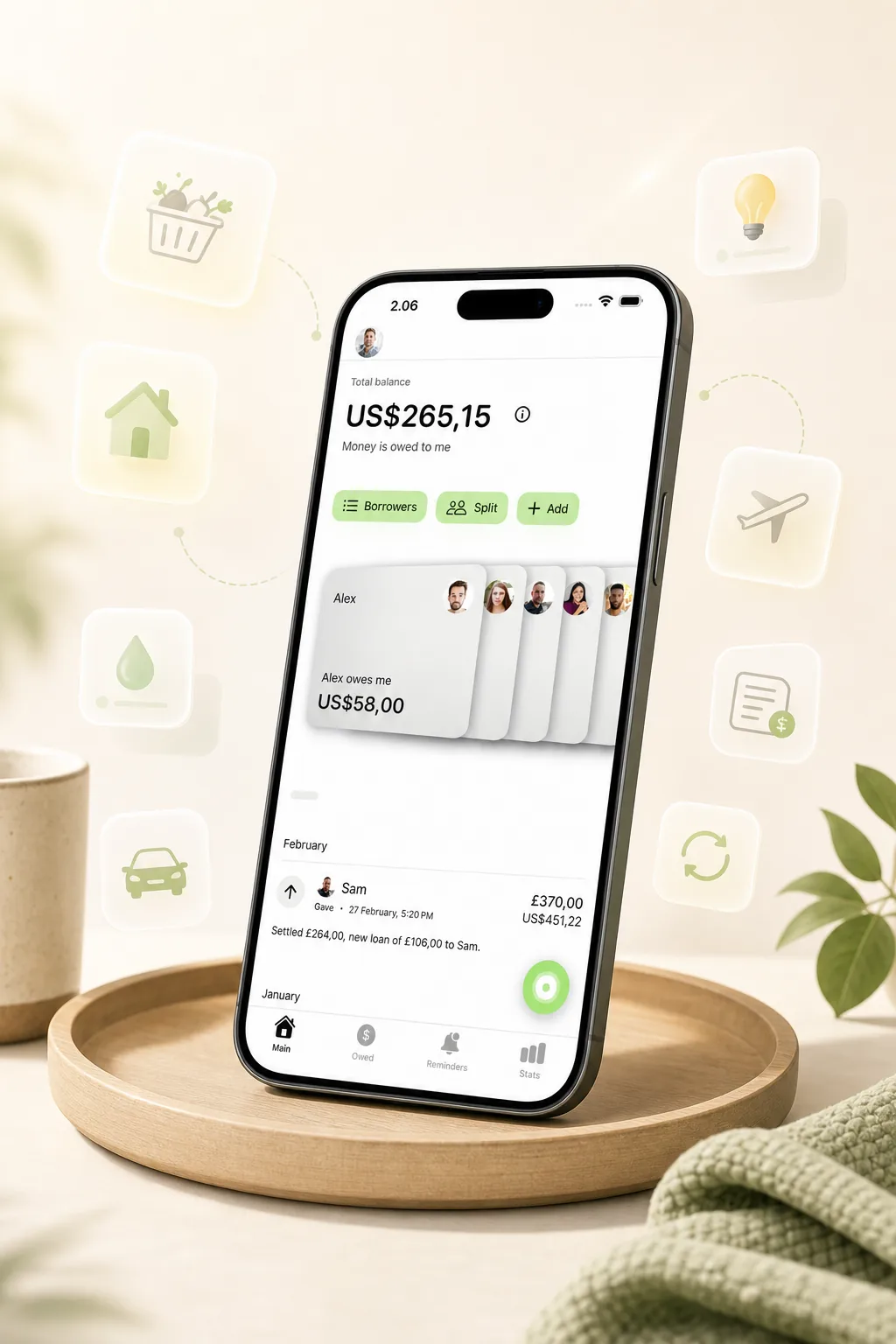
If this keeps happening, recalculating from scratch can become another source of friction. You Owe Me helps when shared spending with the same partner changes over time and you want one calm history instead of scattered notes, screenshots, bank transfers, and memory.
- one running balance with the same partner
- equal or custom shared expense splits
- recurring entries for subscriptions, bills, and repeat costs
- repayments and partial repayments
- notes and context for why the money changed
- payment reminders with context
- Money Conversations for calmer wording
- Live Link so the other person can view the balance in a browser without installing the app
- PDF statements if a clearer record is needed
- works offline, no mandatory sign-up, and Face ID / Touch ID lock
Use You Owe Me when one partner often pays first, shared expenses repeat, transfers happen later, or you want one clear partner balance that does not depend on memory. For the full workflow, see how to track couple expenses over time.
What if we do not split 50/50?
Paying more than your partner may be completely fair if you both agreed on a different contribution style. Some couples split 50/50. Some split by income. Some divide categories. Some let one person cover recurring costs while the other handles larger purchases. The problem is not the method. The problem is when the method is assumed instead of agreed.
50/50 works when both partners agree equal shares feel fair.
Income-aware splits can help when one partner earns more.
Category-based splits can work when one person handles rent and the other handles groceries, utilities, or subscriptions.
A running balance helps when the method is agreed but the timing keeps changing.
If you are deciding between a collaborative shared-expense app and one ongoing partner balance, compare the shared expense app vs running balance app approach.
If the relationship is ending rather than continuing, use the breakup closeout guide to set a cutoff and settle only the everyday shared expenses both people accepted.
Frequently asked questions
Is it unfair if I pay more than my partner?
Not automatically. It depends on what both of you agreed, what counts as shared, whether incomes differ, and whether the extra spending is expected to balance later. Uneven spending becomes stressful when expectations are unclear.
Should couples split expenses 50/50?
Some couples prefer 50/50, but it is not the only fair method. Income-based, custom, or category-based splits can work better when one partner earns more, pays bills at different times, or handles different types of expenses. The fair method is the one both people understand and agree to.
What if I earn more than my partner?
If you earn more, paying more may be part of an agreed contribution style. That does not mean every payment is a debt. Separate agreed support from shared costs that both people expect to balance later.
How do I tell my partner I am paying more without sounding petty?
Use specific, calm language. Instead of saying “you never pay,” try “I noticed I have been covering more of our shared costs lately. Can we decide what we want to split, what we are okay ignoring, and whether anything should carry forward?”
Should we settle every shared expense right away?
Not always. Some couples prefer occasional settle-ups or a running balance because constant transfers can feel more stressful than helpful. A running balance works best when shared expenses and repayments keep changing over time.
Is tracking money with my partner bad for the relationship?
Tracking can feel bad if it is used to blame or control. But a calm record can protect the relationship when it replaces memory, guessing, and quiet resentment. The goal is clarity, not scorekeeping.
What if I am temporarily covering my partner’s rent, bills, or groceries?
That may be temporary support rather than normal shared spending. Decide what is a gift, what should be repaid, what can change later, and when to check in again. If repayment is expected, keep a clear record so both people remember the same thing.
Does my partner need to install You Owe Me too?
Not always. One person can keep the record, and the other person can still view the balance when needed through a Live Link or shared summary.
When should I use the calculator instead of the app?
Use the Couple Shared Expense Balance Calculator for one clear month or one settle-up. Use You Owe Me when expenses repeat, transfers happen later, repayments are partial, reminders matter, or you want a history with the same partner.
Related guides and tools
Keep shared money clear before it becomes a fight
If paying more than your partner has become a pattern, do not leave the balance in memory. Track the shared costs, repayments, and next step in one calm place.
Published · Updated