Shared expenses · Separate finances
How to Track Shared Expenses Without a Joint Account
You do not need a joint account to keep shared expenses clear. Keep personal spending in your own accounts, record only the costs you both agree are shared, use an agreed rule for dividing them, and keep one current balance until you settle.
The goal is to share the shared part of your money—not your entire financial life.
Works for recurring shared costs such as rent, utilities, groceries, household subscriptions, travel, and other expenses you have actually agreed to share.

Set the boundary
Decide what actually counts as shared
The hardest part is usually not the math. It is deciding what the shared balance is allowed to mean.
A useful system has more than two categories. Not everything has to be either “shared” or “personal.”
Shared
Both people already agree that this cost belongs in the shared system.
Examples: rent, utilities, groceries, household supplies, a shared subscription, or a trip cost you both agreed to divide.
Personal
The cost belongs to one person and should not change the shared balance.
Examples: personal clothing, hobbies, individual subscriptions, personal meals, or purchases only one person chose for themselves.
Temporary support
One person may deliberately cover more for a period without that automatically meaning the usual split still applies.
If one person is covering rent, groceries, bills, or another cost because the other person temporarily needs help, clarify whether it is support, a gift, or something expected to be repaid before treating it as an ordinary shared expense.
Read how to keep temporary financial support clearDiscuss first
The expense might benefit both people, but the rule was not clear before the purchase.
Do not let the tracker make the decision for you. Agree on whether the cost belongs in the shared layer before adding an amount the other person is expected to cover.
Choose the rule
Choose a split rule once—not a new argument every time
The page should not decide what is “fair” for you. The useful goal is to agree on a rule before the same question comes up again.
| Method | Useful when |
|---|---|
| 50/50 | Both people agree that an equal contribution is appropriate. |
| Income-proportional | Both people prefer contributions tied to an agreed income percentage. |
| Category-based | Different categories use different rules—for example, rent one way and groceries another. |
| Custom | The appropriate share changes by expense or situation. |
A single percentage does not have to control every category. The important part is that both people understand which rule applies before the expense becomes part of the open balance.
Compare 50/50, income-based, and other split methodsIf the harder part is the conversation rather than the record, read how to split expenses in a relationship without fighting before choosing the long-term workflow.
Choose participation
Decide who needs to keep, see, or update the record
Separate finances do not require the same participation model for every couple.
The lightest setup that stays clear is usually the better one.
| Need | Best operating model |
|---|---|
| Only one person needs the working record | Keep one private record. |
| One person maintains it; the other only needs visibility | One person keeps the record and shares a current view. |
| Exactly two people both need to update it | Use a private two-person shared record. |
| Several people need to add or edit | Use a collaborative group-expense ledger. |
Can one person track shared money without everyone installing an app?
Reduce the admin
Choose when you actually settle the balance
Tracking every shared expense does not mean transferring money after every shared expense.
A settlement rhythm can keep the record accurate without turning everyday life into constant reimbursement.
| Rhythm | Useful when |
|---|---|
| Settle immediately | Shared expenses are occasional and both people prefer to close each one. |
| Settle weekly | Shared spending happens often, but you want the balance cleared regularly. |
| Settle monthly or after the billing cycle | Rent, utilities, subscriptions, groceries, and other recurring household costs are easier to review together. |
| Settle at an agreed threshold | Both people are comfortable carrying a small balance and prefer fewer transfers. |
There is no universally correct settlement rhythm. If you want fewer transfers while the balance stays current, read how to track shared expenses without constantly reconciling every transaction.
If you settle monthly, the running balance can carry each new shared expense and repayment until the review date instead of making you reconstruct the month from messages.
The recurring bill that quietly comes out of one account
Automatic bills create a special problem: the payment happens without a conversation.
One person’s card pays the internet, streaming service, insurance, or utility automatically. The other person may not notice the charge, the payer may forget to request reimbursement, and several months later nobody wants to rebuild the history from memory.
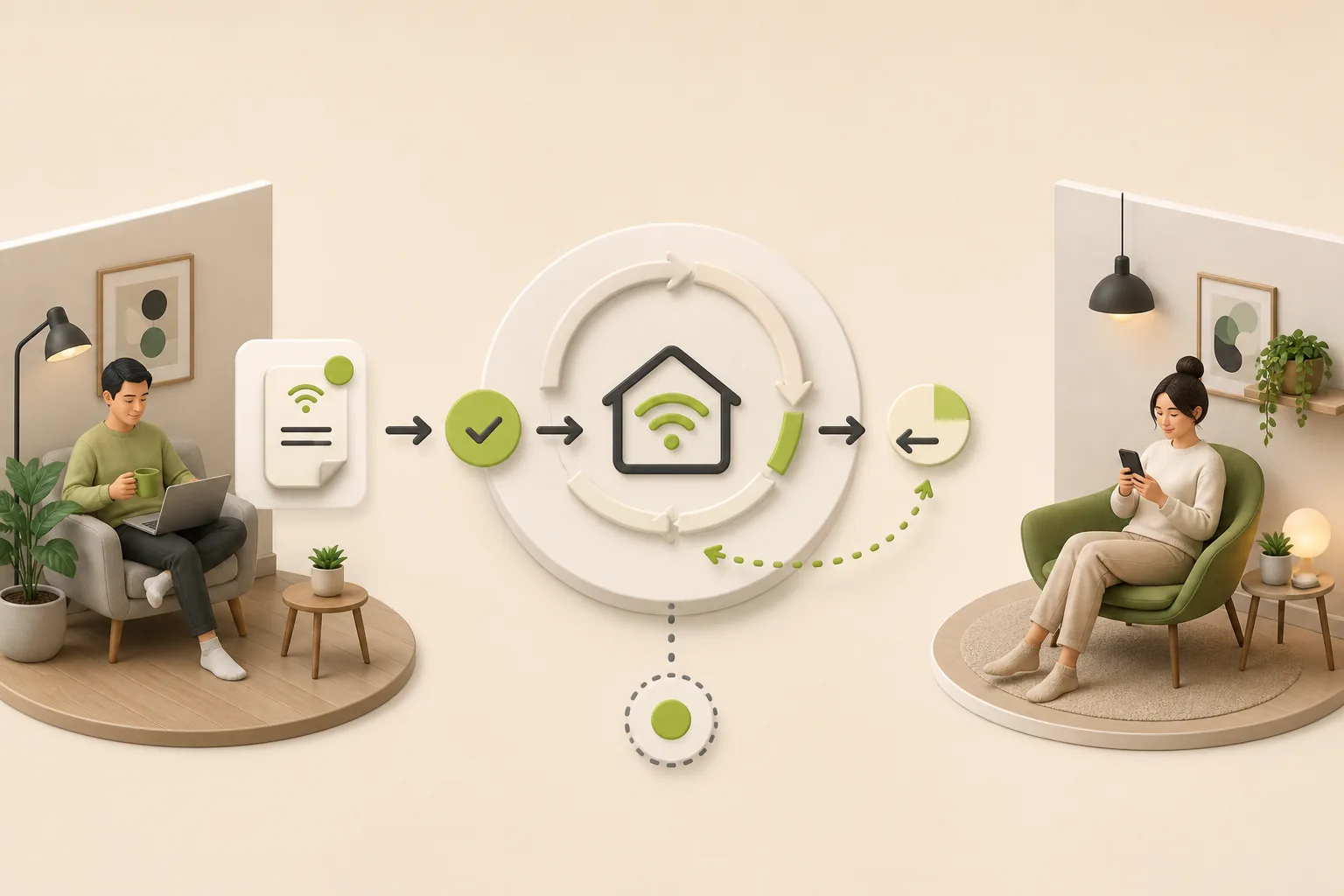
Internet bill: $60
Maya pays automatically.
Agreed split: 50/50.
Noah’s share: $30.
Noah sends: $20.
Remaining shared balance: Noah owes Maya $10.
The important part is not sending another reminder for the original $30. It is keeping the $10 that is still open visible when the next shared expense arrives. See how Recurring Entries create the next agreed record.
Worked example
Separate accounts, one shared balance
Maya and Noah keep their bank accounts and personal purchases separate.
They have agreed that rent, groceries, and one streaming subscription are shared 50/50. Their personal clothing, hobbies, and individual memberships stay outside the shared record.
| Event | Shared? | Effect on the shared balance |
|---|---|---|
| Maya pays $1,200 rent | Yes · 50/50 | Noah owes Maya $600. |
| Noah pays $120 for groceries | Yes · 50/50 | Maya’s $60 share reduces the balance. Noah now owes Maya $540. |
| Maya pays a $20 shared streaming subscription | Yes · 50/50 | Noah’s $10 share increases the balance to $550. |
| Maya buys clothes | No | No change. |
| Noah pays for his gym | No | No change. |
| Noah transfers $550 to Maya | Settlement | The shared balance returns to $0. |
Maya does not need Noah’s full bank history to know that he paid $120 for agreed shared groceries.
Noah does not need to see Maya’s clothing purchases to understand the rent and subscription balance.
The shared record only needs enough context to explain:
- what the shared expense was;
- who paid;
- what share applied;
- what was repaid;
- what remains open.
Use the lightest system
When this is not the best setup
Keeping a selective shared-expense layer is useful when you want shared clarity without merging everything.
It is not the right answer for every household or group.
A joint account may be simpler when
Both people genuinely want broad financial pooling, shared bill payment, and a high degree of day-to-day integration.
A bank-linked household budgeting product may be better when
The real goal is to automatically import, categorize, and analyze both people’s wider household finances, budgets, savings, or bank transactions.
A collaborative group ledger may be better when
Three or more people need to add expenses, edit one shared workspace, and settle with one another inside the group.
Compare shared ledger vs running balanceA note or calculator may be enough when
There is one simple shared bill, the split is clear, and there is no balance that needs to continue afterward.
Split one shared expenseThe goal is not to use the most powerful system. It is to use the lightest system that will still be clear next month.
When the balance keeps changing
How You Owe Me fits this setup
You Owe Me is useful when the shared-money layer will keep changing.
Record only the shared costs that belong between you, keep one running balance, add repayments and recurring expenses as they happen, and choose how much participation the other person actually needs.
Keep the record yourself
One person can maintain the working balance privately without importing or exposing unrelated personal spending.
Share a current view
Use Live Link when one person keeps the record and the other person only needs an always-current, read-only browser view.
Both people update
Use Balance Sync when exactly two You Owe Me users both need to update supported connected entries from their own phones.
Keep the history clear
Repayments, partial repayments, recurring entries, and new shared expenses update the same ongoing balance instead of forcing you to rebuild the story from old transfers or messages.
You Owe Me does not open joint accounts, connect two people’s full financial lives, move money, or decide what either person should owe.
It keeps the money you have actually chosen to track between people clear.
FAQ
Shared expenses with separate finances: common questions
Do couples need a joint account to split bills?
No. You can keep separate accounts and still maintain a clear shared-expense record. Agree on what counts as shared, decide how those costs are divided, record who paid, and keep any repayment or transfer that changes the current balance. A joint account may still be simpler if both people genuinely want broader financial pooling.
How do you track shared expenses with separate bank accounts?
Keep personal spending in each person’s own system and create a small shared-money record for agreed shared costs. For each shared expense, record what it was, who paid, the agreed share, and any repayment that changes the balance. Review or settle that balance on the rhythm you both prefer.
Can personal spending stay outside the shared record?
Yes. That is the point of a selective shared-expense system. Personal purchases, unrelated income, savings, and other private spending do not need to enter the record unless both people deliberately choose to treat something as shared.
What expenses should couples count as shared?
There is no universal list. Common shared categories include rent, utilities, groceries, household supplies, subscriptions, travel, or other costs both people have agreed to share. An expense should not become an open balance simply because one person thinks it looks shared. Agree first, then record it.
Should couples split everything 50/50?
Not necessarily. Some couples use 50/50, some use income-proportional contributions, some divide different categories differently, and some use custom shares. The useful rule is the one both people understand and agree to before the expense becomes part of the shared balance.
How often should couples settle shared expenses?
It depends on the pattern. One-off costs can be settled immediately. Repeated expenses may be easier to review weekly, monthly, after the billing cycle, or when the balance reaches an agreed threshold. The goal is a rhythm you will actually maintain without constantly transferring money back and forth.
What if one shared bill always comes out of my account?
Record the bill when it occurs, apply the agreed share, and then record any reimbursement when it arrives. If the other person pays only part, keep the remaining amount in the current balance instead of treating the original bill as either fully paid or completely unpaid.
Do both people need to use the same app?
No. One person can keep the working record. In You Owe Me, a Live Link can give the other person an always-current, read-only browser view without requiring the app or an account. If exactly two You Owe Me users both need to update supported entries, Balance Sync is the two-way option.
Can one person track the expenses while the other only sees the balance?
Yes. That is a useful setup when only one person wants to maintain the record. The other person may only need a clear current summary or read-only view. If this is your main concern, use the guide to tracking shared money without everyone installing the same app.
Can both partners update the same You Owe Me balance?
Yes, when exactly two You Owe Me users connect a supported balance with Balance Sync. Both can update supported connected entries from their own phones. Balance Sync is not a multi-person group ledger, and it should not be described as instantaneous or real-time synchronization.
What if more than two people need to add expenses?
Use a collaborative group-expense ledger when several people need to add and edit expenses in the same shared workspace. You Owe Me is strongest when one person keeps the record or exactly two users maintain one supported connected balance.
When is a joint account easier?
A joint account may be simpler when both people genuinely want broad pooling, shared bill payment, and a highly integrated household-money system. This page is for the different situation where the shared part needs clarity but the rest of each person’s finances remains separate.
Can an Android user see a You Owe Me shared balance?
Yes, when an iPhone user shares a Live Link. The Android user can open the read-only current balance and history in a browser without installing You Owe Me. Creating or editing the ongoing You Owe Me record requires the iPhone app, and Balance Sync is not available to an Android participant.
Keep the shared part clear
Separate finances do not have to mean separate memories
If your shared balance keeps changing through groceries, bills, subscriptions, travel, repayments, or recurring costs, keep the shared record in one place instead of rebuilding it from messages every time.
You Owe Me keeps the balance, history, repayments, and sharing options connected while unrelated personal spending stays outside the record.
Published · Updated