Personal loan recordkeeping
How to Track a Personal Loan Between Friends or Family
Keep one record for the loan and add every real payment as a separate dated entry. Keep the repayment plan beside that record—not in place of it—so you can always see what actually happened, what remains, and what is expected next.
If a real payment is smaller, larger, early, late, or missed, do not rewrite what happened to make it match the schedule. Record the real event first. The current balance and repayment-plan progress can then reflect that reality; change the future repayment plan itself only when what is expected going forward has genuinely changed.
The copyable template below works in Notes or a spreadsheet. If payments have already started, the free browser tracker can calculate the current state.
Use this when repayment is already understood. If it is unclear whether the money was a gift, a loan, or flexible support, clarify that first.
Actual record
- Jul 10 Loan started · 1,200
- Aug 1 Payment · −150
- Sep 1 Payment · −300
- Sep 15 Additional borrowing · +100
Current balance · 850
Repayment plan
- Expected payment · 200 monthly
- Next expected date · Oct 1
- Projected payoff · updates after real activity
- Plan last confirmed · Sep 15
Real activity updates the current balance. The future plan can change without rewriting the past.
Example amounts use one currency.
Use this guide for one identifiable loan
This guide is for one personal loan between people who know each other—a laptop purchase, repair, deposit, family loan, or another amount that will be repaid over time. It works whether you lent the money or borrowed it.
The arrangement can be informal, but repayment should already be understood. The purpose of the record is to prevent memory, messages, and payment notifications from turning into different versions of what happened.
| Use this guide when | Start elsewhere when |
|---|---|
| One named loan will be repaid over time. | It is unclear whether repayment was expected. Clarify whether the money was a gift or a loan first. |
| You need an actual payment history and a current remaining balance. | One tiny IOU will settle immediately and a note or message is enough. |
| Payments may be partial, early, late, or different from the expected amount. | Mixed expenses and repayments move both ways across the whole relationship. Use the Running Balance Calculator. |
| The loan has its own purpose, plan, or history. | You need legal terms, repayment enforcement, tax guidance, or a formal lending service. |
The core rule
Record reality. Plan the future.
A clear personal-loan record answers two different questions: What actually happened? What is expected next? Those answers belong together, but they should not be treated as the same thing.
A payment is an event. An installment is an expectation.
Only a real payment reduces the balance. A promised or scheduled installment shows what was expected, but it should never be recorded as paid until the money actually moves.
When one payment is smaller, larger, earlier, or later than planned, record the real event first. Review the future plan separately. That keeps the history honest without pretending that the original schedule still fits perfectly.
A payment is history. An installment is an expectation. When the two differ, preserve the real payment first. Then update the current plan state. Only replace the future repayment plan when the future arrangement itself has changed.
| Actual record | Repayment plan |
|---|---|
| What really happened | What is expected to happen |
| The loan started or a current starting balance was confirmed | A regular payment amount was proposed or agreed |
| The date and amount of each real payment | Expected installment dates and amounts |
| Additional borrowing or a confirmed correction | The next expected payment and projected payoff |
| The balance after each event | A future projection that may change |
| History that should remain visible | An expectation that can be revised without deleting history |
History records reality. The plan describes the future. The current status connects them.
Three ways to read an existing loan history
Full known history: keep all three events
Alex borrowed USD 1,000 from you on January 1, 2026, repaid USD 100 on February 1 and USD 200 on March 1. Keep the original 1,000 and both actual payments: 1,000 − 100 − 200 = USD 700 remaining. Another real payment of 50 leaves 650. Do not add a second entry for the 700 summary.
A dated opening balance: say what is unknown
You and Alex confirm USD 700 was still owed on March 1, 2026, but the earlier history is unavailable. Start with “Opening balance, March 1: USD 700”. A payment of 50 on April 1 leaves 650. This preserves the known history from March 1; it does not recreate the original loan or missing payments.
An ambiguous sheet: avoid double subtraction
A sheet says “balance 700” beside earlier payments of 100 and 200. If those payments already explain the 700, subtracting them again would wrongly show 400. Confirm what the balance includes and its date. Likewise, “03/04” and “$” do not reliably establish the date, year or currency. Leave those facts unresolved until checked.
A future agreement to pay USD 100 each month is a schedule, not seven payments that already happened. On USD 700 remaining, an interest-free prospective plan can have seven future installments; it belongs alongside the actual history.
Start with what you already have
Already have these loan records?
Bring your existing notes, file or photo for one loan. Check the details here, then keep adding repayments in You Owe Me on iPhone.
Text · CSV · Excel (.xlsx) · Word (.docx) · Photo
One loan at a time. Review and correct the details before saving. Import does not keep a spreadsheet in sync.
Copyable template
Copy the two-layer personal loan record
Use this blank record in Notes, a document, or a spreadsheet. Keep actual activity in its own history. Keep the current repayment plan in a separate block so an expectation is never mistaken for a payment.
1. Loan snapshot
- Loan: [name or purpose]
- People: [names or labels]
- Direction: [who lent / who borrowed]
- Currency: [currency]
- Repayment expectation: [repayment agreed]
- Loan start date: [date]
- Tracking start date: [date]
- Starting balance for this record: [amount]
- Original loan amount, if known: [amount or unknown]
- Paid before this record, if known: [amount — context only]
- Status: [active / settled]
For a new loan, the starting balance is normally the amount provided. For a loan already in progress, use the amount that is definitely still owed when reliable tracking begins.
2. Actual activity
Add one row for every event that really happened.
| Date | What actually happened | Amount | Balance after | Note |
|---|---|---|---|---|
| [date] | [loan started / payment / additional borrowing / correction] | [amount] | [amount] | [optional note] |
Use the real date and real amount. Do not create a payment row for money that was only promised or scheduled.
3. Current repayment plan, if any
- Regular payment: [amount or no regular plan]
- Frequency: [weekly / every two weeks / monthly]
- Next expected date: [date]
- Projected payoff: [date or not calculated]
- Plan last confirmed: [date]
- Flexibility note: [optional]
This block describes the current expectation. It does not replace the actual payment history.
4. Current status
- Remaining balance: [amount]
- Total paid since tracking began: [amount]
- Last actual payment: [date and amount]
- Next expected step: [amount and date, or check-in]
- Last reviewed: [date]
Review this summary after every confirmed payment, correction, or additional amount.
Plain-text template
PERSONAL LOAN RECORD

Loan: [name or purpose]
People: [names or labels]
Direction: [name] lent / [name] borrowed
Currency: [currency]
Repayment expectation: repayment agreed
Loan start date: [date]
Tracking start date: [date]
Starting balance for this record: [amount]
Original loan amount, if known: [amount or unknown]
Paid before this record, if known: [amount — context only]
Status: [active / settled]

ACTUAL ACTIVITY
- [date] — [loan started / payment / additional borrowing / correction] — [amount] — balance after: [amount] — [optional note]
- [date] — [activity] — [amount] — balance after: [amount] — [optional note]

CURRENT STATUS
Remaining balance: [amount]
Total paid since tracking began: [amount]
Last actual payment: [date and amount]
Next expected step: [amount and date, or check-in]
Last reviewed: [date]

CURRENT REPAYMENT PLAN, IF ANY
Regular payment: [amount or no regular plan]
Frequency: [weekly / every two weeks / monthly]
Next expected date: [date]
Projected payoff: [date or not calculated]
Plan last confirmed: [date]
Flexibility note: [optional]
Payments already started? Use the free browser tracker to calculate what remains and compare actual payments with the expected plan.
Track actual payments in the browserWorked example
One loan, several real changes
Alex lent Jordan 1,200 for a laptop. They expected payments of 200 each month, starting on 1 August. The plan describes what should happen. The activity log records what actually happens.
All amounts in this example use one currency.
| Date | Actual event | Balance change | Balance after | What the record preserves |
|---|---|---|---|---|
| Jul 10 | Laptop loan started | +1,200 | 1,200 | The opening loan remains part of the history. |
| Aug 1 | Jordan paid 150 | −150 | 1,050 | The payment was 150, even though the expected installment was 200. |
| Sep 1 | Jordan paid 300 | −300 | 750 | The complete 300 stays visible as one real payment. |
| Sep 15 | Jordan borrowed another 100 | +100 | 850 | The additional amount is a new event. Earlier payments are not rewritten. |
What changes—and what does not
After the 150 payment, do not replace the original 1,200 loan with 1,050. Add the real 150 payment and show the new balance.
The plan may still show that 200 was expected. The missing 50 belongs to the current plan status; it is not a payment that happened.
When Jordan later pays 300, keep the full payment as one real event. A tracker can apply part of it to the earlier shortfall and part to future installments, but the historical payment should still show the amount and date that actually occurred.
When another 100 is borrowed, add it as new activity. The balance becomes 850. The future projection may change, but the earlier loan and payment entries remain visible.
The balance follows real activity. The plan follows the balance.
Use the browser tracker to reproduce this example and see how the current installment and projected payoff change.
See this example in the payment trackerRecord these facts when the loan begins
A useful record does not need to feel formal. It only needs enough context for the amount, history, and next step to remain understandable later.
People and direction
Record who lent the money and who borrowed it.
Loan name or purpose
Use a short label such as “Laptop purchase,” “Moving deposit,” or “Bike repair” so this loan is not confused with other money between the same people.
Currency
Record the currency instead of assuming the symbol will remain obvious later.
Date the money was provided
Use the real date when the money or purchase was provided, not the date when you finally created the record.
Starting amount
For a new loan, record the amount provided. For an existing loan, start from the balance that is definitely still owed today.
Repayment expectation
Record that repayment is understood. If that is still unclear, resolve the gift-versus-loan question before treating the amount as owed.
Current repayment plan, if one exists
Record the expected amount, frequency, and next date without treating future installments as completed payments.
Where real payments will be recorded
Choose one reliable record rather than splitting the history across a note, spreadsheet, bank notifications, and several chat threads.
What happens if timing changes
Agree to record the real payment first and review the future plan separately when circumstances change.
A transfer receipt can show that money moved. A chat can show what someone said. Neither one automatically maintains the remaining balance. Keep them as supporting context, not as the only record.
Add repayments without rewriting the past
Every repayment should become a new dated event. Use the amount that actually moved, add a short note when context may matter later, and update the current balance.
Do not edit the opening loan every time money is repaid. The starting point explains where the loan began; the activity history explains how it reached the current amount.
| Situation | Correct record action | Avoid |
|---|---|---|
| The payment matches the expected installment | Add the real payment with its actual date and amount. | Replacing the opening loan with a smaller number. |
| The payment is smaller than expected | Add the smaller amount and keep the unpaid difference visible in the plan. | Marking the full installment as paid. |
| The payment is larger than expected | Add the complete amount that was actually paid. | Hiding the extra amount or inventing several separate transfers. |
| The payment arrives early | Use the real payment date. | Moving the payment to the date when it had been expected. |
| More money is borrowed | Add a new activity row that increases the balance. | Replacing the original loan amount and losing the earlier history. |
| An entry was wrong | Correct the affected entry and recalculate every later balance. | Rebuilding the record from memory without preserving the confirmed events. |
| The loan reaches zero | Mark the loan settled and preserve its history. | Deleting the record because nothing remains open. |
Need to confirm one payment clearly? Create a repayment receipt with the amount paid, what it covered, and what remains.
When the schedule meets real life
When real payments don’t match the repayment plan
Real-life repayments do not always match the schedule exactly. Someone may pay less, pay extra, pay early, pay late, borrow more later, or correct an earlier entry. The important thing is to keep three ideas separate: what actually happened, what the active plan looks like now, and whether the future repayment arrangement itself has changed.
Record reality first. Update the current plan state second. Replace the plan only when the future arrangement changes.
Real activity Current plan state Future plan terms
-
Real activity
Question: What actually happened?
Record the real date, amount, and type of activity. If no payment happened, do not create one just to make the schedule look complete.
-
Current plan state
Question: What does that activity mean now?
Update the remaining balance and the active plan’s progress. An installment may become paid, partly paid, ahead, due, or overdue. The projected payoff and next relevant payment can change as the real record changes.
-
Future plan terms
Question: Has what is expected going forward actually changed?
If the future arrangement is still the same, keep the existing plan. If the future repayment arrangement itself has changed, record a deliberate plan change while preserving the earlier history.
What should happen after each kind of payment?
| What happened | What belongs in the real record | What the current plan should show | Change the plan itself? |
|---|---|---|---|
| The expected 200 was paid | Record the real 200 payment and date. | The installment is covered and the plan moves to the next unpaid amount. | No. |
| Only 150 of the expected 200 was paid | Record the real 150 payment. | The installment is partly paid; 50 remains for that installment; progress and projected payoff update. | No, unless future terms also changed. |
| 300 was paid instead of 200 | Record the full 300 as one real payment. | The oldest unpaid amount is covered first; the excess applies forward; the plan may move ahead and payoff can reproject. | No, unless future terms also changed. |
| The payment arrived early | Record the real payment on the date it happened. | Progress reflects the early payment and future projection can update. | No. |
| The payment arrived late | Record the real payment on the date it actually arrived. | The original due history remains; the plan stops showing that amount as unpaid once it is covered. | No. |
| The expected payment never arrived | Do not invent a payment entry. | The unpaid installment remains open and can become overdue. | No, not automatically. |
| Another amount was borrowed later | Record the additional borrowing as a new loan-linked event. | Remaining balance increases and the future schedule/projection is recalculated. | No, unless the future arrangement is also renegotiated. |
| A previous payment entry was wrong | Correct or delete the real entry. | Later balance and plan progress should reconcile from the corrected history. | No. |
| The future repayment arrangement changes | Preserve all earlier real activity. | The new future schedule begins from the current outstanding balance. | Yes — record a deliberate plan change and preserve the previous plan as history. |
Updating progress is different from changing the plan
A partial or extra payment can change what the active repayment plan shows without creating a new repayment agreement. The current installment, remaining balance, projected payoff, and next relevant payment may all update because the real record changed.
A deliberate plan change is different. It is appropriate when the future repayment arrangement itself changes. In You Owe Me, changing a plan starts a new active version from the current outstanding balance while preserving the previous plan as history.
The past should stay historically accurate even when the future plan changes.
What this means in the existing example
- When Jordan pays 150 instead of the planned 200, keep 150 as the real payment. The current installment becomes partly paid and 50 remains for that installment. This does not by itself require replacing the repayment plan.
- When Jordan later pays 300, keep the complete 300 as one real payment. The oldest unpaid amount is covered first and the excess applies forward. Progress and projected payoff may move ahead while the regular future plan can remain unchanged.
- If Jordan borrows another 100, record that as additional borrowing. The real balance increases and the future projection recalculates. This still does not automatically mean the repayment terms were renegotiated.
- If Alex and Jordan later actually agree that the future repayment arrangement will change — for example from 200 each month to 150 each month — that is a true plan change. Preserve all previous payments and begin the revised plan from the current outstanding balance.
The next reminder should reflect what is still needed
A reminder should not keep repeating an outdated installment amount after the real record has changed. If 200 was expected and 150 was paid, the useful next reminder for that installment is the remaining 50, not another 200.
In You Owe Me, a repayment-plan reminder follows the next unpaid installment and its current remaining amount and date. After a partial, full, or extra payment — or another relevant plan update — the reminder is reprojected so it stays connected to the current plan state.
Loan already in progress
Start from what is definitely true today
You do not need to recreate uncertain history before you can begin. Start with the amount that both people can confidently treat as the current remaining balance.
Keep the original start date and any known paid-before-tracking amount as context. Do not subtract earlier payments from the current balance again.
| Question | What to record |
|---|---|
| What is definitely still owed today? | The current starting balance for the reliable new record. |
| When did the arrangement begin? | The historical loan start date, if known. |
| How much was paid before tracking began? | Historical context only. Do not subtract it from the current balance again. |
| Which earlier payments are uncertain? | A separate unresolved note rather than invented transaction rows. |
| What future repayment is currently expected? | The current payment amount, next date, or agreed check-in. |
| When does the reliable record begin? | The tracking start date. |
The current balance is the live starting amount. “Paid before tracking” is historical context and must not reduce that balance again.
Migration note
This record begins on [date] with a confirmed remaining balance of [amount]. The loan originally began on [date, if known]. Approximately [amount] had already been repaid before this record began. Earlier individual payments are not being recreated unless they can be confirmed.
You Owe Me can start a named Loan Record from what remains today while preserving the historical start date and paid-before-tracking context.
See how an existing personal loan can be brought into the appKeep a loan separate when it has its own story
Two people can have more than one kind of money between them. A loan deserves its own record when it has a separate purpose, balance, repayment plan, or settlement point.
A laptop loan and a moving-deposit loan may involve the same two people, but combining them into one unexplained number makes it harder to see which payment belongs where.
| Situation | Best record structure |
|---|---|
| One laptop loan with its own repayment plan | A separate named loan record |
| A laptop loan and a moving-deposit loan with the same person | Two separate named loan records |
| Groceries, taxis, subscriptions, and repayments moving both ways | One relationship running balance |
| One group ticket purchase with several participants | A Group Payback record rather than a personal loan |
| Temporary help where repayment is still unclear | Clarify the expectation or use the temporary-support record template |
| One small amount that will settle immediately | A note or message may be enough |
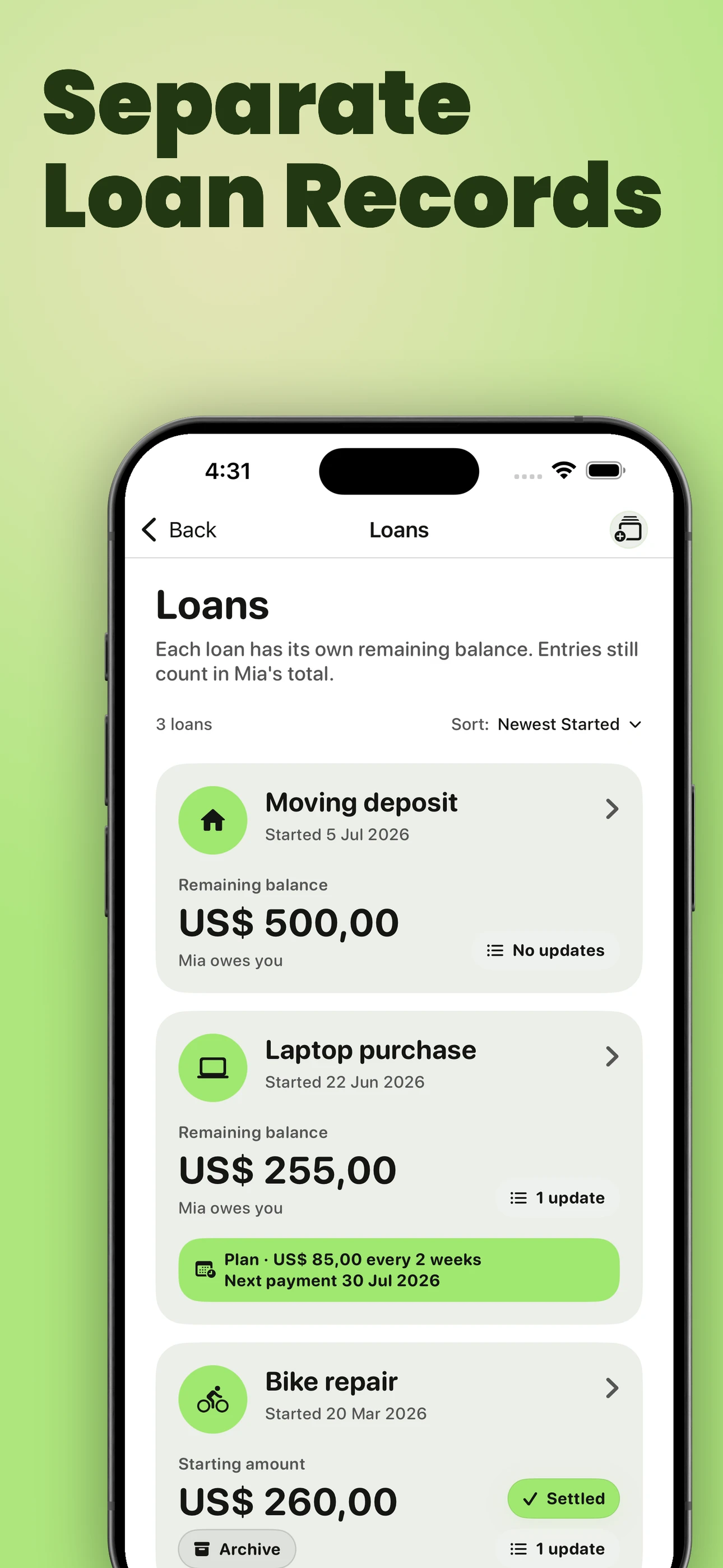
In You Owe Me, “Laptop purchase” and “Moving deposit” can keep separate names, balances, histories, and repayment plans while still contributing to the full balance with that person.
See how separate Loan Records workChoose the lightest method that will stay accurate
You do not need an app for every informal loan. Choose the simplest method that will still be clear after the next real payment.
| Situation | Best next method |
|---|---|
| One clear loan, one predictable payment, and no reminder needed | Use the copyable Notes template on this page. |
| You want manual control and will maintain formulas and history yourself | Use a spreadsheet. |
| The balance is known, but the payment schedule has not been chosen | Use the Payment Plan Calculator. |
| Payments already happened and you need the current balance or installment status | Use the Personal Loan Payment Tracker. |
| Expenses and repayments moved both ways across the relationship | Use the Running Balance Calculator. |
| Future payments, reminders, corrections, or plan changes will continue | Use a You Owe Me Loan Record and repayment plan. |
| Repayment itself was never clearly agreed | Clarify whether the money was a gift or a loan first. |
The best method is not the one with the most features. It is the lightest method that will still give you the correct current answer later.
When the record needs to keep working after the next payment
A note can preserve the starting facts. You Owe Me becomes useful when payments, reminders, corrections, plan changes, and shared updates need to stay connected to the same named loan.
One person can keep the record. The other person does not need to install the app.
Keep each loan named and separate
Keep a laptop loan, moving deposit, family loan, or other meaningful balance in its own Loan Record, with its own remaining balance and history. Each loan still contributes to the full balance with that person.
Connect the plan to real payments
Add a weekly, every-two-weeks, or monthly repayment plan to the same loan record. Smaller, larger, early, or late payments update progress from the real activity instead of creating a second balance that can drift away.
Keep the next step current
Keep the next payment amount, date, projected payoff, and reminder aligned as payments, corrections, or additional borrowing change the schedule.
Preserve the relationship history
Use Relationship Timeline to see when the loan started, when a plan changed, which payments were recorded, and what was shared—without deleting the earlier story.
Share visibility without forcing an install
Share an always-current, read-only Live Link that opens in a browser without requiring the other person to install the app or create an account. When a fixed summary fits better, create a focused PDF loan record.
Write from the real balance
Money Conversations can turn the current balance and history into a calmer follow-up or repayment update, so the next message does not have to be reconstructed from memory.
Keep this loan current in You Owe Me
Use You Owe Me when the record will continue through future payments, reminders, corrections, plan changes, or shared updates.
Share the current understanding without turning it into pressure
One person can maintain the working record. Share the current state when the other person needs context—not every time the number changes.
Use a message for one simple update
State the payment that was recorded, the remaining balance, and the next expected step.
Use a Live Link for an always-current view
You maintain the record. The other person opens a read-only browser link and does not need the app or an account.
Use a PDF for a fixed summary
A focused loan record can preserve the loan name, current balance, payment history, and current repayment-plan summary when a document fits better than a live view.
Do not rely on an old screenshot as the lasting record
A screenshot can become stale as soon as another payment, correction, or plan change happens.
What this record does—and does not do
This record can
- Keep one personal loan understandable
- Preserve the starting point and actual payment history
- Show the current remaining balance
- Keep the current repayment plan visible
- Support a calmer update based on the same numbers
This record does not
- Create a binding loan agreement
- Decide whether money is legally a gift or loan
- Recommend an interest rate
- Provide legal or tax advice
- Move or collect payments
- Enforce repayment
- Prove that every entered detail is correct
- Replace professional advice when formal documentation is needed
You Owe Me records and plans. It is not a bank, lender, payment processor, debt collector, accounting system, tax tool, or legal-contract service. It does not guarantee that another person will pay.
Frequently asked questions
Should I change the original loan amount after each payment?
No. Keep the opening loan or starting balance as part of the history and add each repayment as a new dated event. The current remaining balance changes; the historical starting point does not disappear.
What if a payment is smaller than the planned installment?
Record the amount that was actually paid. Reduce the loan balance only by that real amount, and keep any unpaid part of the expected installment visible in the repayment plan. A partial payment changes the current plan state, but it does not by itself mean the future repayment plan was changed. Do not record the full installment as paid.
Do I need to change the repayment plan after a partial or extra payment?
Usually, no. Record the real payment first. A partial or extra payment can change the current installment status, remaining balance, projected payoff, and next relevant payment without changing the future repayment terms. Change the repayment plan itself only when the future arrangement has genuinely changed. In You Owe Me, real loan activity reconciles the active plan, while a deliberate plan change creates a new active version and preserves the previous plan as history.
What if I do not know the complete earlier payment history?
Begin with the amount that is definitely still owed today. Record the original start date if it is known, and keep any paid-before-tracking amount as historical context only. Do not subtract it from the current balance again or invent uncertain transactions.
Should two separate loans to the same person be combined?
Keep them separate when they have different purposes, repayment plans, interest context, or settlement points. A laptop loan and a moving-deposit loan can each keep their own record while an overall relationship balance shows the combined position.
Do both people need to use the same app?
No. One person can keep the record. When the other person needs visibility, you can share a message, a focused PDF, or an always-current Live Link that opens in a browser without requiring the app or an account.
When is a note enough for a personal loan?
A note may be enough when one clear loan will settle through one predictable payment, both people already understand the arrangement, no reminder is needed, and no future changes are expected. Use a tracker or ongoing app record when payments, corrections, reminders, or plan changes will continue.